
Reviewed · SEGWAY TOURS
Barcelona: 2-Hour Segway Tour
Barcelona rolls by quickly. This two-hour Segway tour links the Gothic Quarter, Port Vell, Olympic Port, and Ciutadella Park without asking you to march across the city. I like the tiny group size, limited to six people, and the gentle practice session before setting off.
I also like the price: at $29 per person, you cover a wide slice of central Barcelona with a guide, helmet, insurance, and storage included. The main caution is that Segways share roads and busy crossings with city traffic, so you need to stay alert. If you are nervous at first, tell the guide. Natasha, Kadir, and other guides are praised for slowing down and building confidence.
In This Review
- Barcelona Segway Tour: Key Points
- Why This Two-Hour Tour Works Well in Barcelona
- Learning to Ride at Carrer d’En Rull
- Through the Gothic Quarter to Plaza de la Mercè
- Columbus Monument and the Port Vell Waterfront
- El Cap de Barcelona and the City’s Public Art
- França Station and the Olympic Port
- Arc de Triomf and the 1888 Exposition
- Ciutadella Park: Cascada, Parakeets, and Catalan Parliament
- The Guides Make the Difference
- Is $29 Good Value?
- Who Should Book This Segway Tour?
- My Verdict on the Barcelona Segway Route
- FAQ
- Where does the Barcelona Segway tour start and finish?
- How long does the Segway tour last?
- What language can the guide speak?
- How large is the group?
- Is Segway training included?
- What equipment is included?
- What is the minimum age to ride a Segway?
- Can I cancel for a full refund?
Barcelona Segway Tour: Key Points
- Six-person maximum: A small group makes road crossings easier and lets the guide adjust the pace.
- A useful first ride: Free training comes before the tour, and beginners often feel comfortable within about 10 to 30 minutes.
- A broad central route: See the Gothic Quarter, Columbus Monument, Port Vell, Olympic Port, Arc de Triomf, and Ciutadella Park in two hours.
- Human guides matter: Natasha, Kadir, Kadyr, Nuno, Carlos, and others are praised for clear instruction, local stories, and help with photos.
- Good value at $29: The tour includes the Segway, helmet, guide, insurance, and storage for personal items.
- Important age and weight limits: Segway riders must be at least 16, and the maximum listed weight is 243 pounds, or 110 kilograms.
Why This Two-Hour Tour Works Well in Barcelona
Barcelona is spread between old lanes, grand avenues, waterfront promenades, and spacious parks. Walking is rewarding, but covering the Gothic Quarter, harbor, Olympic Port, and Ciutadella Park in one outing takes time and energy.
A Segway gives you a practical middle ground. You move faster than on foot, but you still stop often enough to hear stories and take photographs. This is not a sit-back sightseeing ride. You steer, balance, watch the pavement, and follow your guide through public streets.
I see the route as a useful orientation tour for a first stay in Barcelona. It does not cover the whole city, and it does not include major sights such as the Sagrada Família or Park Güell. Instead, it concentrates on the old city and waterfront, then finishes among some of the city’s best public spaces and sculptures.
The group limit of six is important. A large line of Segways can feel awkward in traffic. With fewer riders, the guide can keep an eye on each person, pause when needed, and make crossings less stressful. The tour also feels more personal when you want a photo or have a question.
More Segway Tours in Barcelona
- Barcelona Segway Tour
★ 5.0 · 680 reviews - Barcelona Segway Tour
★ 4.7 · 630 reviews - Barcelona: City Highlights Guided Segway Tour
★ 4.9 · 624 reviews
Learning to Ride at Carrer d’En Rull
The meeting point is Carrer d’En Rull 2, in the old center. You begin with the equipment, helmet, and a short training session before the route starts.
If you have never used a Segway, expect the first minutes to feel odd. The machine responds to your body position, so leaning forward moves you ahead and shifting your weight helps you slow or stop. The supplied feedback makes one thing clear: the guides do not simply hand you a machine and send you into traffic.
Several guides are praised for giving extra time to beginners. Kadir and Kadyr are singled out for patient instruction, while Natasha is praised for checking that everyone felt ready before leaving. One group of first-time riders needed about 30 minutes of practice and finished feeling confident. Another rider said the basics took about 10 minutes.
That range is useful. Your learning time depends on your balance and comfort, so do not worry if you need longer than someone else. Comfortable shoes are recommended, and you should expect some physical effort through your feet, knees, and back. One experienced rider felt that two hours was enough and that a longer tour might become tiring.
Through the Gothic Quarter to Plaza de la Mercè
Once you are comfortable, the tour heads through the Gothic Quarter. This is the part where the Segway feels most distinctive, since the route uses narrow streets and compact lanes rather than only broad tourist avenues.
The old quarter rewards slow looking. You pass historic buildings, street corners, and architectural details that are easy to miss from a bus. The guide introduces the area while keeping the group moving, then pauses for short explanations.
The first notable stop is the Basilica of Our Lady of Mercy, also known as the Basilica of La Mercè. From there, the route continues toward Plaza de la Mercè and the Paseo de Colom.
I like this early section because it gives you a sense of Barcelona’s layers. You start among older streets, then gradually move toward the open waterfront. The change is clear and helps you understand the city’s layout without studying a map.
The drawback is that narrow streets require concentration. You will need to follow the guide closely and be aware of pedestrians. The pace may feel slower here than on an open promenade, but that is a fair trade for seeing parts of the old center that are less practical to cover by vehicle.
Columbus Monument and the Port Vell Waterfront
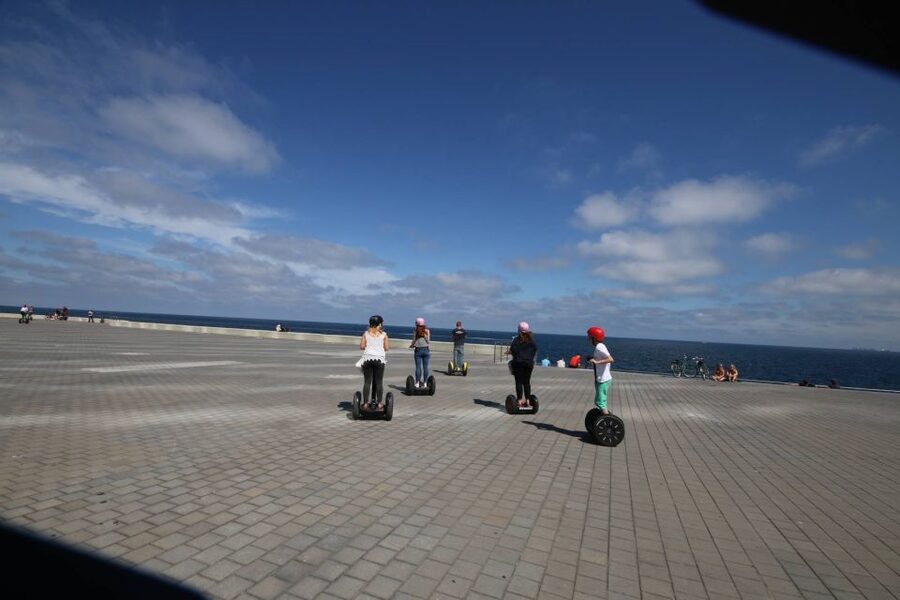
The Columbus Monument marks the transition from the old center to Barcelona’s waterfront. It sits at the lower end of La Rambla, near the beginning of the harbor area, and is one of the city’s most familiar landmarks.
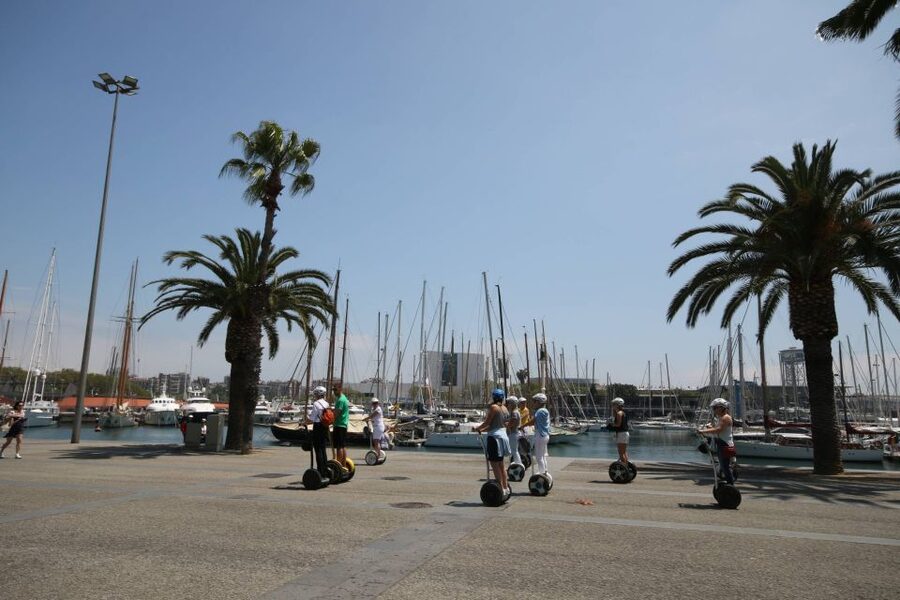
The tour continues through Port Vell, Barcelona’s old harbor. Here, the setting opens up. You may see expensive yachts moored in the marina, while the guide explains the importance of the port and points out public artworks along the route.
Port Vell is a good place for a Segway because the wider spaces make riding feel easier after the tighter Gothic Quarter streets. It also offers a change in mood. You move from stone lanes and church façades to water, boats, promenades, and modern urban design.
This part is more about seeing Barcelona in motion than entering buildings. The activity is outdoors, and the guide’s stories provide the context. If you want long visits inside churches or museums, this is not the right format. If you want to connect several waterfront sights without walking the full distance, it works well.
Same base, a different kind of afternoon:
- Barcelona: Sagrada Familia Entry Ticket with Audio Guide
★ 4.6 · 105,312 reviews - Barcelona: Park Güell Admission Ticket
★ 4.4 · 76,534 reviews - Barcelona: Casa Batlló Entry with Self-Audioguide Tour
★ 4.7 · 25,359 reviews - Barcelona: 24 or 48-Hour Hop-On Hop-Off Bus Tour
★ 4.4 · 20,872 reviews
El Cap de Barcelona and the City’s Public Art
El Cap de Barcelona is a large sculpture by Roy Lichtenstein near the waterfront. Its bright, graphic form is hard to miss, and it gives the tour one of its most recognizable photo stops.
Barcelona uses public art in a particularly noticeable way, especially around the port and Olympic areas. The guide points out pieces such as El Cap de Barcelona while explaining how architecture, sculpture, and public space fit together.
This is one of the tour’s strengths. You are not only collecting landmark names. You are also seeing how Barcelona uses open areas for art and civic life. The Segway lets you move between these works quickly, while the regular stops prevent the ride from becoming a blur.
Guides also take photographs and videos for participants when time allows. Nuno is especially praised for taking strong photographs, while Natasha is noted for helping people keep pictures and videos from selected stops. Still, remember that photography is a courtesy of the guide rather than the main service. The guide must also manage the group and traffic.
França Station and the Olympic Port
The route passes Estació de França, or França Station, one of Barcelona’s notable railway stations. Even from outside, it adds a grand transport landmark to the route and gives the guide another chance to explain the city’s development.
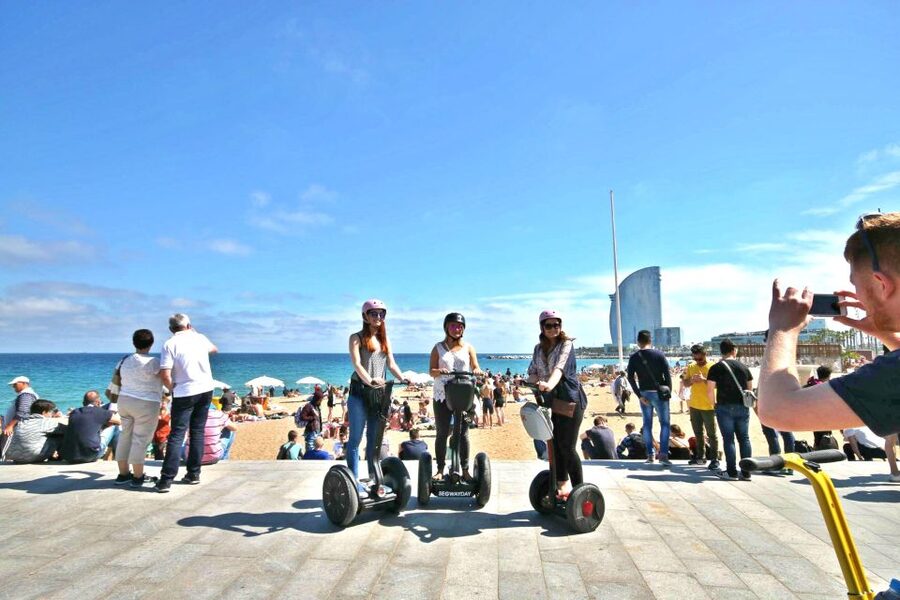
From there, you continue toward Vila Olímpica and the Olympic Port. These areas reflect Barcelona’s major transformation around the 1992 Olympic Games. The setting is more open and modern than the Gothic Quarter, with broad public spaces and a strong connection to the sea.
The Olympic Port is listed as a longer riding section, giving you time to enjoy the waterfront without stopping at every few minutes. You get a sense of the scale of the harbor and the planned public spaces built around the Olympic district.
I would pay attention to how the route changes here. The old city feels enclosed and irregular. The Olympic area feels planned, spacious, and outward-facing. Seeing both in one short tour helps explain why Barcelona can feel like several cities joined together.
Traffic can alter the exact route. That matters because the tour takes place in active city streets, not on a closed course. Your guide may change a crossing or approach to keep the group safe and moving.
Arc de Triomf and the 1888 Exposition
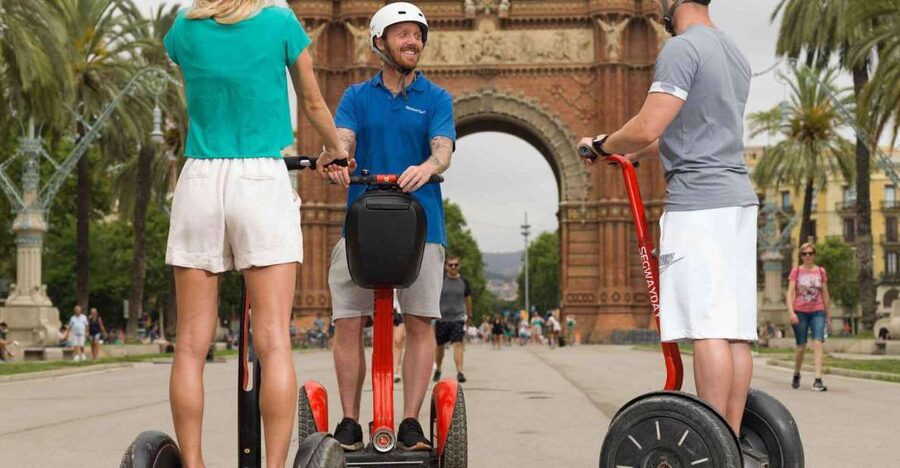
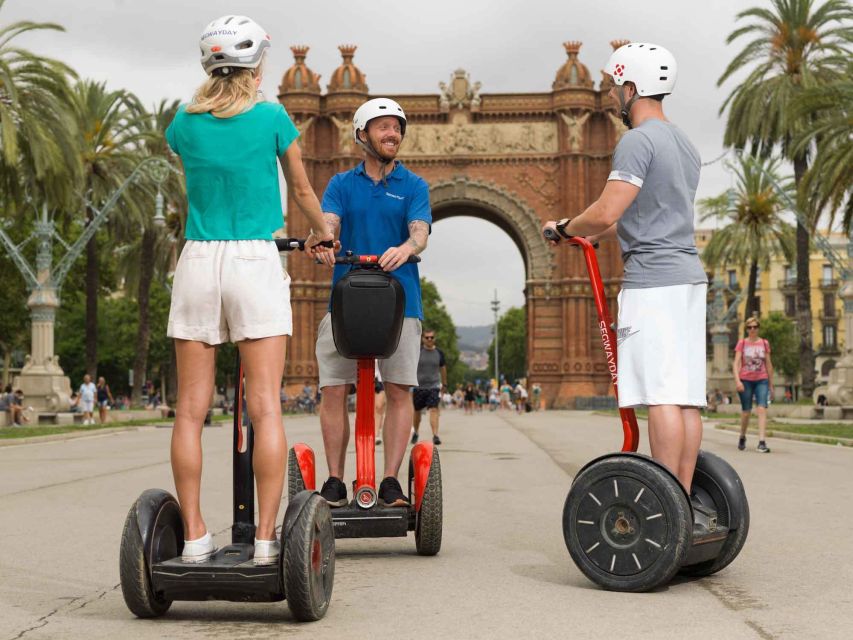
The Arc de Triomf is one of the clearest photo stops on the route. Unlike many triumphal arches, Barcelona’s version was built as the entrance to the 1888 Barcelona Universal Exposition. Its reddish brickwork and broad promenade make it easy to appreciate from a Segway.
The itinerary allows a longer stop here, and that makes sense. You have room for photographs, a closer look, and a short talk from the guide. If you are collecting memorable city images, this is likely one of the best places to have your picture taken.
From the arch, the tour moves toward Mercat del Born. The market building is a striking example of iron and glass architecture, and its location helps connect the modern city with the older Born district.
The market is described as a stop or brief visit rather than a full food-market experience. Do not book this tour expecting time to browse every stall or sit down for a meal. The value is in seeing the building and learning how it fits into the neighborhood.
Ciutadella Park: Cascada, Parakeets, and Catalan Parliament
Parc de la Ciutadella is the final major section of the tour. The park occupies the former site of the 1888 exposition and gives you a greener, calmer setting after the streets and waterfront.
The route includes the Castell dels Tres Dragons, a decorative building linked to the exposition, and the Cascada Monumental, the park’s grand waterfall fountain. You also pass the Parliament of Catalonia, adding a civic landmark to the architectural stops.
This is where the tour becomes especially relaxed. The park has room to ride, and the guide can stop to explain sculptures, buildings, and local details. Several participants enjoyed feeding the park’s resident parakeets with seeds supplied by the guide. That is a small moment, but it turns a standard sightseeing stop into something more personal.
You should treat the parakeet encounter as an optional detail rather than a guaranteed centerpiece. The main attraction remains the park, its monuments, and the surrounding architecture.
The route then passes the Delegació del Govern a Catalunya before returning to Carrer d’En Rull 2. You finish close to where you began, which makes it simple to continue exploring the old center afterward.
The Guides Make the Difference
The strongest part of this experience is the guiding. The machines are fun, but the guide determines how safe, useful, and enjoyable the two hours feel.
Natasha receives repeated praise for being friendly, patient, and alert to safety. She has adjusted the pace, added time when needed, and offered practical suggestions for the rest of a Barcelona stay. Kadir and Kadyr are also praised for humor, clear explanations, and calm help when riders are finding their balance.
Other named guides include Nuno, Carlos, Dara, Ali, Leo, Elisa, Ilaria, and Victor. The consistent picture is a tour shaped by the individual guide rather than a fixed recording. That is valuable when you have questions or need extra instruction.
You should tell the guide early if you are uneasy. One participant found busy road crossings daunting, but the guide stopped and checked on the group. Safety depends on your own attention too, yet a guide who watches the group closely can make a real difference.
The only practical criticism worth noting is that information can be harder to hear while riding in city traffic. The supplied feedback suggests that a headset might help, but no headset is included. Stay near the guide during explanations and ask for repetition if you miss a detail.
Is $29 Good Value?
At $29, I consider this a strong value for a two-hour small-group activity. The price includes the Segway, helmet, training time, guide, insurance, and storage for personal belongings.
A walking tour may offer longer conversations at each site, while a bus tour can cover more distance with less physical effort. The Segway option sits between those choices. You cover more ground than on foot and remain outdoors and engaged, with a group small enough for personal help.
The price becomes especially attractive if you are visiting Barcelona for only a few days. You see the old center, port, Olympic district, Arc de Triomf, and Ciutadella Park in one outing, then can return later to the places that interest you most.
I would not choose it if your main goal is museum entry, detailed architecture lectures, or a full-day survey of Barcelona. I would choose it for a fun orientation, a family or friend-group activity with older children, or a quick way to connect several central districts.
Free cancellation up to 24 hours before the start and the option to reserve now and pay later add useful flexibility. Check the available starting times when booking, since the tour lasts two hours and the route can change with traffic.
Who Should Book This Segway Tour?
I recommend it most for first-time Barcelona visitors who want an active introduction to the city. It also suits people who find a traditional walking tour too slow, and groups who want a shared activity rather than another museum visit.
Beginners are welcome, provided they meet the age and physical requirements. The training is not an afterthought, and the guides have shown patience with people who have never ridden before.
The tour is less suitable if you dislike balancing, feel uncomfortable near traffic, or want a quiet, unhurried examination of each landmark. Pregnant people cannot join, and the listed maximum weight is 243 pounds, or 110 kilograms.
The minimum age to ride a Segway is 16. Children under 16 may join on an e-bike instead, but children under 13 are listed as unsuitable for the activity. Confirm the correct arrangement for your group before paying.
My Verdict on the Barcelona Segway Route
Book this tour if you want to see a lot of central Barcelona in two hours and enjoy being part of the action. The combination of narrow Gothic streets, harbor views, Olympic architecture, Arc de Triomf, and Ciutadella Park gives you a varied introduction for a modest price.
I especially value the small group and the patient guides. Natasha, Kadir, and the other named guides have helped make beginners feel safe, while photo stops and the occasional parakeet feeding add fun without taking over the sightseeing.
Skip it if you want interiors, long visits, or a completely traffic-free ride. For everyone else, this is a lively and efficient first look at Barcelona, with enough local color to help you plan the rest of your stay.
FAQ
Where does the Barcelona Segway tour start and finish?
The tour starts and returns to Carrer d’En Rull 2, 08002 Barcelona.
How long does the Segway tour last?
The activity lasts two hours, including the initial training session and the guided route.
What language can the guide speak?
Live guides are available in Spanish, English, French, German, and Russian.
How large is the group?
The tour is limited to six participants.
Is Segway training included?
Yes. Free training time is provided before the tour begins.
What equipment is included?
The tour includes a Segway, helmet, insurance, tour guide, and storage for personal belongings.
What is the minimum age to ride a Segway?
The minimum age to ride a Segway is 16. Children under 16 may join on an e-bike instead, while children under 13 are not suitable for this activity.
Can I cancel for a full refund?
Yes. You can cancel up to 24 hours in advance for a full refund.
Recently listed in Barcelona
- Transfers From Cruise Port to Barcelona Airport★ 4.5 · 155 reviews
- Bohemian Barcelona Neighborhood Evening Tapas & Wine Tour★ 5.0 · 419 reviews
- Park Guell Guided Tour with Skip the Line Tickets★ 4.0 · 739 reviews
- Montserrat very early : Hiking, Abbey, very small group★ 5.0 · 127 reviews
- Barcelona Sunset Cruise with Light Snacks and Open Bar★ 5.0 · 476 reviews
- Barcelona: Sagrada Familia, Park Guell & Tapas Private Tour★ 5.0 · 903 reviews
- Authentic Flamenco Show Barcelona : Intimate Casa Sors Experience★ 5.0 · 809 reviews
- Barcelona Expert Tour with Local Guide in Eco Tuk Tuk Private★ 5.0 · 216 reviews
Segway Tours, compared.
Malaga City Tour 2 Hours Monumental Segway Tour
Read our review →
Madrid Private Segway tour. Retiro Park – Centro Historico
Read our review →
Seville City Tour 2 Hour Monumental Segway Tour
Read our review →Browse the lists this tour appears in