
Reviewed · MARBELLA TOURS
Marbella Old Town group tour with a True Local
Marbella has more than beaches. This 90-minute walk takes you from the seafront into the old quarter, linking Moorish traces, Castilian squares, small churches, local food advice, and an olive oil tasting. I especially like the guide’s personal connection to the town and the practical restaurant recommendations that help you use the rest of your day well.
The oil tasting is another strong point, with three to six extra virgin oils included when the shop is open. The main consideration is pace: a lot is packed into a short tour, and outdoor weather can affect the schedule. Some outings have lasted closer to two hours, so allow a little extra time if you have plans immediately afterward.
In This Review
- Quick take: what makes this walk worthwhile
- Start by the shore, then turn toward old Marbella
- Avenida del Mar and the Paseo Marítimo
- Capilla de San Juan de Dios: a quiet sixteenth-century stop
- Hospital Bazán and the National Engraving Museum
- Plaza Altamirano and the city’s former command
- Torre de la Pólvora and the medieval wall remains
- Plaza de los Naranjos and the changing street plan
- D.OLIVA turns sightseeing into a food lesson
- The guides make the biggest difference
- How the timing and group size affect the experience
- Is $30.23 a fair price?
- Who should book this Marbella walk?
- My booking recommendation
- FAQ
- How long does the Marbella Old Town tour last?
- How much does the tour cost?
- Is the tour offered in English?
- Where does the tour start?
- Where does the tour finish?
- Is olive oil tasting included?
- Is entrance to the National Engraving Museum included?
- Is private transportation included?
- How large can the group be?
- Can I cancel for a full refund?
Quick take: what makes this walk worthwhile

- A local view of Marbella: Guides such as Javier bring family ties, personal experience, and friendly connections with local shopkeepers and restaurants.
- A useful first-day activity: You finish in Plaza de los Naranjos, well placed for lunch, coffee, and further exploring.
- More than postcard scenery: The route covers Moorish street patterns, sixteenth-century buildings, religious sites, and medieval defenses.
- Olive oil is part of the experience: The tasting at D.OLIVA adds a genuine Andalusian food tradition rather than another simple photo stop.
- Small enough to feel personal: The group limit is 20 people, and audio earphones may be provided to make the guide easier to hear.
- Good value at $30.23: You receive a licensed English-speaking guide, a structured introduction to central Marbella, and a tasting without paying for private transport.
Start by the shore, then turn toward old Marbella
The walk begins at G457+GM Marbella. Check the meeting point carefully before setting out, since the location is given as a map code rather than a conventional named attraction. The route eventually finishes at Plaza de los Naranjos, one of the easiest places in town to recognize.
The opening portion gives you a useful contrast. Marbella is often sold as a beach and resort destination, but this walk quickly shifts your attention to the town’s older layers. You get the sea-facing side first, then move toward chapels, walls, squares, and narrow lanes.
The initial gathering place is described as a spot where locals meet for events or sit in the shade. That small detail matters. It suggests the tour is not only about monuments with a date attached. You also get a sense of how public spaces function in everyday Marbella.
If you are arriving by car, pay attention to parking before the start. Javier has sent visitors advice about car parking in advance, which can be useful in a town where the old quarter itself is best explored on foot. Public transportation is nearby, but private transport is not included.
A few more Marbella ideas to compare
- From Marbella: Guadalmina River Guided Canyoning Adventure
★ 4.9 · 1,486 reviews - Marbella: Sailing & Dolphin Watching with Snacks and Drinks
★ 4.7 · 1,062 reviews - From Marbella: Canyoning Tour in Guadalmina Canyon
★ 5.0 · 778 reviews
Avenida del Mar and the Paseo Marítimo
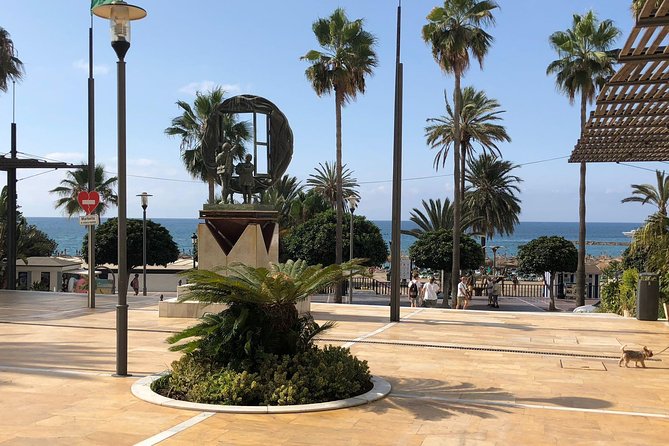
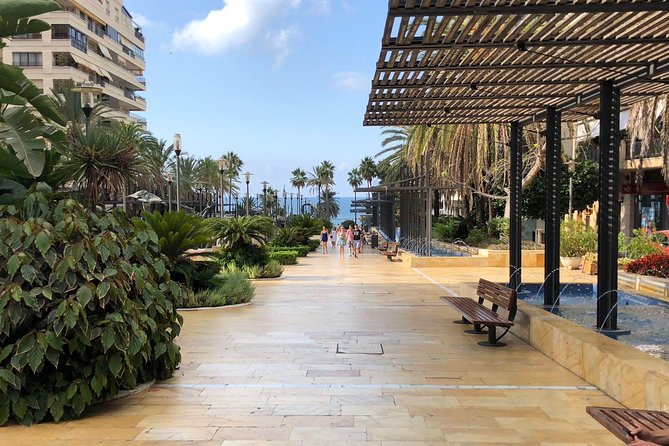
The first named stop is Paseo Marítimo, reached after walking along Avenida del Mar. Here, you can see several Salvador Dalí sculptures displayed along the avenue before reaching the seafront promenade.
The stop is scheduled for about 15 minutes and costs nothing to enter. It is less about a formal attraction and more about establishing Marbella’s modern public face. You pass bars, restaurants, and beachside chiringuitos, giving you a quick look at the social side of the resort.
I like this beginning because it prevents the old town from feeling disconnected from the rest of Marbella. You see the promenade that many people come for, then learn that a short walk inland reveals a very different town.
The drawback is that this portion can feel familiar if you have already spent time along the waterfront. The real value comes from the guide’s context and from the transition into the older streets, not from the promenade alone.
Capilla de San Juan de Dios: a quiet sixteenth-century stop
The Capilla de San Juan de Dios is a small chapel dating from the sixteenth century. Its surviving wooden ceiling is the detail to watch for.
You spend around ten minutes here, with no separate admission charge. This is the kind of stop that benefits from explanation. Without a guide, you might simply admire the building and continue. With context, the ceiling and modest scale become clues to the chapel’s age and purpose.
Do not expect a large church interior or a long museum visit. The appeal is intimate and architectural. It also gives the walk a quieter pause after the open waterfront.
For you, this stop will work best if you enjoy small religious buildings and details that are easy to miss. If grand interiors are your main interest, it will be a brief visit rather than a major highlight.
Hospital Bazán and the National Engraving Museum
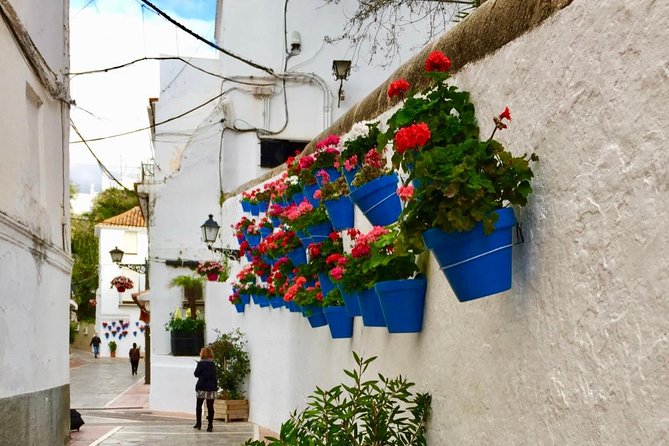
Next comes the old Bazán Hospital, a historic building in the old quarter that now houses the National Engraving Museum. The building itself is the main reason for the stop, while the museum offers an added indoor option.
The scheduled time is about 15 minutes. Admission to the museum is complimentary, and the guide usually enters when the museum is open. That last point is important: the museum visit depends on opening hours, so you should regard it as a welcome possibility, not a fixed part of every departure.
This is one of the stronger cultural stops on the route. It shows how an older civic building can gain a new role, and it gives you a chance to see more than streets and exterior façades.
The practical limitation is timing. Fifteen minutes is not enough for a slow museum visit, especially if the group is moving on to several more stops. Think of it as a compact introduction, not a museum afternoon.
Same base, a different kind of afternoon:
- Natural Parck Jeep Eco Tour from Costa del Sol
★ 5.0 · 662 reviews - Dolphin Watching Adventure in Estepona Bay
★ 4.5 · 626 reviews - Marbella: Sunset Sailing Trip with Drinks and Snacks
★ 4.8 · 586 reviews - Authentic Andalusia – Jeep Eco Tour (pick up from Marbella – Estepona)
★ 5.0 · 564 reviews
Plaza Altamirano and the city’s former command
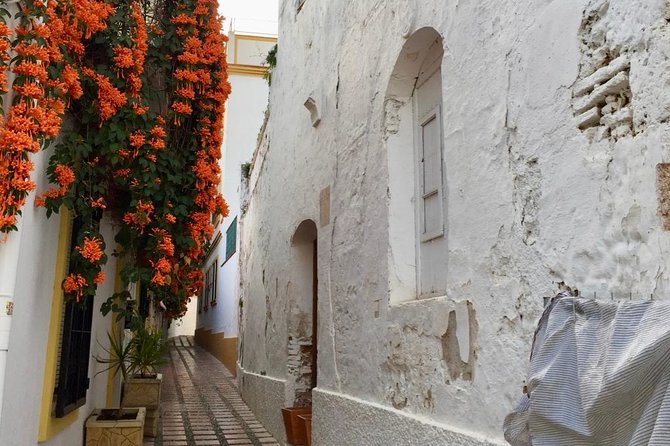
Plaza Altamirano is a charming square associated with a sixteenth-century palace that once belonged to the city’s former commander. The stop lasts about ten minutes.
This is where the walk’s focus on power and civic life becomes clearer. The old quarter is not simply a collection of attractive whitewashed lanes. Its squares and palaces reflect who governed the town and how authority was displayed.
I find stops like this useful because they help you read the buildings around you. Instead of seeing another pretty plaza, you begin to ask who used it, why it was built, and how Marbella changed over time.
The square is also a good place to pause for photographs. As with the other outdoor stops, the experience depends on the guide’s explanation, so staying close enough to hear matters. Earphones may be supplied, a recent addition that can help in a group of up to 20 people.
Torre de la Pólvora and the medieval wall remains
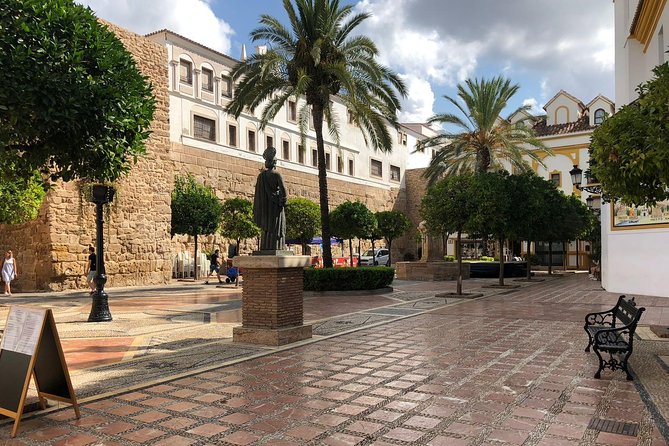
The Torre de la Pólvora offers a look at the remains of Marbella’s medieval defenses. The scheduled visit is about ten minutes, and there is no entrance fee.
You will not find a full fortress complex here. What you see are surviving traces, and the guide’s job is to connect those fragments with the town’s earlier defensive role. That makes this a good example of why a walking tour can add value: a partial wall or tower can be hard to understand without a larger map in your head.
This stop also breaks up the sequence of churches and plazas. It reminds you that Marbella’s old quarter was shaped by protection, conflict, and changing rulers, not just by later tourism.
Keep your expectations sensible. The tower remains are compact, and the visit is short. The reward is the story and the placement within the old town rather than a long inspection of military architecture.
Plaza de los Naranjos and the changing street plan
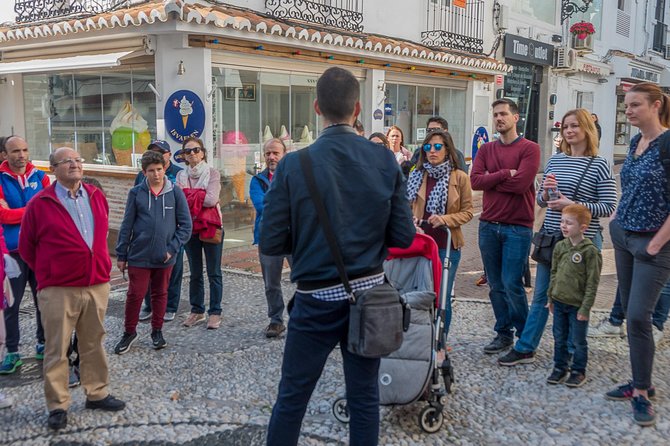
The route then reaches Plaza de los Naranjos, the finish point. It is one of Marbella’s most recognizable spaces, shaded by orange trees and surrounded by cafés, restaurants, flowerbeds, and sixteenth-century buildings.
The square has an interesting urban story. Narrow winding streets from the Moorish period were removed to create this more orderly Castilian-style plaza in the sixteenth century. That contrast is easy to understand once you have walked through the lanes leading toward it.
This is an excellent ending because you arrive somewhere useful, not at an isolated parking area. You can sit under the orange trees, choose a restaurant, or continue exploring the old quarter on your own.
It is also a good place to remember that Marbella’s past is layered rather than uniform. Moorish street patterns, Castilian planning, Christian chapels, old defenses, and modern resort life all sit close together.
D.OLIVA turns sightseeing into a food lesson

The final stop is D.OLIVA, where you taste three to six extra virgin olive oils. The tasting is included in the price, although it depends on the shop’s opening hours.
This is more than a snack at the end. Olive oil is central to Andalusian cooking, and tasting several oils side by side gives you a practical way to notice differences in flavor and quality. Some people have tasted about 15 oils during their visit, but the stated tour inclusion is three to six, so you should expect the included range rather than count on a larger session.
Several useful details emerge from this stop. You may learn what to look for when buying oil, and you can purchase containers to take home if you find a favorite. One American visitor did exactly that after the tasting.
I like the finish because it is relaxed and distinctly local. You have just heard about buildings and rulers, and now you connect the place with a product used in daily Spanish life.
There are two limitations. The shop may not be open for every tour, and the tasting can encourage browsing or buying. You are not required to purchase anything, but allow time if you want to compare products carefully.
The guides make the biggest difference
Javier is the guide most closely associated with this experience. He is described as having family connections in the area going back several generations, and he clearly enjoys explaining Marbella and Andalusia.
His strongest quality is not simply the amount of information. It is the way he connects history with the town you are standing in. He also points out family-owned taverns, tapas restaurants, and places he recommends personally. That turns the walk into a useful orientation for the rest of your stay.
Javier’s English is fluent and easy to follow. Earphones may be available, which is especially helpful when the group reaches a busy public space or when you are standing at the back.
Other guides may lead the outing. Javier’s trainee Juan has also helped with tours, and the feedback about his warmth and assistance has been positive. Your exact guide can affect the tone, so keep in mind that this is a shared tour rather than a guaranteed private walk with one named person.
One practical benefit is the advice you receive after the formal sightseeing ends. Guides have suggested restaurants and places to visit in Marbella, Ronda, Málaga, and Mijas. Those wider recommendations can be especially useful if you are building a longer Andalusian itinerary.
How the timing and group size affect the experience
The advertised duration is approximately one hour and 30 minutes. The stops add up to a similar length, though some outings have lasted about two hours. I would avoid scheduling a train, transfer, or timed meal immediately after the tour.
The group limit is 20 people. That is not a private tour, but it is still manageable for a walking route through narrow streets. The guide’s use of earphones can make a real difference, especially if the group is full.
You should wear comfortable shoes. The experience is entirely on foot and moves through streets, squares, and outdoor public areas. No private transportation is included.
The tour is offered in English and uses a mobile ticket. Confirmation is provided at booking, and service animals are allowed. Most people can take part, but the tour requires good weather, so rain or other poor conditions can lead to a new date or a full refund.
Is $30.23 a fair price?
At $30.23 per person, I consider this good value if you want a clear introduction to Marbella rather than a long specialist lecture. The price covers a licensed local guide and the olive oil tasting, while the monuments and public spaces do not require extra admission.
The value improves if you take the tour early in your stay. You can use the restaurant tips, return to a favorite plaza, and continue through the old quarter with a better sense of what you are seeing.
It is less useful if you already know Marbella’s old town well or prefer exploring at your own speed. The short format means you cannot linger at every site, and the museum and oil shop depend on opening hours.
For a first visit, the combination of orientation, local advice, and tasting makes the price reasonable. You are paying for interpretation and direction, not expensive entry tickets.
Who should book this Marbella walk?
I would choose this tour for a first day in Marbella, a short stay, or a morning when you want to understand the town before making your own plans. It suits couples, solo visitors, families, and anyone who prefers a human explanation to reading plaques.
It also works well for people who think Marbella is mainly about beaches and nightlife. The route gives you a more rounded picture, with churches, walls, old street planning, food traditions, and local dining advice.
Families can benefit from the compact length, and one guide has been praised for being good with a young child. Still, children who need frequent breaks may find the steady sequence of stops a little demanding.
Food lovers should pay special attention to D.OLIVA. History fans will appreciate the chapels, palace, walls, and changing town plan. If you want a private, highly specialized architectural tour, this group outing may feel too broad.
You can cancel for a full refund up to 24 hours before the start time. Changes made inside that period are not accepted, and poor weather or failure to reach the minimum group size can result in a replacement date, another experience, or a refund.
My booking recommendation
Book this tour if you want Marbella explained by someone who knows its streets and local habits. The strongest reasons are Javier’s warm style, the useful food recommendations, the compact introduction to the old quarter, and the olive oil tasting at the end.
Skip it if your schedule is too tight for a flexible 90-minute to two-hour walk, or if you prefer to stop at every site for extended visits. For most first-time visitors, though, the tour offers an easy way to see the town beyond the sand and surf, then finish in Plaza de los Naranjos with the rest of the day still ahead.
FAQ
How long does the Marbella Old Town tour last?
The advertised duration is approximately one hour and 30 minutes. Some outings have lasted closer to two hours, so leave extra time after the walk.
How much does the tour cost?
The price is $30.23 per person.
Is the tour offered in English?
Yes. The tour is offered in English.
Where does the tour start?
The meeting point is G457+GM Marbella, Marbella, Spain.
Where does the tour finish?
The tour ends at Plaza de los Naranjos, Pl. de los Naranjos, 29601 Marbella, Málaga, Spain.
Is olive oil tasting included?
Yes. The D.OLIVA stop includes a tasting of three to six extra virgin olive oils, subject to the shop’s opening hours.
Is entrance to the National Engraving Museum included?
Entrance is complimentary. The guide generally enters when the museum is open, but the museum visit depends on opening hours.
Is private transportation included?
No. Private transportation is not included. This is a walking tour.
How large can the group be?
The maximum group size is 20 people.
Can I cancel for a full refund?
Yes, if you cancel at least 24 hours before the experience’s start time. Cancellations made less than 24 hours in advance are not refunded.
Recently listed in Marbella
- 2 h Estepona Bay Tour★ 5.0 · 179 reviews
- Original Marbella Tapas Adventure★ 5.0 · 174 reviews
- Sunset Sailing Experience in Estepona★ 5.0 · 105 reviews
- Ronda Day Tour and Winery Visits from Marbella★ 5.0 · 134 reviews
- Jet Ski Tour In Fuengirola★ 5.0 · 141 reviews
- Dolphin trips on a catamaran★ 4.5 · 120 reviews
- Canyoning Gorge Descent, river walk in Benahavis.★ 5.0 · 255 reviews
- Marbella 3-hour Catamaran Group Excursion with Dolphin Watching★ 5.0 · 105 reviews
Marbella Tours, compared.
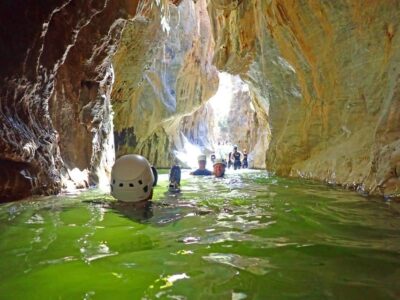

Sailing & Dolphin Watching with Snacks and Drinks
Read our review →
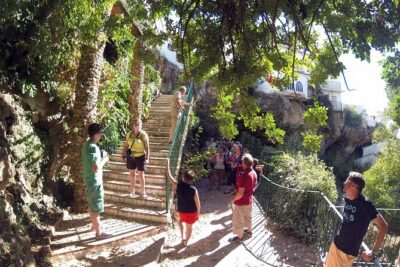
Natural Parck Jeep Eco Tour from Costa del Sol
Read our review →


Authentic Andalusia – Jeep Eco Tour (pick up from Marbella – Estepona)
Read our review →
Benahavís: Guided Canyoning Adventure (Benahavís River Walk)
Read our review →Browse the lists this tour appears in