

Reviewed · WALKING TOURS
Private Half Day Walking Tour of Seville
Seville reveals itself quickly on foot. I like this tour because it links the city’s major monuments with its Islamic, royal, Jewish, and colonial past, while a private guide can shape the pace around your group. I also like that the route includes both famous sights and smaller corners such as Plaza del Cabildo and the old city gates. The main drawback is simple: the tour stays outside the monuments, so you will need separate tickets and extra time for the Cathedral, Alcázar, or Archivo de Indias.
You begin at Puerta de Jerez and finish near the Cathedral in Plaza de San Francisco, with no transport needed between stops. Carlos and Fernando receive especially warm praise for their humor, storytelling, and care with practical needs such as shade, bathrooms, and shopping. At $133.03 per person, the price makes the most sense for couples, families, or a small group that values private attention over a lower-cost group walk.
In This Review
- Key points to know before booking
- Why this private Seville walk works well
- Starting at Puerta de Jerez and the 1929 city
- The Royal Tobacco Factory and Carmen
- San Telmo, Maria Luisa Park, and the riverfront
- The Torre del Oro and the old river defenses
- Postigo del Aceite and the Royal Shipyards
- Plaza del Cabildo and the Cathedral quarter
- The Giralda and the Alcázar walls
- The Archivo de Indias and Seville’s American connection
- Santa Cruz, Seville’s former Jewish Quarter
- El Salvador and the old Islamic medina
- The Setas, Calle Sierpes, and the finish
- What the guides add to the experience
- Price, pace, and who gets good value
- Should you book this Seville walking tour?
- FAQ
- How long does the private Seville walking tour last?
- Where does the tour start?
- Where does the tour finish?
- Is this a private tour?
- Is the tour offered in English?
- Does the tour include private transportation?
- Are monument entrance tickets included?
- Are service animals allowed?
- Can I cancel for a full refund?
Key points to know before booking
- A private route through Seville’s central sights: Only your group takes part, so you can ask questions and request a sensible pace.
- Exterior visits rather than interior entry: The walk covers the Cathedral, Giralda, Alcázar, Tobacco Factory, and other major buildings from outside.
- A useful mix of old and new Seville: You will see Islamic walls and towers, Renaissance buildings, royal sites, Jewish-quarter lanes, and the modern Setas.
- Strong local guiding: Carlos and Fernando are praised for clear explanations, humor, personal attention, and lively stories.
- A compact 2 to 3 hour introduction: The route is useful early in a stay, but it moves through many sights quickly.
- A fully central start and finish: Puerta de Jerez and Plaza de San Francisco are connected by public transportation and sit in Seville’s historic center.
Why this private Seville walk works well
Seville can feel confusing at first. The Cathedral sits beside the Alcázar, the old Jewish Quarter begins just beyond them, and grand buildings from the era of overseas trade crowd the same few streets. A guide helps you connect those pieces instead of seeing them as a string of pretty facades.
This is a walking orientation tour, not a full museum visit. You will hear the story of each place, see the exterior, and learn which buildings deserve a return visit. That format is valuable if you have only a short stay or want context before exploring independently.
The private setup is important. In a large group, a stop at the Giralda may become a quick photograph and a sentence or two. Here, you can ask why the tower looks Islamic, how it became a Christian bell tower, or where to return for an interior visit.
The route covers a lot in two to three hours. That is both its strength and its limitation. You get a broad picture of central Seville, but you should not expect a slow architectural study at every stop.
More Walking Tours in Seville
- Seville: Small-Group City Highlights Walking Tour
★ 5.0 · 1,204 reviews - Cultural Walking Tour of Seville Monumental
★ 5.0 · 861 reviews - Seville: Tapas, Taverns, and History Walking Tour
★ 4.9 · 676 reviews
Starting at Puerta de Jerez and the 1929 city
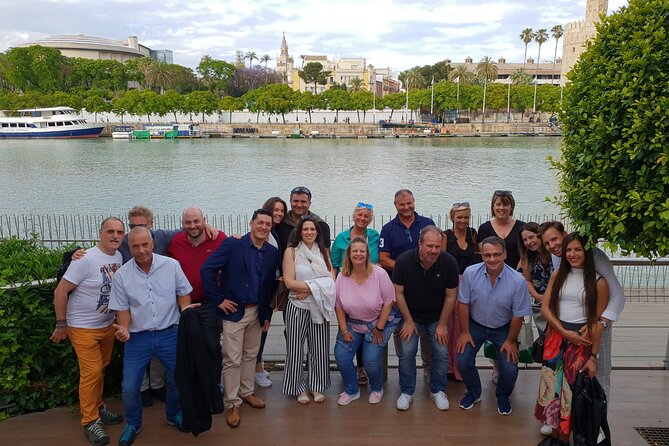
The walk begins at Puerta de Jerez, one of Seville’s old city gates. The gate itself gives you a first clue to the city’s layered past, where medieval walls, royal buildings, and modern streets meet.
Nearby is the Hotel Alfonso XIII, built for the Ibero-American Exposition of 1929. You see the exterior along with the Palacio de San Telmo, the old Royal Tobacco Factory, and the Torre del Oro. This opening section is useful because it sets up several themes that return throughout the walk: Spain’s royal power, trade with the Americas, Islamic architecture, and Seville’s grand public image.
The 1929 exposition also explains why several buildings and open spaces in this part of town feel unusually formal. You will not enter the hotel on this tour, but the outside gives you a sense of the city’s ambition at the time.
The Royal Tobacco Factory and Carmen
The old Royal Tobacco Factory is one of the route’s most imposing buildings. It is described as the largest building in Spain after the Escorial, and it now houses the Rectorate of the University of Seville.
You see the exterior and hear how the factory fits into Seville’s history. The building also has a strong place in popular culture as the setting associated with Bizet’s opera Carmen. That connection gives the architecture an immediate human story, even if you know little about the opera.
The tour does not include entry, so the stop works best as an introduction. If the factory interests you, you can make a note to return and check what areas are open to the public during your stay.
San Telmo, Maria Luisa Park, and the riverfront
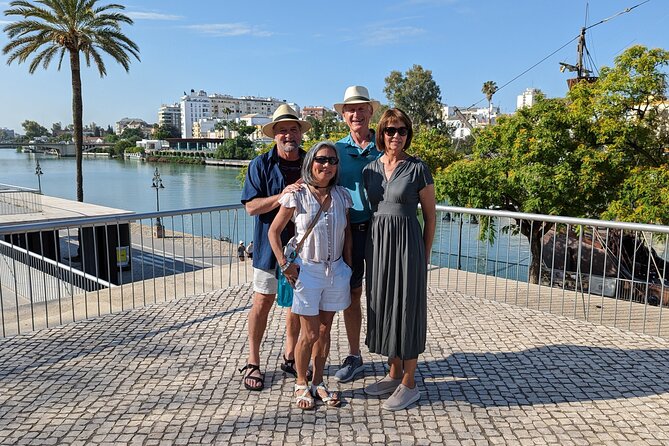
The Palacio de San Telmo began as a school for navigators during the period of Spanish exploration in the Americas. It later served as a residence for the Spanish royal family. Its gardens are now connected with Maria Luisa Park, which hosted the 1929 Ibero-American Exposition.
That history makes the palace more than an ornate building. It points to Seville’s role in navigation, royal life, and international display. You will see the exterior, while the guide explains how the site changed uses over time.
This is one place where a private guide can add useful detail. You can ask how the palace relates to the park and the exposition, or how Seville used its riverfront setting to build power and wealth. The stop also gives the walking route a little breathing room before the tighter streets around the old city center.
Same base, a different kind of afternoon:
- Seville: Royal Alcázar Entry Ticket
★ 4.6 · 28,378 reviews - Seville: Cathedral and La Giralda Entry Ticket
★ 4.5 · 24,592 reviews - Seville: Live Flamenco Dancing Show Ticket at the Theater
★ 4.7 · 16,396 reviews - Seville: Casa de la Memoria Flamenco Show
★ 4.8 · 12,964 reviews
The Torre del Oro and the old river defenses
The Torre del Oro is one of Seville’s most recognizable structures. The tour views it from outside and explains its role in maritime traffic and the city’s Islamic past.
The tower dates to the 13th century and is an example of Islamic architecture. Its position beside the river helps you understand that Seville’s story was never only about palaces and churches. Boats, defense, trade, and control of the Guadalquivir mattered just as much.
The outside visit is enough to appreciate the tower’s shape and location, though anyone wanting a fuller look will need to return independently. The guide’s explanation helps you read the tower as part of a working river system rather than as an isolated monument.
Postigo del Aceite and the Royal Shipyards
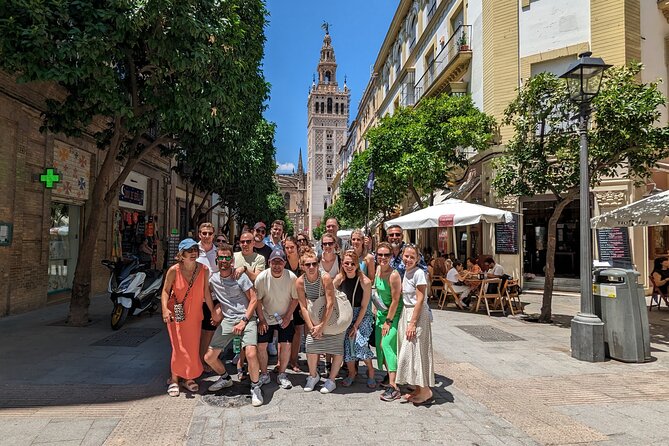
Next comes the Postigo Arch, another preserved gate from Seville’s old defenses. You also see the Royal Shipyards, where ships bound for the Americas were built.
The shipyards add an unusual practical note to the walk. Instead of hearing only about kings and artists, you get a reminder that ships required enormous workshops, labor, and organization. The site was also used in filming Game of Thrones, giving the stop a modern screen connection.
The tour keeps to the exterior. That is worth remembering if the shipyards are high on your list. The guide can explain the site and point out its role in the city, but interior access is not included.
Plaza del Cabildo and the Cathedral quarter
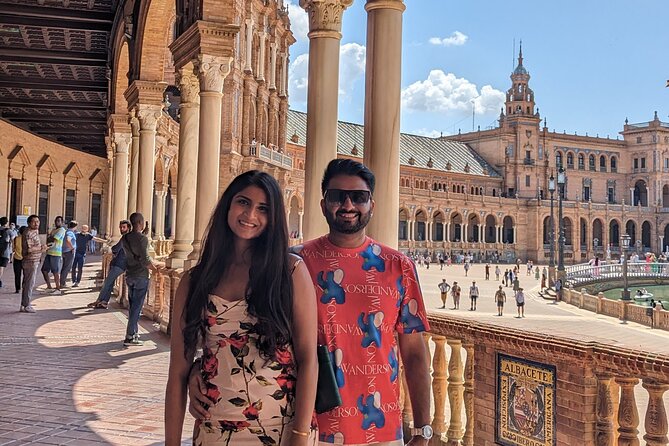
Plaza del Cabildo is one of the most distinctive spaces on the route. Its curved form and elegant arcades create a quiet pocket close to the Cathedral. An antiques market is still held there on Sundays, adding a small local tradition to the stop.
This square rewards a slower look. It is easy to rush from one major monument to the next in Seville, but places such as Plaza del Cabildo show how the city hides intimate spaces beside its grandest buildings.
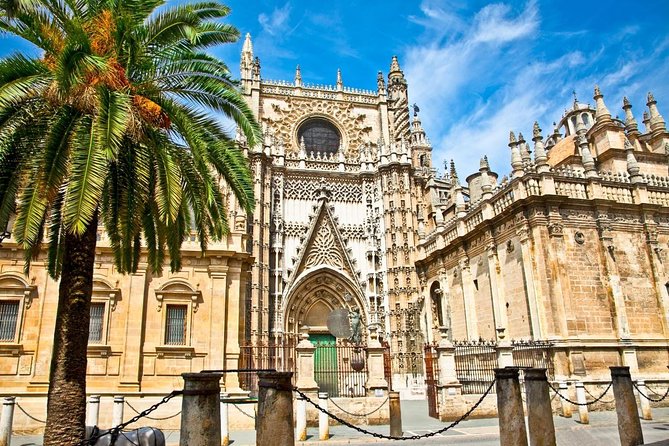
From there, you see the exterior of Seville Cathedral. It is the largest Gothic temple in the world and became a UNESCO World Heritage Site in 1987. The church was built over Seville’s former main mosque, so its Gothic form carries an Islamic past within it.
The exterior explanation matters because Seville’s religious history is not a clean break from one period to another. The mosque became a cathedral, and the Giralda became its bell tower. A guide helps you spot that change in the building instead of treating the Cathedral as a single-style monument.
The Giralda and the Alcázar walls
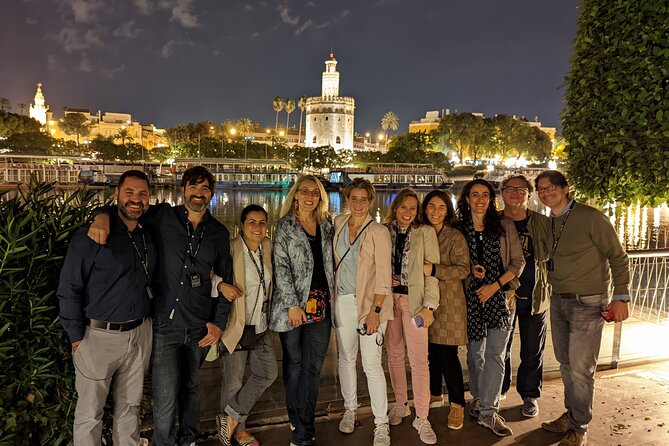
The Giralda is Seville’s symbol. You see it from outside and learn how the 12th-century Islamic tower was converted into a bell tower when the mosque became the Cathedral.
Its survival is one of the clearest signs of Seville’s layered architecture. The tower’s lower story and overall form point back to the Islamic city, while its later Christian use reflects the political change that followed.
You also see the outside of the Real Alcázar, a UNESCO World Heritage Site and the oldest royal palace in Europe still in use. The guide explains the kings who lived there and points out its connection with Dorne in Game of Thrones.
The Alcázar is one of the biggest reasons to consider this walk an introduction rather than a complete visit. Exterior stories may help you appreciate the palace later, but they do not replace the courtyards, rooms, gardens, and decorated interiors. Plan separate time if you want to go inside.
The Archivo de Indias and Seville’s American connection
The General Archive of the Indies sits beside the Cathedral and Alcázar. You see the exterior and hear about its collection of more than 40,000 documents connected with the Americas.
The archive holds maps, the Treaty of Tordesillas, and handwritten texts by Christopher Columbus. Even from outside, the building helps explain Seville’s importance as a port and gateway during Spain’s American empire.
This stop gives useful balance to the royal and religious sights. It shifts the focus toward records, navigation, treaties, and administration. If you enjoy exploring historical documents, you may want to return for a separate visit, since the walking tour does not include interior admission.
Santa Cruz, Seville’s former Jewish Quarter
The route then turns into Barrio de Santa Cruz, the old Jewish Quarter and one of the city’s most picturesque areas. Here the scale changes. Grand facades give way to narrow lanes, small squares, patios, flowers, and winding passages.
The guide takes you through Plaza de Doña Elvira, Plaza de los Venerables, Plaza del Agua, Plaza de la Vida, and Plaza de Santa Cruz. Each space offers a different view of the neighborhood, though the real pleasure is how the lanes connect them.
Santa Cruz also has a strong place in opera. The neighborhood is associated with works including The Barber of Seville. That artistic connection adds a bit of fun, but the streets are worth seeing even if opera is not your thing.
This part of the walk may be the most rewarding for first-time visitors because it shows Seville as a lived-in city rather than a list of monuments. The trade-off is that narrow streets can feel crowded and confusing, especially if you try to explore them alone without a map.
El Salvador and the old Islamic medina
The Church of El Salvador provides another clear example of changing religious use. The site was originally Seville’s first mosque, dating to the 9th century, and later became a collegiate church in the 13th century under Fernando III.
You see the exterior and the former ablution courtyard. The church sits among shops, much as it did when this area formed part of the old Islamic medina.
This stop gives you a practical way to understand Seville’s street plan. The modern commercial center follows routes that have served the city for centuries. You are not just looking at a church. You are seeing how an older urban center continues beneath today’s shops and traffic.
The Setas, Calle Sierpes, and the finish
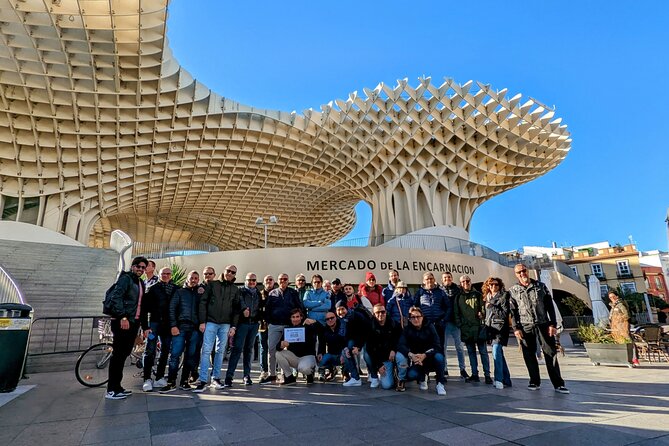
The route continues through the former Islamic medina toward Plaza de la Encarnación and the Setas de Sevilla, also called Metropol Parasol. Designed by German architect Jürgen Mayer, the large wooden structure is one of the city’s most recognizable modern buildings.
The Setas can divide opinion, but that is part of its appeal. After so much medieval, Islamic, Gothic, and Renaissance architecture, the modern structure gives you a sharp contrast. It also shows that Seville is not frozen in the past.
From there, you walk along Calle Sierpes, one of the city’s best-known shopping streets. It is lined with shops and cafes, and the old Royal Prison associated with Miguel de Cervantes is part of its story.
The tour finishes at Plaza de San Francisco, close to the Cathedral and Seville City Hall. The City Hall dates from the 16th century, during the time of Emperor Carlos V, and is a strong example of Renaissance architecture in Seville.
Ending here is practical. You are in the heart of town, near major sights, shops, and public transportation. It is an easy place to continue sightseeing, stop for food, or return to a monument you want to visit properly.
What the guides add to the experience
The provider describes its official Seville guide as having 30 years of experience. The guide names most often associated with the tour are Carlos and Fernando.
Carlos is praised for his humor, warmth, storytelling, and detailed explanations. One especially useful quality is his ability to make a family group feel at ease while still covering a large amount of information. Fernando is described as equally strong on Spanish and Seville history, with a passion for the city and careful attention to shade, bathrooms, and shopping during hot weather.
Those details matter. Seville can be very hot, and a private guide who notices your comfort can make the difference between an enjoyable walk and a tiring one. The tour includes photos, so you do not have to spend every stop holding up your phone.
The experience is offered in English. Since only your group participates, you can ask for more detail on architecture, royal history, opera, or filming locations, depending on your interests.
Price, pace, and who gets good value
At $133.03 per person, this is not the cheapest way to see Seville. The value comes from privacy, a professional guide, a broad central route, and the chance to ask questions without competing with a large group.
Group discounts may improve the price for larger parties. For a couple, the cost is easier to justify if you want a strong first orientation and personal attention. For a family, the private format can be useful because the guide may adjust the pace and keep the information engaging for different ages.
The two to three hour length suits a morning or afternoon. You need moderate physical fitness, since the experience involves walking through the historic center. There is no private transportation, but that is not a major weakness here because the route is designed around central sights.
Start with comfortable shoes, water, and protection from the sun. The walk requires good weather, and poor conditions may lead to a new date or a full refund.
Should you book this Seville walking tour?
Book it if you want a private first look at Seville, especially if you care about history, architecture, local stories, and a guide who can answer questions. It is also a good choice for families and small groups who prefer a personal pace.
Do not book it as your only Seville sightseeing plan if you expect interior visits. The Cathedral, Alcázar, Archive of the Indies, Tobacco Factory, and Royal Shipyards are presented from outside, so you should reserve separate time and admission for the places you want to enter.
The tour earns its price through its range and personal guiding. You begin with old city gates and river defenses, pass royal and religious monuments, wind through Santa Cruz, and finish with modern architecture and central shopping streets. For a compact introduction led by Carlos or Fernando, it is a strong choice.
FAQ
How long does the private Seville walking tour last?
The tour lasts approximately two to three hours.
Where does the tour start?
It starts at Puerta de Jerez in Seville’s historic center.
Where does the tour finish?
The tour finishes at Plaza de San Francisco, near the Cathedral and in the heart of Seville.
Is this a private tour?
Yes. Only your group participates in the activity.
Is the tour offered in English?
Yes. The tour is offered in English.
Does the tour include private transportation?
No. Private transportation is not included. The experience is a walking tour.
Are monument entrance tickets included?
No entrance tickets are listed as included. The major sights, including the Cathedral and Real Alcázar, are viewed from outside.
Are service animals allowed?
Yes. Service animals are allowed.
Can I cancel for a full refund?
Yes. You can cancel at least 24 hours before the start time for a full refund. If poor weather cancels the experience, you will be offered another date or a full refund.
Recently listed in Seville
- White Villages and Ronda: Day trip from Seville.★ 4.7 · 171 reviews
- Private Guided Day Trip to the White Villages and Ronda from Seville★ 5.0 · 158 reviews
- White Villages and Ronda Day Trip from Seville★ 5.0 · 295 reviews
- White Villages and Ronda Day Trip from Seville★ 4.0 · 142 reviews
- Private personalized Seville street tour of 2.5 hours★ 5.0 · 116 reviews
- Cathedral of Seville English Guided Tour with Skip the Line & Access to Giralda★ 4.5 · 139 reviews
- Alcazar of Seville with Cathedral & Giralda English Tour★ 4.5 · 661 reviews
- Skip the Line: Tablao Flamenco Pura Esencia Ticket★ 5.0 · 735 reviews
Walking Tours, compared.
Barcelona Tapas and Wine Experience Small-Group Walking Tour
Read our review →
Tapas Walking Tour with Food, Wine, and History
Read our review →
Albaicín and Sacromonte Guided Sunset Walking Tour
Read our review →
Toledo Tour & Vineyard Walk with Wine Tasting from Madrid
Read our review →
Madrid Walking Tour from Puerta del Sol to Retiro Park
Read our review →
Barcelona Tapas Walking Tour: Food, Wine & History
Read our review →
Madrid Old Town & Royal Palace Walking Tour Skip the Line Ticket
Read our review →
Browse the lists this tour appears in