
Reviewed · WALKING TOURS
Private walking tour in Palma de Mallorca with local guides.
Palma rewards slow wandering. This private walk links the cathedral, royal palace, Jewish quarter, modernist buildings, and market while giving you a guide who can adjust the conversation to your group. I like the private format, which keeps you out of a large crowd, and the chance to ask questions as you go. The main drawback is that the tour lasts about two hours, while the full route includes more sights than you can study in depth during that time.
I also like the price for a group of up to six. At $266.16 per group, the cost works out well for six people, though it feels less attractive for one or two. The route is mainly an introduction: several buildings are explained from outside, and entry fees for the Palau de l’Almudaina and Cathedral of Mallorca are not included.
In This Review
- Key points to know before you book
- Why this private Palma walk works well as a first look
- Sa Llotja and the waterfront start
- The royal palace and cathedral quarter
- Courtyards, old families, and Palma’s Jewish quarter
- Santa Eulalia and the city’s local character
- Can Corbella and Palma’s modernist face
- City Hall, Plaça Major, and the stories in the streets
- Mercat de l’Olivar for a useful finish
- How the two-hour timing really feels
- The guides and the value of personal attention
- Who should book this walk?
- My recommendation
- FAQ
- How long does the private Palma walking tour last?
- How many people can join the private tour?
- Is the tour offered in English?
- Are entrance fees included?
- When is Mercat de l’Olivar open?
- Can the tour ending point be changed?
Key points to know before you book
- A private group of up to six: You get your own guide rather than sharing the walk with strangers, with room to ask questions and set a comfortable pace.
- Palma’s essential sights in one route: The walk covers Sa Llotja, the royal palace, the cathedral, old patios, Jewish-quarter landmarks, City Hall, Plaça Major, and Mercat de l’Olivar.
- A useful history-and-architecture mix: You’ll hear about Guillem Sagrera, Catalan Modernism, Gaudí, Miquel Barceló, Mallorca’s Jewish community, and local customs.
- The cathedral deserves extra planning: Its interior visit is listed separately, and admission is not included. Allow time and budget if seeing the inside matters to you.
- Some stops have limited opening hours: The Jewish-quarter interpretation center is available only during weekday mornings, while Mercat de l’Olivar opens Monday through Saturday until 2:30 p.m.
- A flexible ending: The usual finish is near Plaça Major, but the end point can be adapted to suit your group.
Why this private Palma walk works well as a first look
Palma can feel confusing at first. Its old center mixes grand Gothic buildings, narrow lanes, elegant courtyards, royal spaces, churches, shops, and busy squares. A private guide helps you connect those pieces instead of simply ticking them off on a map.
The walk begins at Carrer del Moll, 3, near the waterfront, and usually ends at Plaça Major. That direction makes sense. You move from the city’s maritime and royal edge toward its central streets and market district.
You can book for up to six people at $266.16. For a full group, that is about $44 per person. For three people, it is about $89 each, and for two, about $133 each. I would see the best value for families or friends traveling together, especially if you want a private guide and do not want to fit into someone else’s schedule.
The tour is offered in English and uses a mobile ticket. Confirmation arrives within 48 hours, subject to availability. It is also near public transportation, and service animals are allowed.
More Walking Tours in Mallorca:
- Palma de Mallorca: City Walking Tour with The Cathedral
★ 4.0 · 657 reviews - Palma de Mallorca: Foodie Walking Tour of the Old Town
★ 4.6 · 372 reviews - Palma, Cathedral & Valldemossa: Guided walking Tour
★ 4.1 · 182 reviews
Sa Llotja and the waterfront start
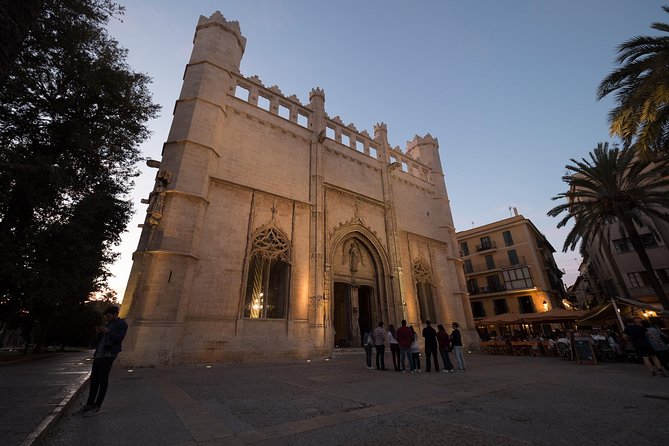
The first stop is Sa Llotja, a striking building designed by Guillem Sagrera, a famous architect from Mallorca. The visit is planned for about 15 minutes, with no admission charge.
This is a good opening stop because the building gives your guide a chance to explain Palma’s commercial and maritime past through its architecture. You are not simply looking at an attractive facade. You are beginning to see how trade shaped the city.
Sa Llotja has set opening times. It is open Tuesday through Sunday from 10:30 a.m. to 1:30 p.m. and from 5:30 p.m. to 11 p.m. It is closed on Mondays. The stated tour schedule does not guarantee an interior visit, so ask your guide what will be open when you book.
The royal palace and cathedral quarter
Next comes the Palau de l’Almudaina, with roughly 10 minutes set aside for its history, architecture, royal connections, and anecdotes. This is one of the stops where the guide’s commentary matters more than the clock. Ten minutes is enough for orientation and context, but not a full palace visit.
Admission is not included. If the palace interior is important to you, treat this walking tour as a preview and make a separate plan for entry.
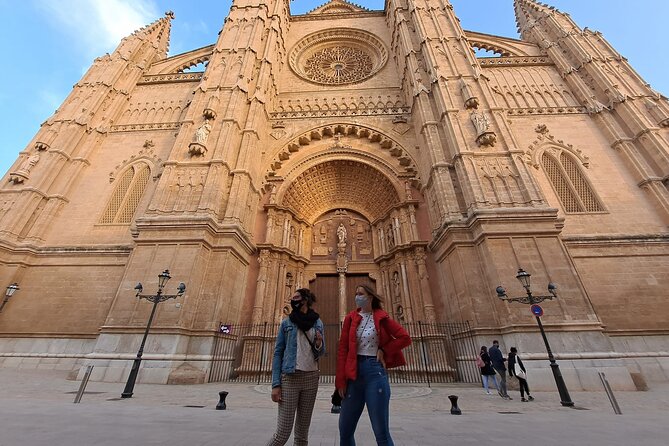
The route then reaches the Catedral de Mallorca. One short stop covers the cathedral’s history, unusual details, and recent changes. A second, longer section is designed for the interior, with about 40 minutes devoted to the building’s chapels, light effects, Catalan Modernism, Gaudí, and the contemporary work of Miquel Barceló.
That combination is one of the strongest parts of the experience. The cathedral is not presented only as an old church. You get a sense of its changing artistic life, from earlier styles to modern interventions.
Admission is not included, so budget for it separately. The description also separates the exterior explanation from the interior visit. That distinction matters if you are booking mainly to see inside. Confirm the access arrangements and timing before you arrive, especially if your tour is tightly scheduled.
Courtyards, old families, and Palma’s Jewish quarter
The next section moves away from the grand monuments and into the city’s smaller architectural details. At Ca’n Oms, the guide discusses a traditional Mallorcan courtyard, both indoors and outdoors, for about seven minutes.
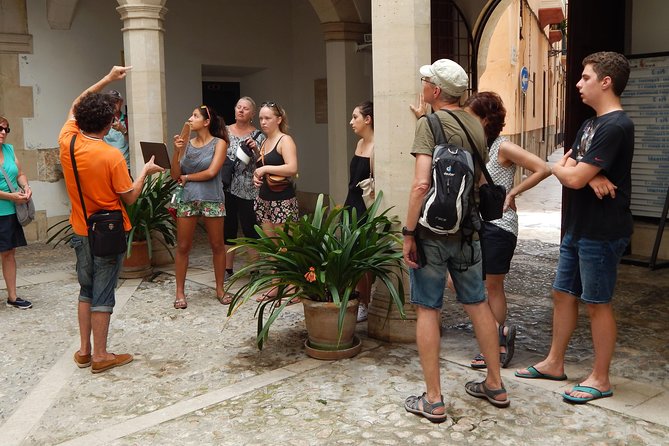
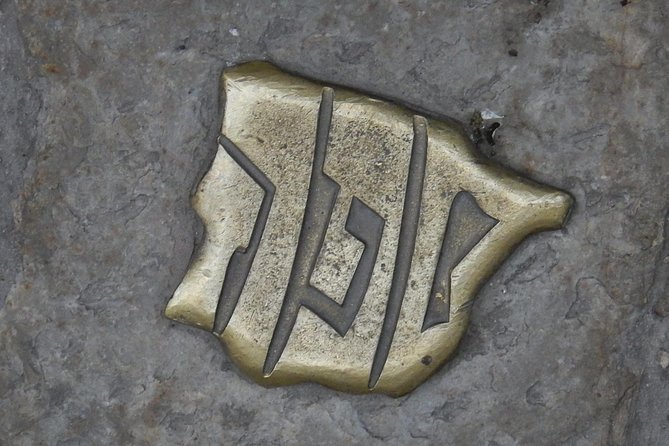
Can Bordils adds another courtyard and a longer 20-minute stop. During weekday mornings, the walk can include the interpretation center of Palma’s Jewish quarters. This is a valuable addition because it brings in a part of Mallorca’s past that can be easy to miss when you focus only on the cathedral and palace.
The center also introduces the Xuetas, a group connected to Mallorca’s Jewish heritage. The timing is important: this visit is available only during the week and in the mornings. If this subject matters to you, choose your tour time carefully and confirm that the center can be included.
Courtyards are easy to overlook on your own. They may not have the instant impact of a cathedral, but they help you notice how old Palma was organized and how its grand homes looked beyond the street facade. The short stops also keep the walk moving.
A few more Mallorca ideas to compare
- Palma: Cathedral of Mallorca Skip-the-Line Entry Ticket
★ 4.6 · 14,386 reviews - Palma de Mallorca: 5-Hour Catamaran Cruise with Lunch & Swim
★ 4.5 · 9,957 reviews - Porto Cristo: Caves of Hams Entry Ticket
★ 4.2 · 6,548 reviews - Palma de Mallorca: City Sightseeing Hop-On Hop-Off Bus Tour
★ 4.1 · 4,450 reviews
Santa Eulalia and the city’s local character
Santa Eulalia is a parish church with a planned 10-minute stop. Here, the guide explains the church and local expressions.
This is a small but useful part of the walk. A good city introduction should include more than dates and rulers. Local expressions give you a sense of how Palma’s identity appears in everyday speech and custom.
The visit is free, so you can focus on the explanation without deciding whether to pay for another admission. The pace is brief, which suits a two-hour orientation, though you should not expect a long church visit.
Can Corbella and Palma’s modernist face
Can Corbella brings the route into Catalan Modernism and the Jewish quarter. The planned stop is about 15 minutes, with admission not included.
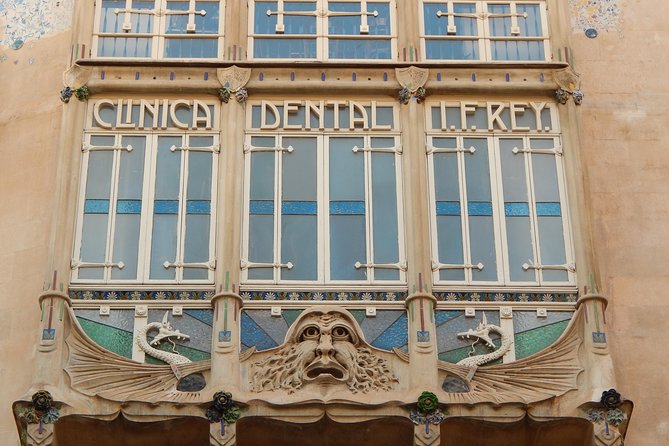
Then comes Can Forteza Rey, a much shorter five-minute stop. The focus is Catalan Modernism and a face, an architectural detail that gives the building a human touch.
These stops add welcome variety. Palma is not only Gothic stone and royal architecture. Modernist buildings introduce curves, decoration, and a different period of local design. The short timing suggests that you will look, listen, and move on rather than explore each building in depth.
If you are especially interested in architecture, keep notes or take photos where permitted. The private format gives you a better chance to ask why certain details matter, instead of losing your question in a large group.
City Hall, Plaça Major, and the stories in the streets
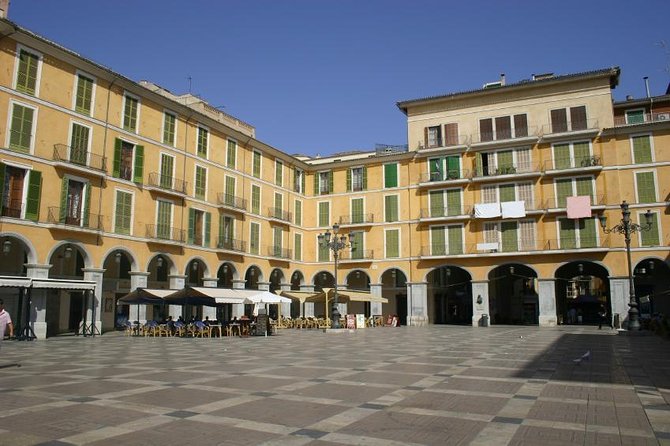
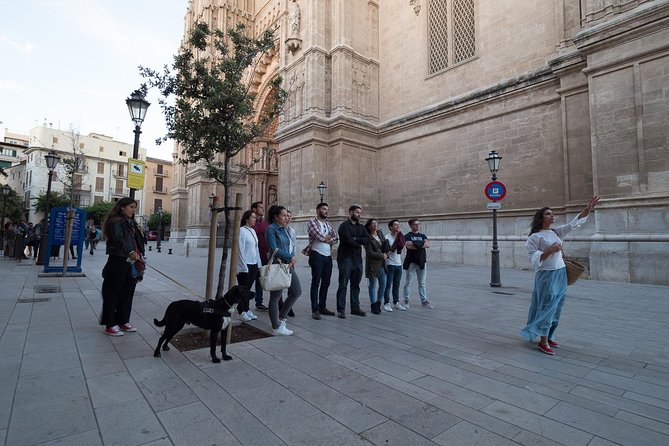
At the Ajuntament de Palma, the guide covers the town hall, the main square, and the Banc de sino fos. This stop lasts about 15 minutes and has no admission charge.
The town hall area is a natural place to discuss civic Palma. It also helps you understand how the old center functions as a public space, not just as a collection of historic buildings.
Plaça Major comes next, with about 10 minutes for its surroundings, history, and recent changes. It is also the usual finishing area, though the end point can be adapted.
The Banc de s’Oli Oleoteca receives a quick five-minute explanation, including local anecdotes about the area and its orange trees. Small details such as this can make the route more memorable. You begin to connect streets with smells, plants, commerce, and local stories rather than seeing only formal monuments.
Mercat de l’Olivar for a useful finish
The final listed stop is Mercat de l’Olivar, Palma’s main municipal and local market. It opens Monday through Saturday from 7:30 a.m. to 2:30 p.m., and the planned visit lasts about 10 minutes.
This is a practical ending. After hearing about kings, churches, architecture, and old communities, you reach a place tied to daily life and local shopping. It is also a good point to continue exploring on your own.
The market will not fit every tour time because of its opening hours. It is closed on Sundays, and the afternoon schedule matters. If the market is high on your list, make sure your chosen time allows for it.
How the two-hour timing really feels
The advertised duration is approximately two hours. The route includes 13 stops, but the individual time allocations add up to more than that. That tells you something important: the schedule is a framework, not a promise that every stop will receive the full stated time on every departure.
You will get a broad introduction to Palma, with some places treated in a few minutes and the cathedral receiving the longest planned attention. The private guide can adjust the pace, but you should not expect a leisurely interior study of every church, palace, courtyard, and market.
One family experience made this point especially clear. With two overheated children, the group appreciated seeing the main sights at surface level rather than trying to enter everything. Guide Carlos kept the children involved as best he could. That makes this a sensible choice for families who want context without a long, demanding museum session.
I would still plan for sun and walking. The route covers the old center, and the ability to pause or shorten a stop is one of the main benefits of booking privately.
The guides and the value of personal attention
Guide Carlos is praised for being friendly and for making an effort with children. Guide Maria led another highly successful old-town introduction, giving the group historical background and time afterward to explore independently.
Those details point to the tour’s main strength: the guide is not just reciting a fixed script. You can ask about the parts that catch your interest, request more explanation, or keep the pace moving when your group is tired.
The tour has a 4.8 rating from 182 ratings, with 97 percent recommending it. Those figures support the idea that the experience is dependable, but they do not remove the need to match it to your expectations. It is best as a first orientation, not as a full archaeological or art-history course.
Who should book this walk?
I would choose this tour if you are staying in Palma briefly, arriving by cruise, or visiting Mallorca for the first time. It gathers the old center’s main themes in a compact route and gives you a guide who can explain the links between them.
Families may appreciate the private setting and the ability to keep children moving. Couples and small groups can also get good value if they want a focused introduction without a large-group schedule.
You may want another option if you mainly want extended interior visits. Palace and cathedral admission are extra, some stops are brief, and the whole route covers a great deal in about two hours.
Book early if your schedule is fixed. The experience is booked, on average, eight days ahead, and confirmation depends on availability. Free cancellation is available until 24 hours before the start time. Changes or cancellations inside that window are not refunded.
My recommendation
I would book this for orientation, context, and flexibility. The strongest features are the private group of up to six, the mix of famous sights and less obvious courtyards, and the chance to ask a real guide about Palma’s Jewish heritage, Modernist buildings, cathedral art, and local customs.
Go in with the right plan. Use the walk to learn where you want to return, then spend extra time inside the cathedral, palace, or market according to their opening hours. If you want a friendly first look at Palma and a guide who can adapt to your group, this is a solid choice. If you want detailed access to every building, two hours will feel too short.
FAQ
How long does the private Palma walking tour last?
The tour lasts approximately two hours.
How many people can join the private tour?
The private booking is for one group of up to six people.
Is the tour offered in English?
Yes. The experience is offered in English.
Are entrance fees included?
No. Admission to the Palau de l’Almudaina and Catedral de Mallorca is not included. Sa Llotja, Ca’n Oms, Can Bordils, Santa Eulalia, Ajuntament de Palma, Plaça Major, Banc de s’Oli Oleoteca, and Mercat de l’Olivar are listed with free admission, though opening access can vary by time and day.
When is Mercat de l’Olivar open?
The market is open Monday through Saturday from 7:30 a.m. to 2:30 p.m. It is not listed as open on Sundays.
Can the tour ending point be changed?
Yes. The usual ending point is Plaça Major, but the end point can be adapted to suit your group.
Recently listed in Mallorca
- Alcudia/Marratxi: Valldemossa & Soller Tour by Tram & Bus★ 4.7 · 499 reviews
- Discover Cala des Moro and S’Almunia the smart way★ 5.0 · 370 reviews
- “Cala Millor & Sa Coma: TOP Buggy Tours – your mega experience!”★ 4.5 · 340 reviews
- Palma de Mallorca Bike Tour★ 4.5 · 128 reviews
- Explore Mallorca in Your Own Formula One Car★ 4.5 · 388 reviews
- Scooter and Motorbike Rental to Explore Mallorca★ 4.5 · 186 reviews
- Ticket Palma Aquarium★ 4.0 · 354 reviews
- Food Tasting Walking Tour in Palma with a Local★ 4.5 · 105 reviews
Walking Tours, compared.
Barcelona Tapas and Wine Experience Small-Group Walking Tour
Read our review →
Tapas Walking Tour with Food, Wine, and History
Read our review →
Albaicín and Sacromonte Guided Sunset Walking Tour
Read our review →
Toledo Tour & Vineyard Walk with Wine Tasting from Madrid
Read our review →
Madrid Walking Tour from Puerta del Sol to Retiro Park
Read our review →
Barcelona Tapas Walking Tour: Food, Wine & History
Read our review →
Madrid Old Town & Royal Palace Walking Tour Skip the Line Ticket
Read our review →
Browse the lists this tour appears in