
Reviewed · NATIONAL PARKS
Teide National Park: Stargazing Experience
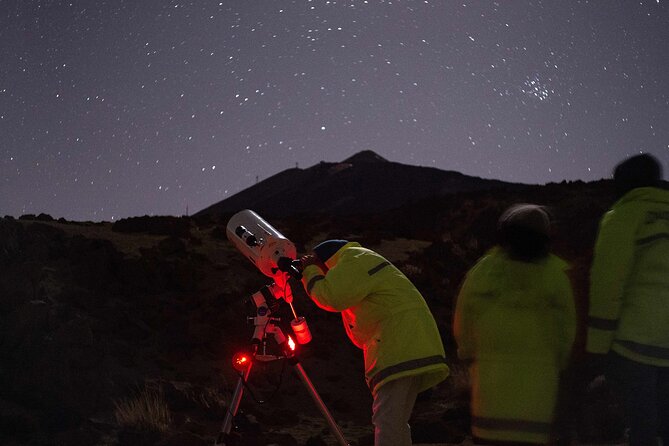
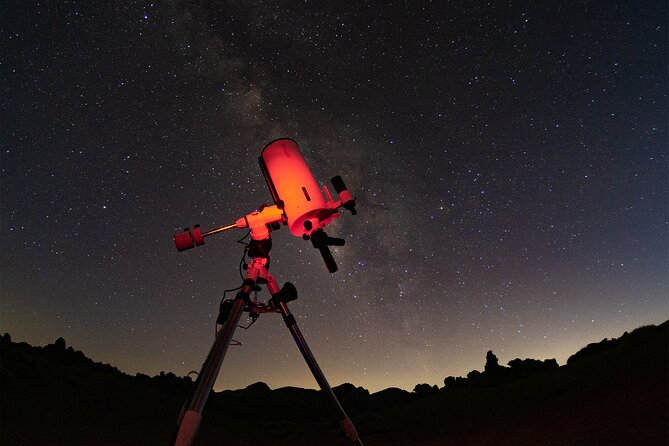
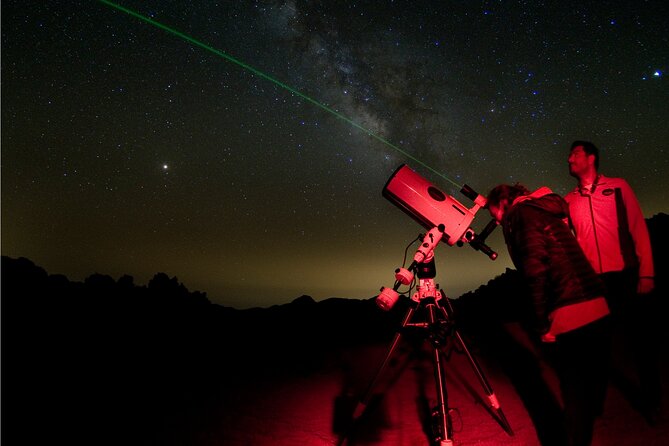
The best show begins after sunset. This 80-minute stargazing tour in Teide National Park combines clear mountain skies, telescope viewing, and simple guidance through the constellations. I especially like the way it starts with the naked eye, helping you find Polaris, the celestial north pole, the ecliptic, and the zodiac before the telescopes take over. I also like the high-grade telescopes and the chance to turn selected sights into astrophoto images.
The main catch is the cold. At altitude, temperatures can feel far lower than at the coast, even in summer, and some visitors were still chilled after nearly two hours outside. The $41 price is reasonable for a guided astronomy session, but the tour is best for people who enjoy listening, standing outdoors, and looking carefully rather than expecting a fast-moving attraction.
In This Review
- Key points at a glance
- Why Teide is a fine place to study the night sky
- Finding your bearings before the telescope
- What the telescopes add
- The moon can change the whole mood
- The cold is not a minor detail
- Meeting at Minas de San José
- Is $41 a fair price?
- The guides shape the evening
- Who will enjoy this most?
- How to prepare for a better night
- Should you book the Teide stargazing tour?
- FAQ
- How long does the Teide stargazing experience last?
- How much does the tour cost?
- Where is the meeting point?
- Is hotel pickup included?
- Which languages are available?
- What should I bring?
- Can I cancel the booking?
Key points at a glance
- Start with the naked eye: Learn the major stars, constellations, Polaris, the celestial north pole, and the zodiac line before using a telescope.
- Look through advanced telescopes: Depending on the season and sky conditions, you might see planets, moons, star clusters, galaxies, nebulae, and the Milky Way.
- Hear the stories behind the stars: Greek mythology helps turn scattered points of light into shapes and memorable patterns.
- Meet at Minas de San José: The meeting point is the car park in front of the natural environment, with different directions depending on whether you arrive from the north or south.
- Prepare for mountain cold: Warm clothing and warm shoes are essential, especially in autumn and winter.
- Expect an English or Spanish guide: Guides such as Miguel, Manuel, and Luke have been praised for clear explanations, humor, and enthusiasm.
Why Teide is a fine place to study the night sky
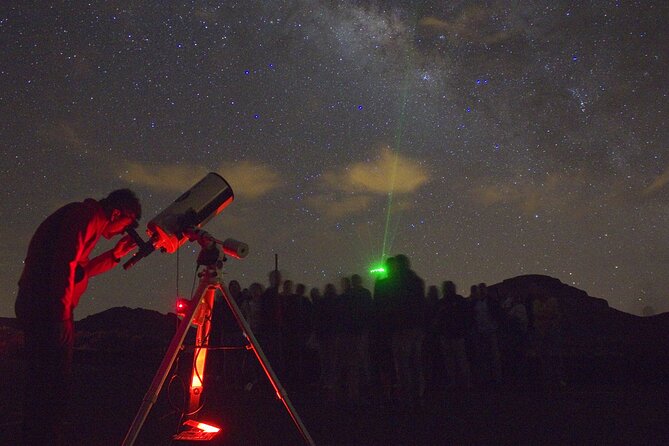
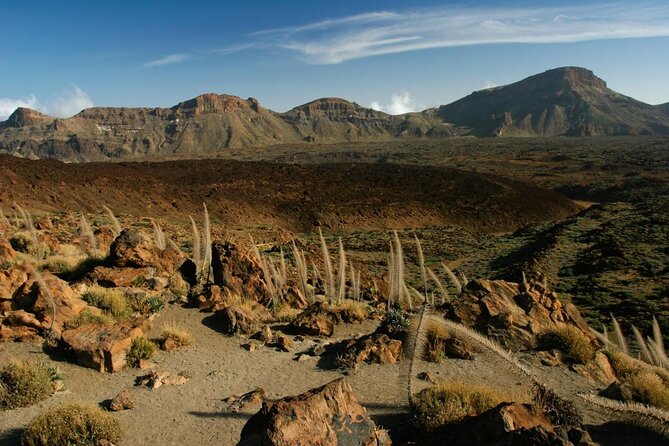
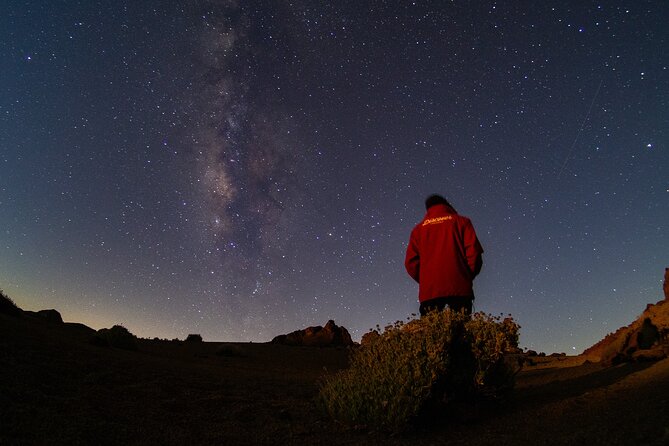
Teide National Park offers something simple but precious: darkness. The absence of town lights lets you see many more stars than you normally can from a city, resort, or even a small town. One visitor described seeing more stars than ever before, and that reaction makes sense when you consider how much artificial light normally washes out the sky.
The setting also gives the tour a strong sense of place. You are not looking at a planetarium ceiling or a screen. You are outside, under the actual sky, with the mountain air around you and the stars overhead. That can make basic astronomy feel surprisingly direct.
I like that the tour does not rush straight to the telescope. First, the guide helps you understand what you are looking at. This matters because a telescope can show a bright object, but it does not automatically tell you where that object sits in the wider sky.
The exact sights depend on the date, visibility, and the moon’s phase. Past sessions have included Jupiter with its moons, Saturn, Mars, Orion’s Nebula, the Andromeda Galaxy, star clusters, the Milky Way, and the Moon. You should treat these as possible examples, not a guaranteed program.
A few more Tenerife ideas to compare
- Siam Park Entry Tickets
★ 4.5 · 15,710 reviews - Tenerife: Eco-Yacht Whale and Dolphin Watching and Swimming
★ 4.7 · 15,619 reviews - Los Cristianos Respectful No-Chase Whale and Dolphin Safari
★ 4.6 · 12,782 reviews
Finding your bearings before the telescope
The opening section uses no equipment beyond your eyes and the guide’s explanation. You learn to recognize important stars and constellations, then locate Polaris and the celestial north pole. This gives you a fixed point for understanding how the sky appears to move.
The guide also introduces the ecliptic, the apparent path followed by the Sun across the sky, and the zodiac line connected with that path. This is where the session becomes more than a series of pretty views. You begin to understand why certain planets and constellations appear in particular parts of the sky.
Greek mythology adds an easy way to remember the patterns. The guide links constellation shapes and positions with old stories, so the sky becomes less like a random scattering of lights. You might not leave ready to chart the whole heavens, but you should have a better chance of recognizing several major patterns later.
This part suits beginners especially well. You do not need a background in astronomy, and the explanations are intended to work in both English and Spanish. Guides have been praised for being clear, funny, and easy to follow, with Miguel receiving particular praise for his lively presentation.
What the telescopes add
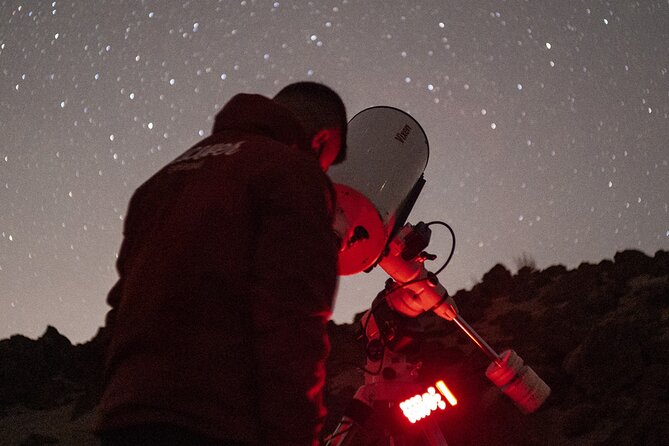
Once you have your bearings, the tour moves to telescope observation. This is the moment many people anticipate, and the equipment gives you a closer look at objects that are only points of light to the naked eye.
A telescope can make the Moon’s surface, a planet, or a cluster of stars feel much more immediate. In past sessions, people have seen the rings of Saturn, Jupiter and its moons, Mars, Orion’s Nebula, and the Andromeda Galaxy. The exact view will depend on what is visible during your visit, so I would book this for the overall night-sky experience rather than one particular planet.
The tour also includes an astrophoto telescope. That means selected objects can be turned into images, and one person received photographs of a star cluster and a galaxy after the session. The details of how images are provided are not specified, so consider the photography an appealing feature rather than a guaranteed set of pictures.
The telescope portion works best when you are patient. Everyone may need time to look, adjust, and listen to the explanation. This is not a private observing session where you control the instrument, but a guided introduction designed to show the most notable visible objects of the night.
The moon can change the whole mood
The moon deserves special attention when you choose your date. Its cycle affects how dark the sky appears. A bright moon can be beautiful and may give you a strong lunar view, but it can also reduce the contrast of faint stars and distant objects.
A darker night may offer a better chance of seeing the Milky Way and less bright celestial material. A moonlit night has its own appeal, especially if the Moon is one of your main interests. The important point is to check the moon’s phase before booking instead of assuming every night will look the same.
The tour does not promise a fixed list of objects. Clouds, visibility, the season, and the moon all matter. That uncertainty is normal for outdoor astronomy, and it is one reason I would keep your expectations flexible.
Same base, a different kind of afternoon:
- Tenerife: Loro Parque Entry Ticket
★ 4.8 · 12,411 reviews - Loro Parque and Siam Park Combined Admission Tickets
★ 4.7 · 7,307 reviews - Tenerife: Kayak and Snorkel with Turtles, Wetsuits Included
★ 4.6 · 7,215 reviews - Costa Adeje: Whale & Dolphin Eco-Cruise with Snacks & Drinks
★ 4.6 · 5,096 reviews
The cold is not a minor detail
Bring comfortable shoes, warm shoes, and genuinely warm clothing. The repeated warning is justified. At Teide’s altitude, the temperature can be far lower than at the coast, and wind can make an already cold evening feel harsher.
One person described being frozen after around two hours outside in November. Another noted that August temperatures were about 25 degrees lower on the mountain than below, with strong wind making the difference sharper. Even visitors who loved the tour repeatedly singled out the cold as the main practical challenge.
I would wear several warm layers, a proper outer layer, and closed shoes suitable for standing outdoors. The official advice is especially strong for autumn and winter, but summer visitors should not assume short sleeves will be enough. Warmth affects concentration. If you are shivering, you will enjoy fewer of the guide’s explanations and spend more time thinking about getting back indoors.
The tour is not suitable for people with heart or respiratory problems, or for anyone who has been scuba diving within the previous 24 hours. Pets are not allowed, and minors cannot attend without an accompanying adult.
Meeting at Minas de San José
The meeting point is the parking area directly in front of the natural environment of Minas de San José. If you come from the south, it is the second car park on the right. If you come from the north, it is the first car park on the left.
That detail matters because Teide National Park has wide open areas and more than one possible stopping place. I would allow extra time to identify the correct car park rather than arriving at the last minute. The tour does not include hotel pickup or drop-off, so you need to arrange your own transport to the meeting point.
The site is selected for good and safe access. That is useful in a dark mountain setting, where a remote viewpoint might sound romantic but could be awkward or unsafe to reach at night. Even so, comfortable footwear remains part of the preparation.
The provider may confirm the start time through WhatsApp or email, especially if you book months ahead. The time can change as the date approaches, so check your messages after booking and respond to any schedule confirmation.
Is $41 a fair price?
At $41 per person, the tour sits in a reasonable range for a guided evening activity, particularly because it includes a professional astronomical guide, naked-eye instruction, telescope observation, and insurance. You are paying for the guide’s ability to explain what you see, not just for access to a dark place.
The value is strongest if you are new to astronomy. Without help, you might look up and see thousands of stars but have no idea which ones matter. The guide gives you a method: identify major stars, use Polaris for orientation, follow the ecliptic, then examine selected objects through the telescope.
The value is less clear if you expect a long private session or guaranteed photographs of several objects. The listed duration is 80 minutes, although one account referred to spending about two hours outside, likely including waiting or the full evening schedule. Plan for a cold outdoor commitment longer than a quick photo stop, but use 80 minutes as the official tour length.
One visitor felt the price could be slightly lower for the time spent. That is a fair reservation, especially if the night is cloudy or the cold limits your enjoyment. The free cancellation option up to 24 hours before the activity and the reserve-now, pay-later choice do make the booking less risky.
The guides shape the evening
A strong guide makes a major difference in astronomy. The subjects can become technical, but the best explanations connect facts with things you can actually find above your head.
Miguel has been praised for clear, passionate, and funny explanations. Manuel was remembered for making the Moon, constellations, and mythology interesting. Luke was praised for inspiring people who did not already consider themselves astronomy fans.
That range tells you something useful about the tone. This is not presented as a dry lecture for experts. It is built for curious beginners, with enough detail to interest people who already know a little about the sky.
The guide also helps with practical orientation. Pointing out Polaris and the celestial north pole gives the session a useful structure, while the zodiac and Greek mythology add memorable stories. I like this mix of science, observation, and storytelling because it gives you several ways to connect with the night.
Who will enjoy this most?
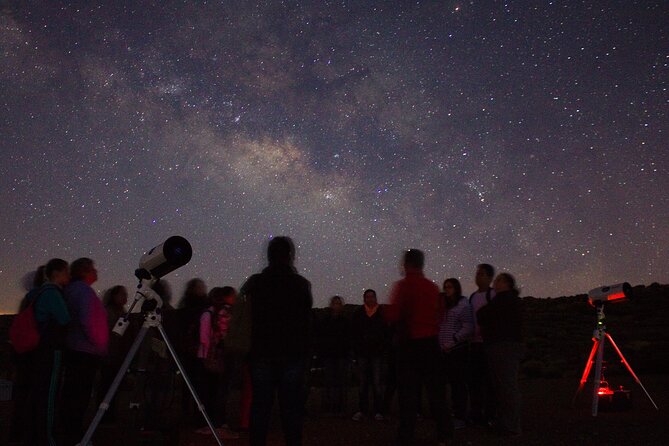
I would recommend this activity to couples, families with older children, and anyone who wants a calm evening away from Tenerife’s busy resort areas. It can also suit people who think astronomy sounds too difficult. The simple explanations and guided telescope viewing remove much of the guesswork.
It is a particularly good fit if you enjoy learning while you look. You will get more from it if you want to know why a constellation is positioned where it is, how to use the stars for orientation, and what makes a galaxy or nebula different from a planet.
You should think twice if you dislike cold weather, standing outdoors, or uncertain conditions. The tour cannot control the moon, clouds, or the exact objects visible that night. It is also not suitable for people with heart or respiratory problems, or for anyone who has recently scuba-dived.
How to prepare for a better night
Wear more than you think you need. Warm socks, warm shoes, several layers, and a wind-resistant outer layer can make the difference between a memorable evening and a long wait for the finish.
Check the moon’s cycle before choosing a date. If you want the darkest possible sky, you may prefer a less bright moon, while a strong lunar view may appeal to you more on a brighter night.
After booking, watch for the provider’s WhatsApp or email message. If you reserve far in advance, the start time may change, and the schedule is confirmed closer to the date.
Finally, arrive ready to pay attention. The first part uses the naked eye, and the guide’s explanations help you make sense of the telescope views later. If you treat the activity as a quick look through a large instrument, you will miss half its value.
Should you book the Teide stargazing tour?
Book it if you want an accessible introduction to the night sky in a genuinely dark mountain setting. The strongest parts are the clear orientation before telescope viewing, the range of possible celestial objects, the Greek mythology, and the guides’ warm, engaging style.
The main warning is the cold, followed by the uncertainty of outdoor conditions. Bring serious winter clothing even in warmer months, check the moon phase, and do not book if you need guaranteed views of a particular planet.
For $41, this is a good-value choice for curious beginners and couples looking for a different evening on Tenerife. It is less suitable for anyone seeking comfort, private telescope time, or a quick sightseeing stop.
FAQ
How long does the Teide stargazing experience last?
The stated duration is 80 minutes. Some participants spent closer to two hours outside, so you should allow extra time for the full evening and changing conditions.
How much does the tour cost?
The listed price is $41 per person.
Where is the meeting point?
Meet in the parking area directly in front of the natural environment of Minas de San José. From the south, it is the second car park on the right. From the north, it is the first car park on the left.
Is hotel pickup included?
No. Hotel pickup and drop-off are not included, so you must arrange your own way to the meeting point.
Which languages are available?
The live tour guide is available in Spanish and English.
What should I bring?
Bring comfortable shoes, warm shoes, and warm clothing. Warm layers are essential because temperatures can be low, particularly in autumn and winter.
Can I cancel the booking?
Yes. You can cancel up to 24 hours in advance for a full refund. You can also reserve now and pay later.
Recently listed in Tenerife
- Las Galletas: Whale & Dolphin Tour with Local Skipper★ 4.8 · 397 reviews
- Tenerife: Teide, Icod de los Vinos & Garachico Full Day Tour★ 4.3 · 602 reviews
- Tenerife: Loro Parque & Siam Park Entry Ticket with Transfer★ 4.6 · 732 reviews
- Tenerife: Teide National Park Guided Buggy Tour★ 4.6 · 299 reviews
- Tenerife: Sunset Night Tour and Stargazing at Teide + Dinner★ 3.8 · 316 reviews
- Tenerife: Surfing Lesson for All Levels, Photos included★ 4.9 · 861 reviews
- Tenerife: Sunset Catamaran Tour with Transfer, Buff & Drinks★ 4.8 · 570 reviews
- Tenerife: Siam Park Full-Day VIP Entry Ticket★ 4.5 · 183 reviews
National Parks, compared.
Teide National Park Sunset & Stargazing with Dinner (Star Safari)
Read our review →
Arrecife/Playa Blanca: Timanfaya National Park Area Day Tour
Read our review →
Jávea: Cala Tango and San Antonio Nature Reserve Kayak Tour
Read our review →
Browse the lists this tour appears in