
Reviewed · MADRID TOURS
From Madrid: Escorial Monastery and the Valley of the Fallen
Two monumental sites, one half-day. This outing links El Escorial’s royal monastery with the Valley of the Fallen, giving you art, architecture, monarchy, war, and modern Spain in one well-planned trip. I especially like the clear historical thread from Felipe II to the present democracy, and the comfortable bus ride makes both sites practical without renting a car.
The guides are the heart of the experience. Cristina, Beatriz, Sergio, Rafael, Oscar, and others are repeatedly praised for explaining difficult subjects in clear English and Spanish, while keeping the pace friendly. I also like the skip-the-line entry and the headsets, which matter when a group is moving through large, echoing buildings.
The trade-off is time. Five hours is efficient, but you have little room for a leisurely meal or long independent wandering. Both monuments involve plenty of walking and steps, and the basilica at El Escorial is not visited on Sundays, so check the day before booking.
In This Review
- Key points at a glance
- Why these two sites belong together
- Leaving Madrid for San Lorenzo de El Escorial
- El Escorial, Felipe II’s great statement
- How the guided visit works inside El Escorial
- The transfer to the Valley of the Fallen
- Understanding the Valley of the Fallen
- Timing, pace, and group comfort
- Is $73 a fair price?
- Who should book this half-day trip?
- Should you book it?
- FAQ
- How long does the tour last?
- Where is the meeting point?
- How long is the bus ride to El Escorial?
- How long is the visit to El Escorial?
- How long is the visit to the Valley of the Fallen?
- Is food included?
- What languages are available?
- Is the tour suitable for wheelchair users?
Key points at a glance
- A 45-minute ride from Madrid: The journey to San Lorenzo de El Escorial is short enough for a half-day outing.
- Two very different monuments: El Escorial represents royal power and Catholic Spain, while the Valley of the Fallen confronts the memory of the Civil War.
- Skip-the-line admission included: You enter through a separate entrance at both sites, saving valuable time.
- Strong guiding is the main advantage: Guides such as Cristina, Beatriz, Sergio, and Rafael add context that is hard to get from the buildings alone.
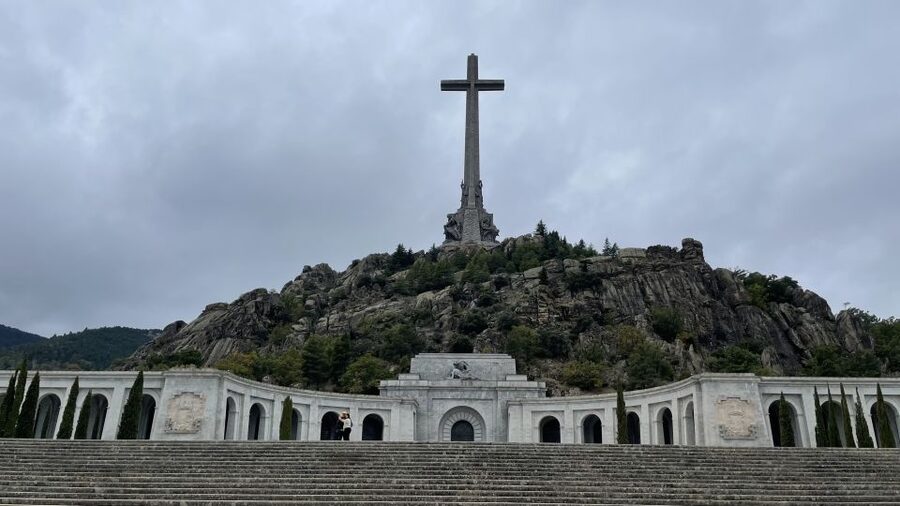
- A striking rock-cut basilica: The church at the Valley of the Fallen is carved into the mountain and marked by a huge granite cross visible from far away.
- Not suited to limited mobility: The visit includes substantial walking and steps, and it is not suitable for wheelchair users.
Why these two sites belong together
Madrid is full of grand palaces, museums, and churches, but the wider Community of Madrid tells a different story. Here, Spain’s political and religious ambitions become physical. El Escorial is the careful, ordered world of Felipe II. The Valley of the Fallen is a much later monument tied to the Spanish Civil War and the dictatorship that followed it.
That contrast gives the excursion its purpose. You are not simply ticking off two impressive buildings. You are moving from the Spanish Golden Age to one of the most painful chapters in modern Spanish history.
I find the pairing especially useful if you have only a few days in Madrid. You see royal rooms, paintings, burial chambers, gardens, a basilica, and a monastery in the morning. Then you confront a monument whose meaning is far more politically charged. The guide helps connect those subjects without turning the day into a dry lecture.
The overall rating is 4.7 from 1,434 bookings, and the praise is focused in fairly consistent places: the guides, the comfortable coach, the good pacing, and the chance to reach both sites without a car.
A few more Madrid ideas to compare
- Madrid: Tour Bernabéu Entry Ticket
★ 4.5 · 21,573 reviews - Madrid: Prado Museum Entry Ticket
★ 4.6 · 17,509 reviews - Madrid: Royal Palace Fast-Access Admission Ticket
★ 4.6 · 13,856 reviews
Leaving Madrid for San Lorenzo de El Escorial
The meeting point is outside the Commercial Gallery at San Bernardo Street 7. From there, an air-conditioned coach takes about 45 minutes to San Lorenzo de El Escorial, with Wi-Fi available on board.
The short ride is one of the practical strengths. You avoid working out regional transport, transfers, and connections, and you arrive as part of a group already prepared to enter the monastery. The coach also provides a useful break between the two guided visits.
A bathroom stop takes place after arrival. That is sensible because the first guided visit lasts about 105 minutes, followed by a transfer to the Valley of the Fallen. One piece of useful advice: do not count on a proper meal stop. Food and drinks are not included, and the schedule is built around the monuments rather than cafés.
Wear comfortable shoes and clothes. This is not a sit-back-and-look-out-the-window excursion. The buildings are large, and the route through them includes walking and steps.
El Escorial, Felipe II’s great statement
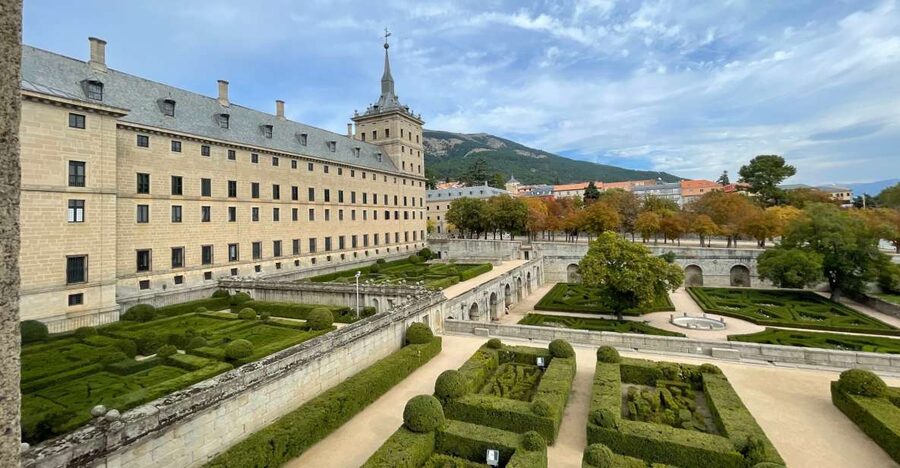
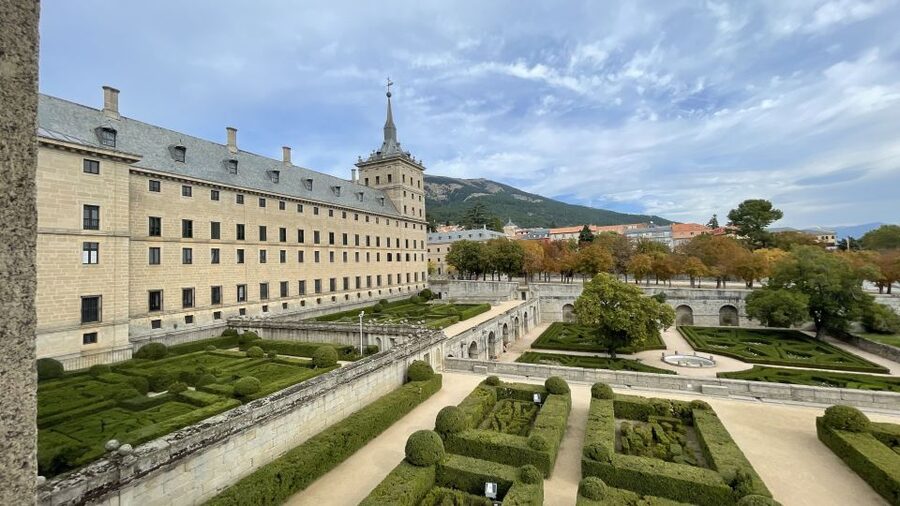
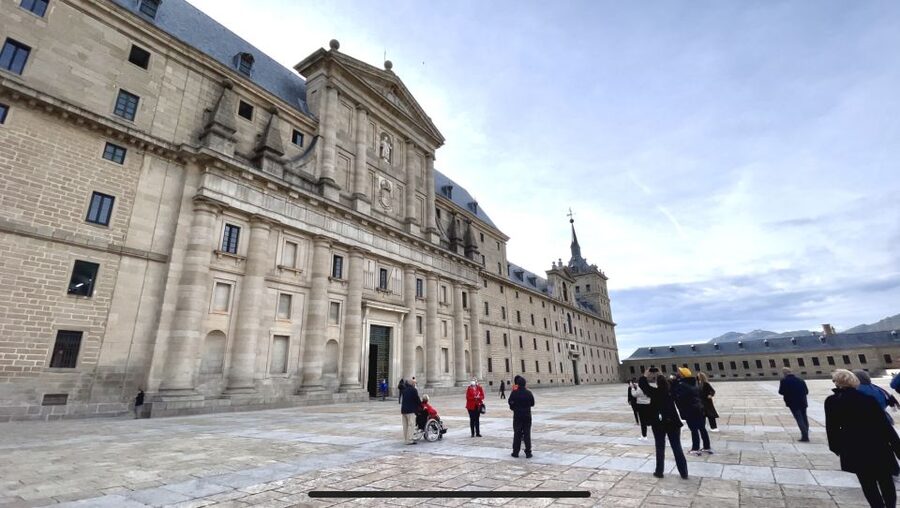
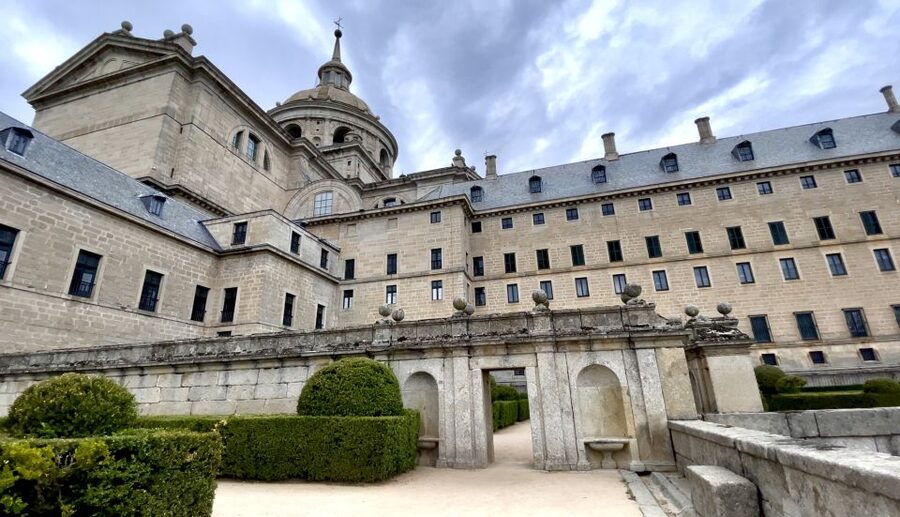
San Lorenzo de El Escorial is the main event for anyone interested in Spain’s monarchy, art, architecture, or religion. The complex is a World Heritage Site and is described as the building that best expresses the ideological and cultural aims of Spain’s Golden Age.
That is a grand claim, but the building gives you plenty to consider. Felipe II commissioned El Escorial as a royal residence, monastery, burial place, and center of religious life. The result is not a light, playful palace. It feels ordered, serious, and purposeful.
The guided route includes several major spaces:
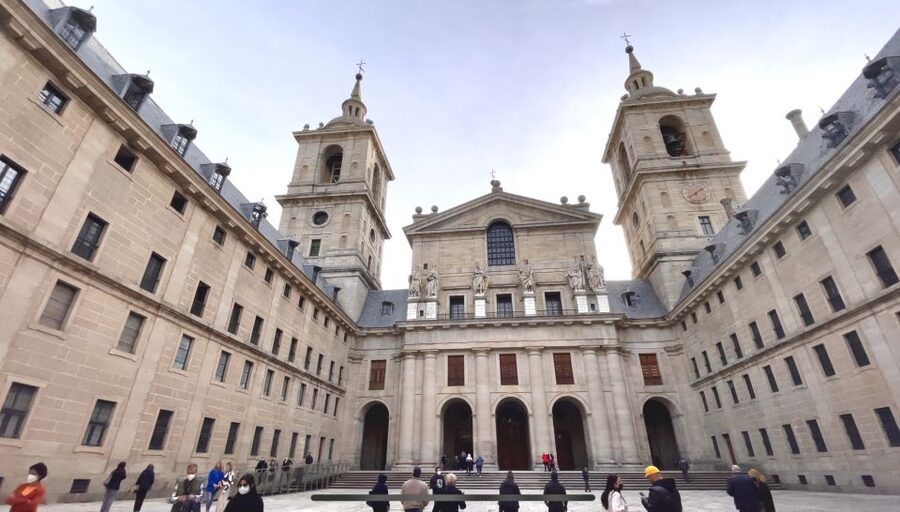
- The Patio de Reyes, or Courtyard of the Kings
- The cloister
- The Chapter Rooms
- The basilica, except on Sundays
- The Pantheon of Kings and Pantheon of Infants
- The Royal Rooms
The Pantheons are particularly important. They show how the Spanish monarchy used architecture to preserve dynastic memory. The Royal Rooms offer a different view, linking the monumental institution to the people who lived and worked within it.
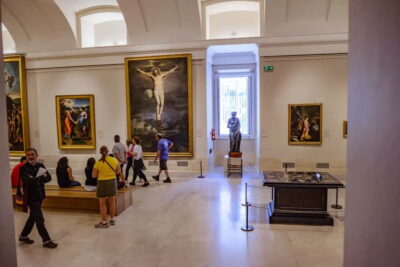
The artwork is another strong reason to come. Paintings are part of the experience, and one reviewer who had recently studied El Escorial’s art wished for even more time on individual works. That is a fair criticism. The guide provides the broad story well, but a visitor who loves art may want to linger longer than the group schedule allows.
The library and gardens also attract attention. The library is one of the spaces that gives El Escorial more depth than a standard royal residence. It presents the monastery as a place of study and spiritual work, not simply a palace decorated for show.
You should also expect a large complex rather than a compact museum. The guide keeps the group moving, which prevents the visit from becoming tiring or confusing, but it means you will not inspect every corner at your own pace.
How the guided visit works inside El Escorial
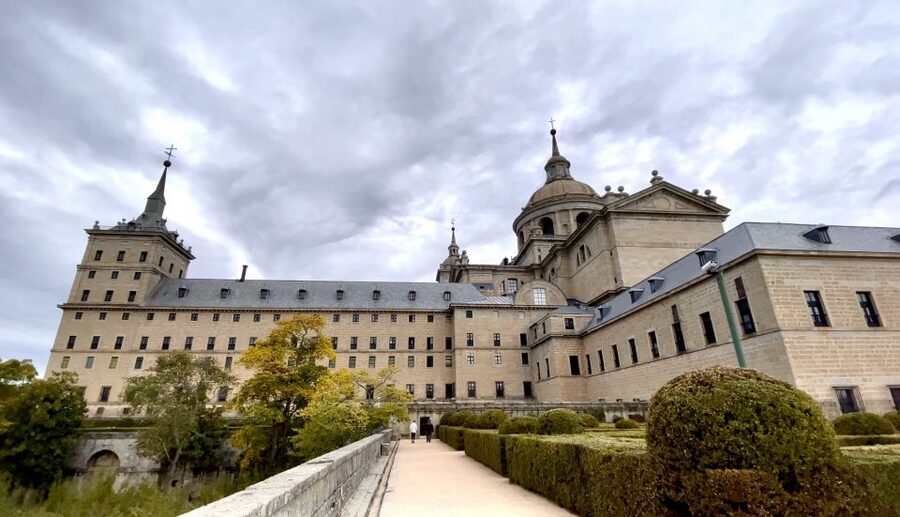
The tour includes skip-the-line entry through a separate entrance. That does not make the building small or simple, but it does reduce wasted time at the start.
A headset is provided, with Spanish and English options. This is useful in grand interiors where a guide’s voice might otherwise fade into the room. One report noted some background noise with the sound system, so the equipment may not be flawless, but it remains helpful for following the explanation.
The guide normally presents the monastery as a connected story rather than a list of rooms. That is exactly the right approach here. Without context, you see courtyards, religious art, royal furniture, and tombs. With context, those rooms explain how Felipe II wanted Spain to see itself.
The strongest guides combine facts with a sense of proportion. Cristina was praised for switching smoothly between Spanish and English, while Pilar was appreciated for staying politically even-handed when the subject became sensitive. That matters at both El Escorial and the Valley of the Fallen. You want a guide who explains the evidence and competing meanings without turning the visit into a political performance.
Same base, a different kind of afternoon:
- Madrid: “Emociones” Live Flamenco Performance
★ 4.8 · 12,866 reviews - Madrid: Panoramic Route City Tour
★ 4.1 · 12,259 reviews - Madrid: Live Flamenco Show with Food and Drinks Options
★ 4.5 · 9,901 reviews - Avila & Segovia Tour with Tickets to Monuments from Madrid
★ 5.0 · 9,762 reviews
The transfer to the Valley of the Fallen
After El Escorial, the coach takes about 15 minutes to the Valley of the Fallen, located in the Peña de Cuelga Muros area. The transfer is short, which helps the five-hour schedule work.
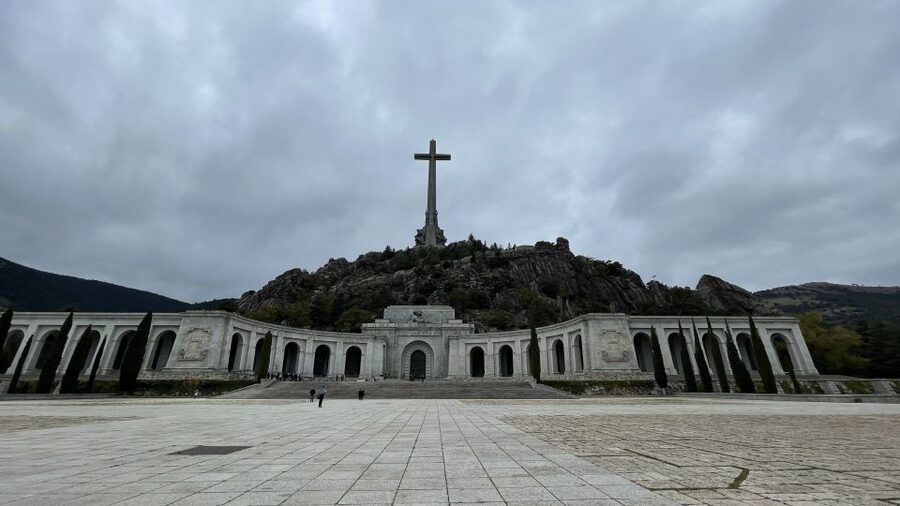
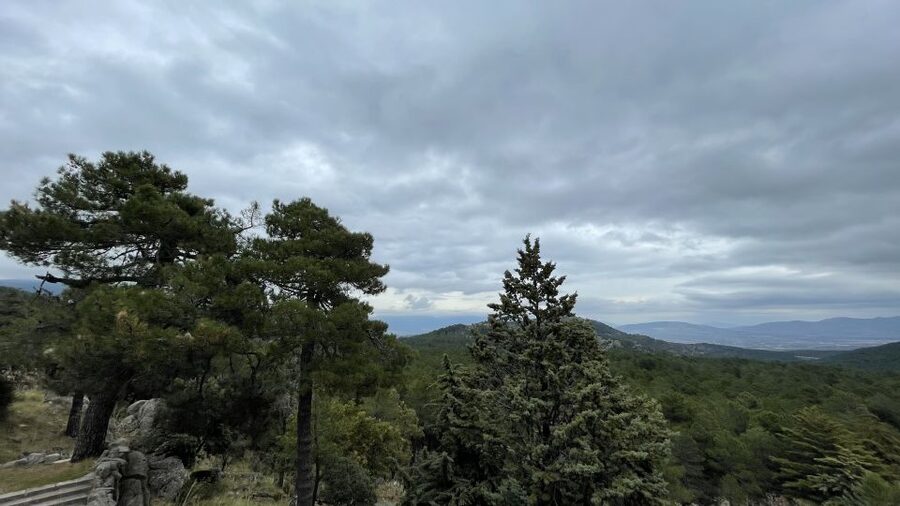
The setting changes sharply. El Escorial is an enclosed royal and religious complex in San Lorenzo. The Valley of the Fallen is a monument in a mountain setting, dominated by a granite cross visible from several kilometers away.
The scale is hard to grasp until you are close to it. The cross gives you a sense of the monument before you reach the basilica, and the approach prepares you for a place built to make a powerful impression.
You visit the surrounding area and enter the basilica carved into the rock. The church is the unusual centerpiece of the stop. It is not merely built beside a mountain. It is cut into one, which makes the interior feel inseparable from the stone around it.
Understanding the Valley of the Fallen
This is the more difficult stop emotionally and politically. The basilica is connected with the burial place of 33,847 people who died during the Spanish Civil War. That fact alone changes how you read the monument.
The tour presents the history from the Civil War through the dictatorship and into present-day democracy. You should expect a serious explanation rather than a simple sightseeing stop. The monument has a contested meaning, and the guide’s role is important in giving you enough background to understand why.
Several guides are praised for handling the subject respectfully. That is especially valuable if you know little about Spain’s twentieth-century history. The site can otherwise seem like a strange, oversized church in the hills, impressive but difficult to place.
The basilica itself is the visual highlight for many people. One participant described the church inside the rock as especially impressive, while another felt the Valley of the Fallen was the most memorable part of the day. I would allow yourself time to look upward, take in the stone, and consider the purpose of the monument, not just photograph the cross.
The limitation is the amount of free time. The guided visit lasts about one hour, and the group must return to the coach on schedule. One person wanted more time at this second monument and felt rushed while getting back to the bus. If you prefer to explore every viewpoint and pause for a long independent visit, this excursion may feel too structured.
Access can also change. A wedding once affected entry to the basilica, although the guide managed to get the group inside. That example shows why a guided visit can help, but it also means the exact flow may not be identical every day.
Timing, pace, and group comfort
The full outing lasts about five hours:
- About 45 minutes from Madrid to San Lorenzo de El Escorial
- Around 105 minutes inside El Escorial
- About 15 minutes to the Valley of the Fallen
- Around one hour at the Valley
- About 45 minutes back to Madrid
This is a brisk half-day, but it is not designed as a race. Several guides are praised for keeping a relaxed pace while still covering the major rooms and stories. You receive time for photographs and some brief independent looking, but the guide remains the main source of information.
That balance suits most first-time visitors. You get more historical explanation than an audio guide alone and more structure than an independent day trip. At the same time, you should not expect a slow art seminar or a full afternoon at either monument.
The bus is air-conditioned and generally described as comfortable and well maintained. Safe driving also receives praise, including from people who specifically mentioned drivers such as Javier, Juan Antonio, Enrique, and Eugenio.
Because there is no food stop included, eat before meeting the group or carry something allowed for the day. The provided information confirms that food and drinks are not part of the price, so do not assume the schedule includes a restaurant break.
Is $73 a fair price?
At $73 per person, the value is strongest if you do not have a car and want both sites in one morning. The price includes round-trip coach transport, Wi-Fi on the bus, a live guide, headsets, and skip-the-line admission to both monuments.
You are paying for convenience as much as entry tickets. Reaching El Escorial is possible by public transport, but combining it with the Valley of the Fallen is less straightforward without driving. A rental car would give you more freedom, but it would not provide the historical explanations, group organization, or separate entrances included here.
The price is less attractive if you already have a car, prefer to spend several hours at one site, or want to eat slowly and wander without a timetable. It is also not the best match for someone who mainly wants scenery. The tour includes impressive mountain views, but its real focus is history and architecture.
For a short Madrid visit, I consider the cost reasonable. The coach removes transport worries, and the guide turns two difficult monuments into a coherent lesson about Spain.
Who should book this half-day trip?
I would recommend it to you if:
- You want to see important sites outside Madrid without renting a car.
- You enjoy history, royal architecture, religious art, or twentieth-century politics.
- You value a live guide who can answer questions.
- You want a structured morning with transport and admission arranged.
- You can walk comfortably and manage steps.
- You are interested in the contrast between Spain’s Golden Age and the legacy of the Civil War.
I would think twice if you have mobility limitations, use a wheelchair, need frequent rest breaks, or dislike fixed schedules. The tour is specifically not suitable for wheelchair users or people with mobility impairments.
I would also reconsider if you want a quiet, self-guided visit. The guide is a major part of the experience, and the pace is set by the group. You will have some time for photos and a little personal exploration, but not unlimited freedom.
Should you book it?
Yes, if you want an efficient and historically serious half-day from Madrid. El Escorial is the stronger stop for art, monarchy, and architecture, while the Valley of the Fallen adds a difficult but necessary chapter about the Spanish Civil War.
Book it for the guide, transport, and context, not for a leisurely day out. Keep your shoes comfortable, bring water or a snack, and choose a day other than Sunday if seeing the basilica at El Escorial matters to you. If your schedule allows only one excursion from Madrid, this is a strong choice for understanding how Spain’s past still shapes its present.
FAQ
How long does the tour last?
The experience lasts five hours, including transport from Madrid, guided visits, and the return journey.
Where is the meeting point?
Meet your driver outside the Commercial Gallery at San Bernardo Street 7 in Madrid.
How long is the bus ride to El Escorial?
The coach journey from Madrid to San Lorenzo de El Escorial takes about 45 minutes.
How long is the visit to El Escorial?
The guided visit to the Monastery of San Lorenzo de El Escorial lasts about 105 minutes.
How long is the visit to the Valley of the Fallen?
The guided visit at the Valley of the Fallen lasts about one hour.
Is food included?
No. Food and drinks are not included in the tour price.
What languages are available?
The live guide and audio guide are available in Spanish and English.
Is the tour suitable for wheelchair users?
No. The tour is not suitable for wheelchair users or people with mobility impairments. Comfortable shoes are recommended because both sites involve walking and steps.
Recently listed in Madrid
- Madrid: Don Quixote de la Mancha Windmills & Toledo Tour★ 4.9 · 254 reviews
- Tour Madrid: Secrets in a Electric Tuk Tuk★ 4.6 · 155 reviews
- Madrid: Toledo Day Trip with Winery Visit and Wine Tasting★ 4.4 · 177 reviews
- Madrid: Guided Tour of Toledo with Cathedral Visit★ 4.3 · 399 reviews
- Madrid: 6-Hour Day Trip to Toledo with Guided Walking Tour★ 4.0 · 865 reviews
- Madrid: Tasty Tapas Tour & Visit to a Terrace with Views★ 4.5 · 118 reviews
- Madrid: Flamenco Show&Drink at Tablao 1911 (World’s Oldest)★ 4.7 · 253 reviews
- Madrid: Street Art Tour with Local Graffiti Hunter★ 4.8 · 270 reviews
Madrid Tours, compared.


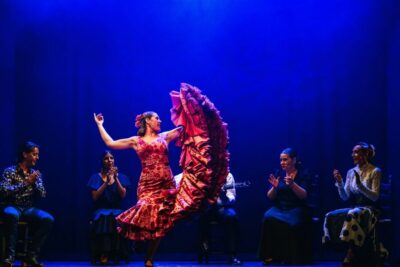

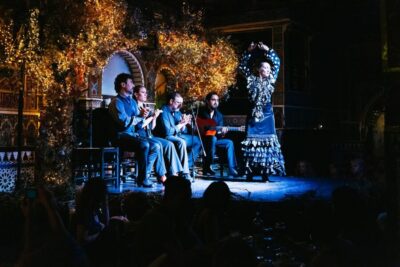
Live Flamenco Show with Food and Drinks Options
Read our review →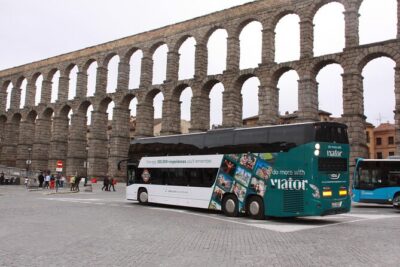
Avila & Segovia Tour with Tickets to Monuments from Madrid
Read our review →
Three Cities in One Day: Segovia, Avila and Toledo from Madrid
Read our review →Browse the lists this tour appears in