
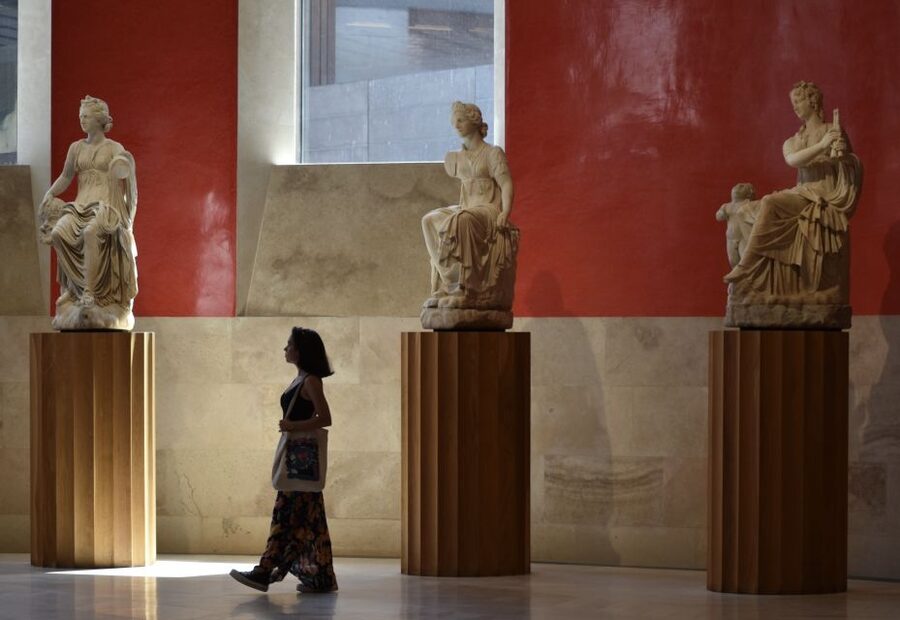
Reviewed · PRADO MUSEUM TOURS
Madrid: Museo del Prado Guided Tour
The Prado rewards a good guide. This 1.5 to 2-hour tour gives you a clear path through one of Europe’s great painting collections, with special attention to Velázquez, Goya, Bosch, Rubens, Titian, Raphael, and El Greco. Instead of wandering through room after room and wondering what matters, you get stories, context, and a manageable group visit.
I especially like the flexible format, since you can ask to focus on particular works or follow the guide’s suggested route. I also like the guides’ teaching style. Names such as Macarena, Maria, Alex, Paula, Stephi, Natalia, Clara, and Belen appear often in the praise for this tour, with repeated credit for clear storytelling and strong command of the museum.
The main drawback is time. The Prado is enormous, and even two hours only introduces you to its finest rooms. Photography is not allowed, you must meet outside at the Goya statue, and a crowded museum can make it harder to hear or pause in front of popular paintings.
In This Review
- Key points to know before booking
- Meeting the guide at Goya’s statue
- Entering the Prado with a clear plan
- Bosch, Van der Weyden, and the early rooms
- Raphael, Titian, and the Venetian school
- Velázquez and the royal court
- El Greco, Murillo, and the Spanish tradition
- Rubens and the drama of the Baroque
- Goya’s difficult, powerful final chapter
- How much can you see in 90 minutes?
- Group size, languages, and access
- Is $49 a fair price?
- Practical tips for a better visit
- Should you book this Prado tour?
- FAQ
- Where does the Prado guided tour meet?
- How long does the tour last?
- Is the Prado admission ticket included?
- Can I request specific paintings or artists?
- Is photography allowed inside the museum?
- What languages are available?
- Can I stay in the Prado after the tour?
Key points to know before booking
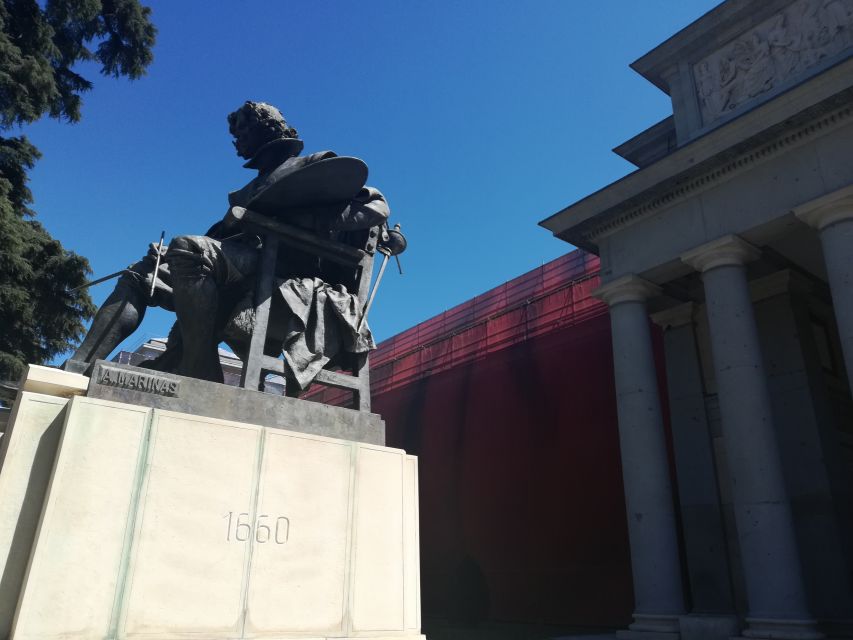
- The tour begins at the Goya statue, directly in front of the Prado’s ticket office, where the guide carries a sign reading The guides you need.
- You can request specific paintings or artists, although a chronological route is usually suggested for a clearer sense of how styles changed.
- The major Spanish masters get proper attention, especially Velázquez and Goya, along with Bosch, Rubens, Titian, Raphael, El Greco, and others.
- Small groups can make a major difference, with some visits limited to six or seven people and others operating as private tours.
- Skip-the-line admission is included, and you may continue exploring inside the museum after the guided portion until closing time, though you cannot leave and reenter.
- The tour is offered in English, Spanish, Italian, and French, and wheelchair access is available.
Meeting the guide at Goya’s statue
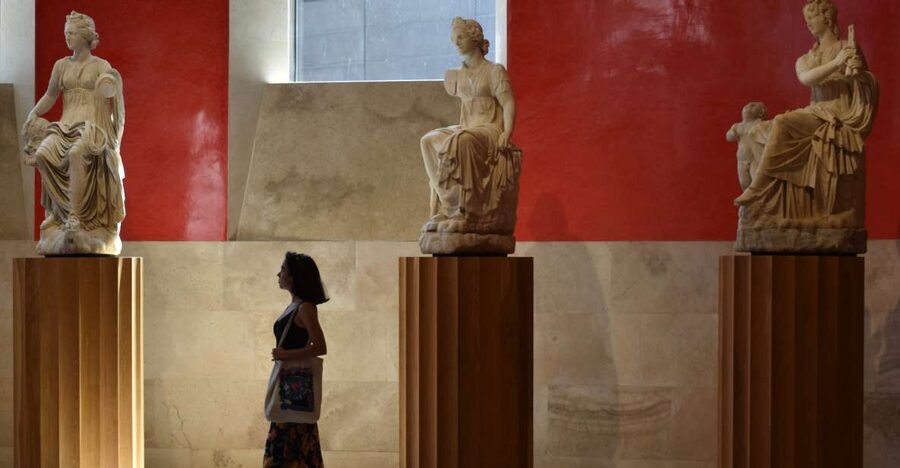
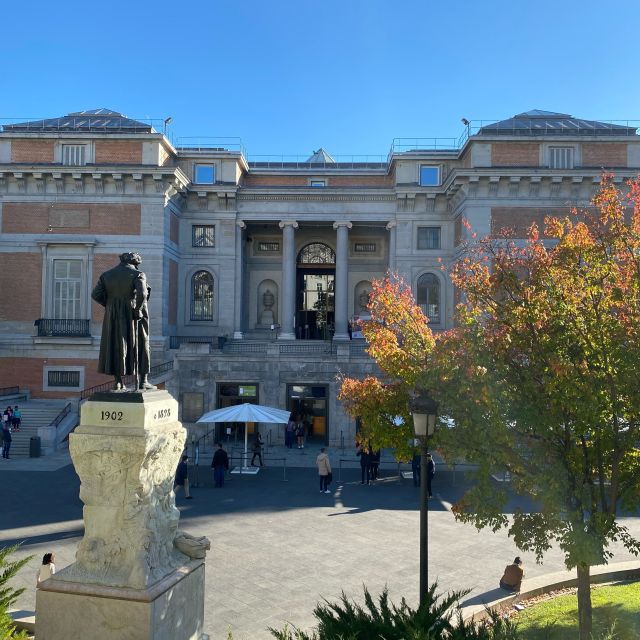
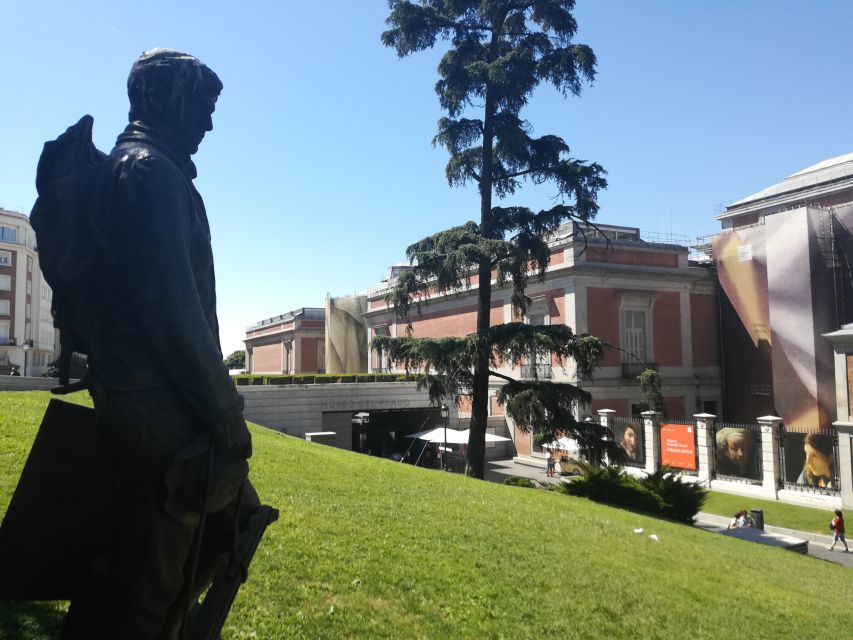
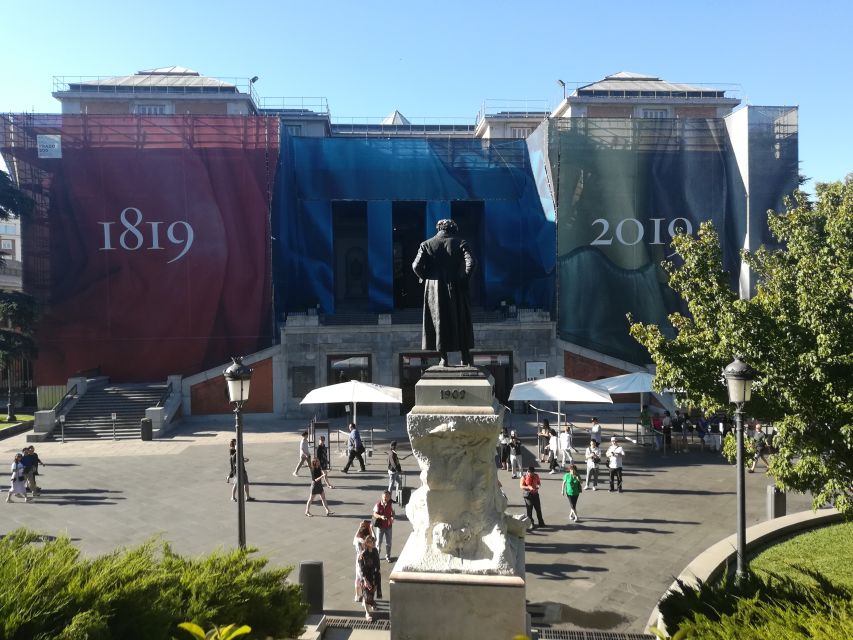
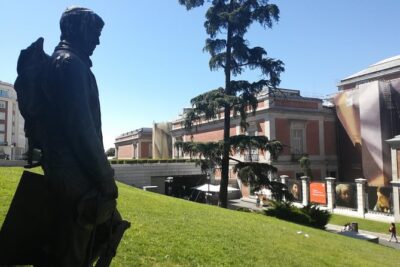
Your visit begins outside the Prado, at the Monument to Goya in front of the museum ticket office. This is a useful meeting point, but look carefully for the guide’s sign, which reads The guides you need. The Prado has several entrances and a broad frontage, so arriving with a few extra minutes to spare is sensible.
There is no hotel pickup. You make your own way to the museum, then enter with the guide after the group is assembled. Comfortable shoes matter because the visit involves substantial walking and standing, and the museum itself can be tiring even before you add Madrid’s warm weather or a full day of sightseeing.
The tour runs in most weather because the main activity is indoors. The exception is a museum closure. Bring only what you need, since food and water are not included and photography is forbidden inside under Prado policy.
More Prado Museum tickets:
- Madrid: Prado Museum Entry Ticket
★ 4.6 · 17,509 reviews - Madrid: Small Group of Prado Museum Tour & Optional Tapas
★ 4.6 · 2,437 reviews - Madrid: Prado Museum Guided Tour with Skip-the-Line Ticket
★ 4.5 · 2,018 reviews
Entering the Prado with a clear plan
The Prado can feel confusing on a first visit. Its collection covers centuries of European painting, and its rooms are spread across multiple floors. A guide gives you a practical route, helping you spend your limited time on works that explain both the collection and the development of European art.
The standard approach is chronological. You might begin with earlier religious painting, move through the Renaissance, follow the Venetian school, then reach the Spanish masters of the Baroque and later periods. The route can shift because of the museum’s size, crowd levels, room access, or your own interests.
That structure is valuable. You do not simply receive a list of famous names. You get a sense of how artists borrowed from one another, how religious and royal commissions shaped painting, and how ideas about color, realism, drama, and human emotion changed over time.
If you already have a must-see painting in mind, send that request in advance. The tour is designed to allow customization, although you should not expect to cover every favorite work in a single session.
Bosch, Van der Weyden, and the early rooms
The earlier paintings offer a good reminder that the Prado is not only a museum of Spanish art. Works by Hieronymus Bosch and Rogier van der Weyden introduce the symbolic, highly detailed world of Northern European painting.
Bosch is often a highlight because his strange figures and crowded scenes reward explanation. A guide can help you read the symbols and understand why a painting that first looks like a wild fantasy may carry serious religious or moral ideas.
Van der Weyden gives you a different experience. The emotional force of his figures and the careful handling of faces, gestures, and textiles show how Northern artists pursued detail and feeling. These rooms may not be as immediately familiar as the Spanish galleries, but they help set up the larger story.
The guide may also include Albrecht Dürer, whose work connects Northern precision with Renaissance interest in proportion, nature, and individual identity. These early stops are particularly useful if you have little background in art. You learn how to look before arriving at the blockbuster paintings.
Raphael, Titian, and the Venetian school
The Renaissance and Venetian rooms shift the mood. Raphael represents balance, order, and graceful human figures, while Titian and other Venetian painters bring a stronger interest in color, atmosphere, flesh, and rich surfaces.
A good guide will not make you memorize dates. Instead, you may be asked to compare what you see. Look at the way a figure is placed, how light falls across fabric, and how color creates depth. These small observations make the museum less intimidating.
Titian, Tintoretto, and related painters also show how artists could use loose brushwork and dramatic compositions to pull you into a scene. Their work helps explain why later painters, including Velázquez, found the Venetian tradition so useful.
This part of the tour suits you if you want more than a march toward the famous Spanish rooms. It gives the Prado a wider European frame and makes the later masterpieces easier to understand.
A few more Madrid ideas to compare
- Madrid: Tour Bernabéu Entry Ticket
★ 4.5 · 21,573 reviews - Madrid: Royal Palace Fast-Access Admission Ticket
★ 4.6 · 13,856 reviews - Madrid: “Emociones” Live Flamenco Performance
★ 4.8 · 12,866 reviews - Madrid: Panoramic Route City Tour
★ 4.1 · 12,259 reviews
Velázquez and the royal court
Velázquez is one of the central reasons to visit the Prado, and the tour gives him the attention he deserves. His paintings reward a slow look, but a guide can point out details you might miss when facing a large canvas in a crowded room.
The discussion often centers on the relationship between artist, subject, viewer, and royal power. Velázquez was not simply recording people at court. He was playing with viewpoint, status, reflection, and the act of painting itself.
Las Meninas is the obvious draw, but the value of a guided visit is that the painting does not have to carry the entire experience. Other works help show Velázquez’s control of expression, fabric, gesture, and atmosphere.
This is also where pacing matters. The room can be busy, and you may not get a silent, uninterrupted view. A strong guide knows how to position a group, speak clearly, and keep the explanation moving without turning the painting into a lecture.
Several guides receive particularly warm praise for this balance. Macarena is repeatedly described as funny, lively, and strong at connecting art to modern ideas. Maria is praised for historical context and for keeping groups focused in busy rooms. Alex is often singled out for detailed explanations and an engaging manner.
El Greco, Murillo, and the Spanish tradition
El Greco’s work offers a sharp change from the calm balance of the Renaissance. His elongated figures, intense colors, and spiritual tension can seem unusual at first. With context, you can see how his style served religious drama rather than simple naturalism.
Murillo brings another tone, with paintings known for warmth, humanity, and emotional appeal. The guide can help connect these works to the religious and social world that shaped Spanish painting.
The strength of this portion is comparison. You see that Spanish art was not one fixed style. It absorbed ideas from Italy and Northern Europe, then reshaped them through local religious, political, and cultural needs.
For families and first-time art museum visitors, this kind of explanation can make a real difference. One parent traveling with children aged nine and eleven praised the guide’s ability to keep both young visitors engaged. That does not mean every child will enjoy every room, but the storytelling approach gives families a better chance than a silent walk with an audio guide.
Rubens and the drama of the Baroque
Rubens brings movement, scale, and theatrical energy. His paintings can be physically large and visually crowded, with bodies, fabric, color, and action pulling your eye in several directions at once.
A guide helps you sort out that visual drama. You may look at composition first, then movement, then the painter’s use of color and gesture. The goal is not to admire the work simply because it is grand. It is to understand how the grand effect was built.
Rubens also helps bridge the gap between the Italian and Spanish traditions. His work shows the international nature of royal collections and the way painters, patrons, and court culture crossed national borders.
You may find this section especially rewarding if you normally feel unsure about Baroque art. The guide’s explanation gives you a few simple tools for reading movement and theatrical lighting without requiring an art history degree.
Goya’s difficult, powerful final chapter
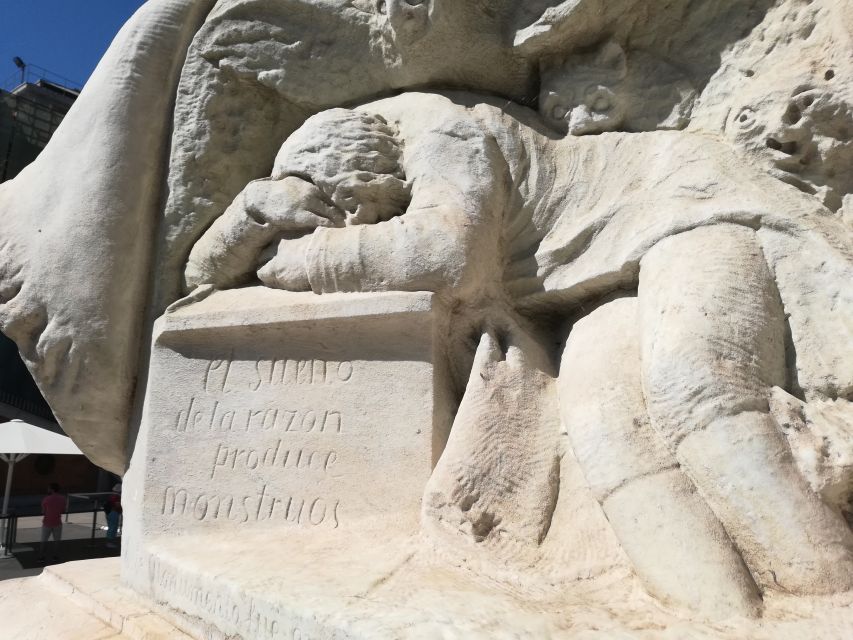
Ending with Goya can be a strong choice. His work carries political fear, war, superstition, suffering, satire, and private emotion. The change from court portraiture to darker, more unsettling images gives the tour a serious final note.
One guide ended with Goya’s works, and the visitors found the experience deeply moving. That response makes sense. Goya’s paintings often ask harder questions than the polished royal portraits seen earlier in the museum.
A good explanation can also show Goya as more than a painter of famous dark images. His work reflects shifts in Spanish society and the changing role of the artist. You may leave with a clearer idea of how painting can record public events while also expressing personal anxiety and moral judgment.
If you prefer a lighter museum visit, this ending may feel intense. If you want art that stays with you after you leave, it can be one of the strongest parts of the route.
How much can you see in 90 minutes?
The advertised duration is about 1.5 to 2 hours, with the guided visit itself listed at roughly 1.5 hours. That is enough for a well-chosen introduction, not a complete Prado tour.
The guide selects important works rather than attempting every room. This is the right strategy. Rushing through dozens of paintings would leave you with names but little understanding.
Some visitors use the tour as an orientation, then stay inside to explore independently. The included admission allows you to remain in the museum until it closes, although you cannot leave and return. If you want extra time, an earlier starting time is useful. One person specifically noted that an earlier visit would have allowed more time afterward.
Crowds affect the experience. Popular works can be surrounded, and your group may need to shift position or wait for a clear view. Several guides, including Stephi, Natalia, Clara, and Maria, are praised for moving groups through crowded rooms while keeping the explanation easy to follow.
Group size, languages, and access
This experience can be private or arranged for a small group. Group size matters at the Prado. A group of six or seven is easier to hear, easier to place in front of a painting, and more likely to allow questions.
A private format may suit you if you have a very specific list of artists or want a slower pace. A small group is likely the better value for many people, since you still get personal attention without paying the full cost of a private guide.
Tours are offered in English, Spanish, Italian, and French. The English delivery receives repeated praise, including from visitors who appreciated clear speech, humor, and detailed historical explanations.
Wheelchair access is available. Still, the practical comfort of the visit depends on your own walking needs, the museum’s crowds, and how long you can comfortably stand in front of paintings. Ask the provider about current arrangements if you need specific assistance.
Is $49 a fair price?
At $49 per person, the tour costs more than entering a museum alone, but the comparison is not quite fair. You are paying for admission, a certified official guide, a planned route, and the chance to ask questions in real time.
I consider the price fair if the Prado is a major priority for you or if art museums often feel hard to approach. The guide can help you avoid spending an hour on rooms that do not match your interests, then missing the artists you came to see.
The value is even better in a small group. Several people described groups of six or seven, and one pair had what felt like a private visit because they were the only participants. That kind of attention can make the fee feel reasonable.
The value is weaker if you already know the Prado well, prefer wandering alone, or plan to spend many hours studying a narrow group of paintings. In that case, admission alone and a museum plan may suit you better.
Practical tips for a better visit
- Wear comfortable shoes and clothing. The tour involves museum walking and standing.
- Arrive early at the Goya statue, especially if you are unfamiliar with the Prado’s entrances.
- Look for the sign reading The guides you need.
- Send a request ahead of time if you have a particular work or artist you want to see.
- Choose an earlier tour if you want a long period afterward for independent exploring.
- Do not plan on taking photographs. The museum does not allow photography inside.
- Bring water for before or after the visit, since food and drinks are not included.
- Ask questions. The flexible format works best when you tell the guide what interests you.
- If you are visiting with children, let the guide know. The storytelling style has worked well for younger visitors, according to the experiences shared.
Should you book this Prado tour?
Book it if you want a smart introduction to the Prado without trying to conquer the entire museum in one exhausting sweep. It is particularly well suited to first-time visitors, families, people who want historical context, and anyone who has ever looked at a famous painting and wondered what they were supposed to notice.
I would also choose it if Velázquez and Goya are high on your Madrid list. The chronological structure, flexible focus, and strong guide feedback give you a useful way into the collection.
Skip it if you strongly prefer independent museum visits or need a full day with one artist. The tour is selective, and crowded rooms can limit the time you spend face to face with a painting.
For most people, $49 is a sound investment in making sense of the Prado. You get the ticket, a route through the major schools, and a guide who can turn a huge collection into a story you can continue on your own.
FAQ
Where does the Prado guided tour meet?
The meeting point is at the Monument to Goya, directly in front of the Prado Museum’s ticket office. The guide carries a sign reading The guides you need.
How long does the tour last?
The experience lasts about 1.5 to 2 hours. The guided museum visit is listed as approximately 1.5 hours.
Is the Prado admission ticket included?
Yes. The Prado Museum ticket and a professional certified official guide are included.
Can I request specific paintings or artists?
Yes. You can send a request for specific works or subjects. The tour can be customized, although a chronological route is generally suggested for easier understanding.
Is photography allowed inside the museum?
No. Photography is not allowed inside the Prado under the museum’s policy.
What languages are available?
The tour is available in English, Spanish, Italian, and French.
Can I stay in the Prado after the tour?
Yes. You can remain inside the museum until it closes after the guided visit. You cannot leave and return once you exit.
Recently listed in Madrid
- Madrid: Don Quixote de la Mancha Windmills & Toledo Tour★ 4.9 · 254 reviews
- Tour Madrid: Secrets in a Electric Tuk Tuk★ 4.6 · 155 reviews
- Madrid: Toledo Day Trip with Winery Visit and Wine Tasting★ 4.4 · 177 reviews
- Madrid: Guided Tour of Toledo with Cathedral Visit★ 4.3 · 399 reviews
- Madrid: 6-Hour Day Trip to Toledo with Guided Walking Tour★ 4.0 · 865 reviews
- Madrid: Tasty Tapas Tour & Visit to a Terrace with Views★ 4.5 · 118 reviews
- Madrid: Flamenco Show&Drink at Tablao 1911 (World’s Oldest)★ 4.7 · 253 reviews
- Madrid: Street Art Tour with Local Graffiti Hunter★ 4.8 · 270 reviews
Prado Museum Tours, compared.
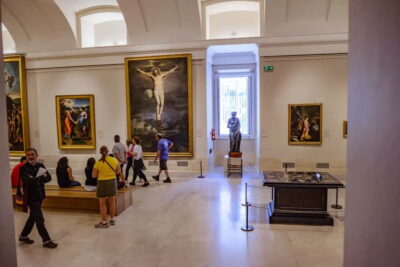

Small Group of Prado Museum Tour & Optional Tapas
Read our review →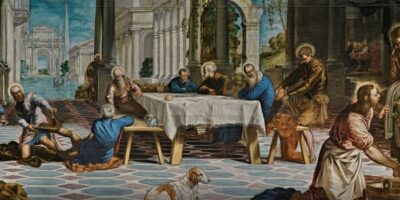
Prado Museum Guided Tour with Skip-the-Line Ticket
Read our review →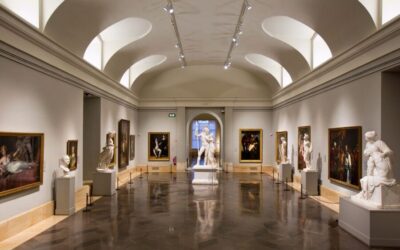
Prado Museum Small Group Tour with Skip the Line Ticket
Read our review →
Royal Palace & Prado Museum Skip the Line Guided Tour
Read our review →

Prado Museum Guided Tour with Skip-the-Line Ticket
Read our review →Browse the lists this tour appears in