

Reviewed · ROYAL PALACE TOURS
Madrid: Royal Palace Guided Tour with Entry Ticket
Royal rooms rarely feel this close. This two-hour visit takes you through Madrid’s Royal Palace with a live guide, from the grand staircase and Hall of Columns to Charles III’s private rooms, the royal dining room, throne room, and armory. I especially like the small groups of up to eight and the chance to skip the ticket line. I also like that luggage storage is included, a useful touch if you have a large suitcase. The main drawback is that the palace can be busy, and one person found it difficult to hear the guide without headphones.
Guides Jesús and David receive especially warm praise for making the tour lively rather than stiff. Jesús is often described as funny, clear, and good at answering questions, while David brings plenty of enthusiasm and historical gossip. The tour costs $38 per person, which is fair if you want context and a smoother entrance, though independent visitors may prefer to save money and explore at their own pace.
In This Review
- Key things to know before you book
- Starting at Plaza de Oriente
- Entering through the main staircase
- Alabarderos Hall and the Hall of Columns
- Charles III’s private rooms and Gasparini’s decoration
- The royal dining room still used today
- Silver, porcelain, and the prince’s courtyard
- The final royal collections
- Is $38 a good value?
- Timing, bags, and mobility
- Who will enjoy this palace tour?
- Should you book the Royal Palace guided tour?
- FAQ
- Where does the tour start?
- Where does the activity end?
- How long does the tour last?
- Is palace admission included?
- Does the tour skip the ticket line?
- What languages are available?
- Can I bring a large suitcase or backpack?
- Is the tour wheelchair accessible?
- What is included besides admission?
- Can I cancel the booking?
Key things to know before you book

- The tour begins at Calle de la Independencia 2: Check in at the Segway Madrid store, not directly at the palace.
- The Royal Palace visit lasts about two hours: You also pass through Plaza de Ópera and stop at Plaza de Oriente before entering.
- You see the palace’s headline rooms: Expect Charles III’s chambers, Gasparini’s room, the royal dining room, Hall of Columns, throne room, and royal armory.
- Small groups make a real difference: The maximum group size is eight, so questions are easier and the guide can keep the pace under control.
- Large bags are a problem: Suitcases and large backpacks are not allowed inside, but free luggage storage is offered to tour clients.
- English and Spanish tours are available: The experience is wheelchair accessible, and cancellation is free up to 24 hours before the start time.
Starting at Plaza de Oriente
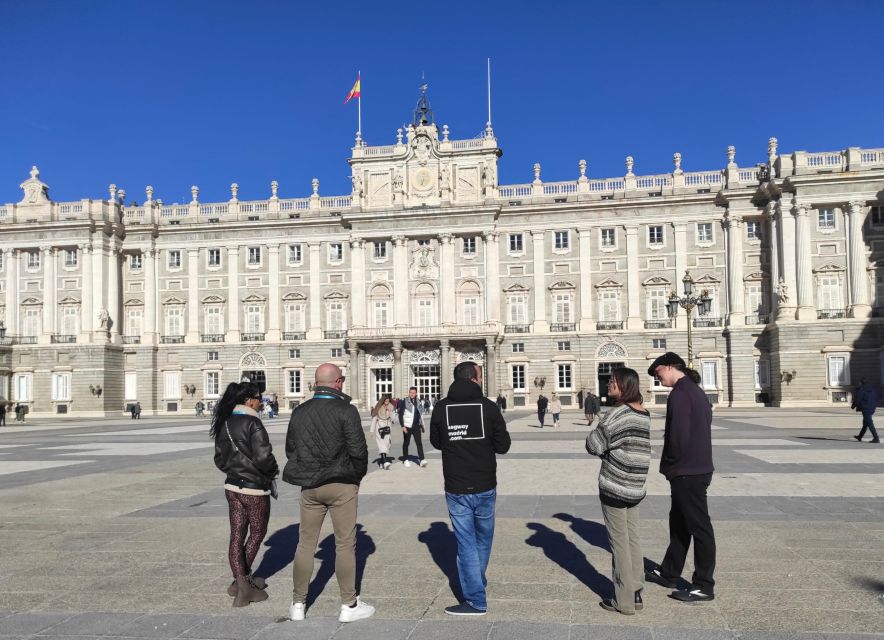
Your meeting point is the Segway Madrid shop at Calle de la Independencia 2. Despite the shop’s name, this experience is a walking tour, not a Segway ride. It is worth arriving ready to walk and carrying only a small bag.
The route includes a short pass by Plaza de Ópera, followed by a 15-minute sightseeing and photo stop at Plaza de Oriente. This gives you a useful first look at the setting before the palace visit begins.
Plaza de Oriente is one of the better places to frame the palace in your mind. From here, you can appreciate how the building relates to the city around it. The route then continues toward the Plaza de la Armería, the large ceremonial square in front of the palace entrance.
Before going inside, you get views toward Almudena Cathedral, Campo del Moro Gardens, and Casa de Campo. These views add value because the palace can feel almost too large to understand from a single interior room. The guide’s introduction to the Spanish monarchy also gives the building a basic timeline before you begin moving through its apartments and ceremonial halls.
More Royal Palace tickets:
- Madrid: Royal Palace Fast-Access Admission Ticket
★ 4.6 · 13,856 reviews - Madrid: Royal Palace Expert Guided Tour with Skip-the-Line
★ 4.7 · 6,986 reviews - Madrid Essential: Historic Center, Plaza Mayor & Royal Palace
★ 5.0 · 6,416 reviews
Entering through the main staircase
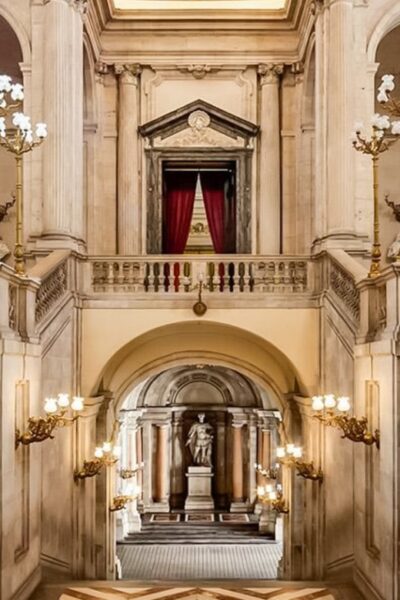
The interior begins with the entrance hall and main staircase, an appropriately grand opening. The scale is immediate. You are not easing into a small historic house, but entering a royal building designed to make power visible.
The staircase leads toward several former leisure and banqueting areas. Paintings, tapestries, and decorated ceilings fill your view, and this is where a guide earns the admission price. Without background, it is easy to admire the decoration, take a few photographs, and move on. With an explanation, you get a better sense of how these rooms functioned and why they were arranged in such a formal sequence.
The guide-led format also keeps you moving at a useful pace. You have time to look, but the visit does not become a slow march through every corner of the palace. Several people particularly appreciated that the guides did not rush the rooms.
The main staircase and entrance spaces are among the busiest parts of the visit. Stay close to your guide and listen carefully during transitions. The group limit of eight helps, although the guide may still be speaking over other groups nearby.
Alabarderos Hall and the Hall of Columns

The tour continues through Alabarderos Hall and the Hall of Columns, two of the palace’s major ceremonial spaces. These rooms help explain the difference between a royal residence and an ordinary museum.
The Hall of Columns is especially important because of its size and formal design. The name points to the room’s strong architectural character, but the guide’s explanation gives it purpose beyond decoration. This was a place built for ceremony, public occasions, and the display of royal authority.
I like this part of the route because it balances the private rooms that come later. You see both sides of monarchy: enormous spaces for formal events and more personal rooms designed for daily royal life.
The tour is conducted in English or Spanish. English-speaking guides such as Jesús and David are praised for clear speech, humor, and a friendly manner. Still, the palace is not always quiet. If you have hearing difficulty, position yourself close to the guide and ask for clarification when needed. Headphones are not listed as part of the package.
Charles III’s private rooms and Gasparini’s decoration
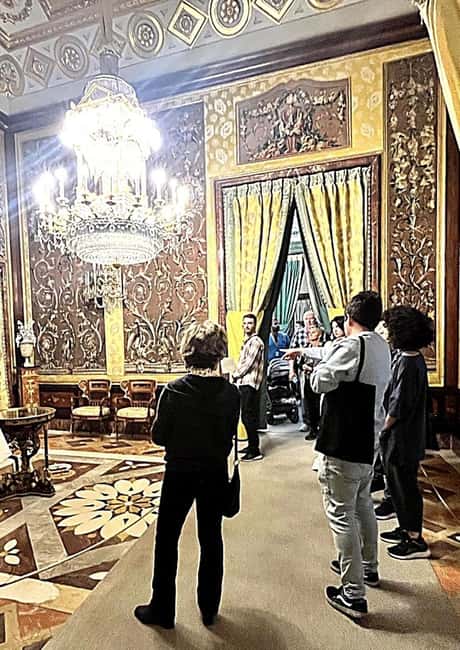
The route then moves into the private rooms associated with Charles III. This change in scale and mood is one of the most interesting parts of the visit.
You stop at the king’s dressing room and Gasparini’s room, which uses chinoiserie with rococo influences. The decoration is highly detailed, with a very different feel from the more imposing ceremonial halls. Look closely at the surfaces and patterns here. The appeal is in the workmanship and the contrast between the rooms.
Charles III’s main room follows, giving you a better idea of how the monarch’s private spaces fit within the larger palace. These chambers can be more rewarding than the famous throne room because they reveal the tastes and routines of the people who lived in the building.
This is also where the guide’s storytelling matters. The best guides connect the furnishings with the people who used them. Jesús is praised for making the information interactive and entertaining, while David is often appreciated for adding unusual details and a little royal gossip without losing the main historical thread.
The small group format works well in these rooms. Eight people can gather around a guide without spreading too far across the space, and you have a better chance of asking about a particular object or decoration.
A few more Madrid ideas to compare
- Madrid: Tour Bernabéu Entry Ticket
★ 4.5 · 21,573 reviews - Madrid: Prado Museum Entry Ticket
★ 4.6 · 17,509 reviews - Madrid: “Emociones” Live Flamenco Performance
★ 4.8 · 12,866 reviews - Madrid: Panoramic Route City Tour
★ 4.1 · 12,259 reviews
The royal dining room still used today

One of the tour’s most memorable stops is the massive royal dining room. Unlike many rooms that belong only to the past, this space is still used for special events.
The dining room is made up of three connected rooms, giving it an impressive length and ceremonial scale. Seeing it as a functioning event space helps you understand why royal banquets required so much room and planning.
I find this more interesting than a simple display of furniture because the room has a present-day role. It is not just preserved behind a rope. Special occasions still take place here, so the palace remains connected to official life.
The dining room can also be a good point to pause and ask questions. A guide can explain how the palace shifts between a public monument and a working royal venue. The experience does not promise access to every room at all times, so the exact route may depend on palace operations and capacity.
Silver, porcelain, and the prince’s courtyard
After the dining room, you pass through the silver and porcelain rooms. These collections show the practical side of royal life, from formal table settings to the objects used for large-scale entertaining.
The displays may not have the instant drama of the staircase or throne room, but they reward a closer look. Plates, cups, silverware, and ceremonial pieces help put the dining room into context. They show how much equipment was needed to serve a royal household and its official guests.
Next comes the prince’s courtyard. The route then includes the reliquary and the palace chapel, guarded at the entrance by figures connected with the Catholic monarchs.
This section shifts attention from royal ceremony to religion and dynastic identity. The chapel is not simply another decorated room. It shows how faith, monarchy, and public representation were linked within the palace.
The transition between rooms is part of the pleasure here. You are not looking at one repeated style for two straight hours. The palace moves between grand halls, private chambers, service-related collections, religious space, and military displays.
The final royal collections
The last chambers contain some of the most recognizable objects on the route. You see Stradivarius violins, the crown room, the scepter, the table of sphinxes, and the throne room.
The Stradivarius collection is a highlight for anyone interested in music or craftsmanship. These instruments add a personal and cultural dimension to the palace. They also break up the parade of furniture and architecture with objects made for sound and performance.
The crown room presents the symbols of monarchy more directly. The scepter and table of sphinxes are reminders that royal power was expressed through objects as much as through ceremonies.
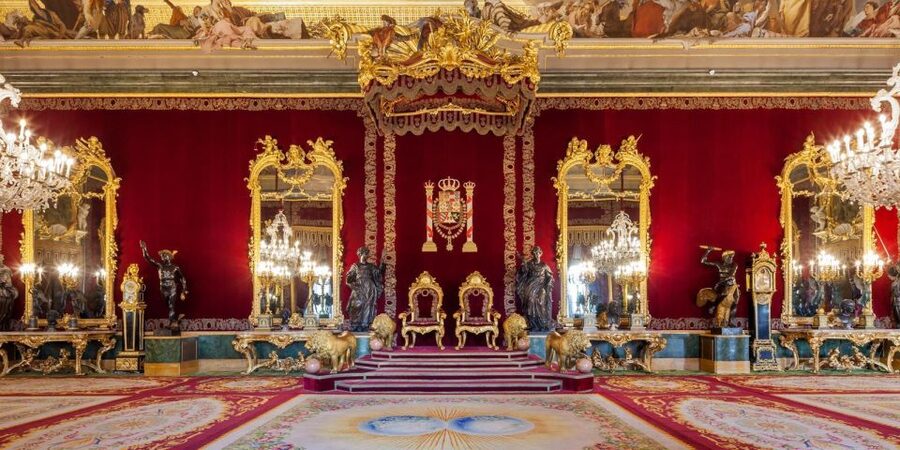
The throne room is the grand finale for many people. Its 12 mirrors and armchairs are guarded by Velázquez’s lions, creating one of the palace’s most formal scenes. The room is designed to impress from every angle, and the guide can help you notice details that might otherwise blur together.
The royal armory is also included in the route. It adds a strong contrast to the soft fabrics, porcelain, and decorative interiors. Armor and weapons bring the military side of monarchy into view and make the final section feel more varied.
One important practical point: the tour ends back at the original meeting point, but you should expect to spend the main portion inside the palace. The listed palace stop lasts two hours, while the full route includes the short stops before and after it.
Is $38 a good value?
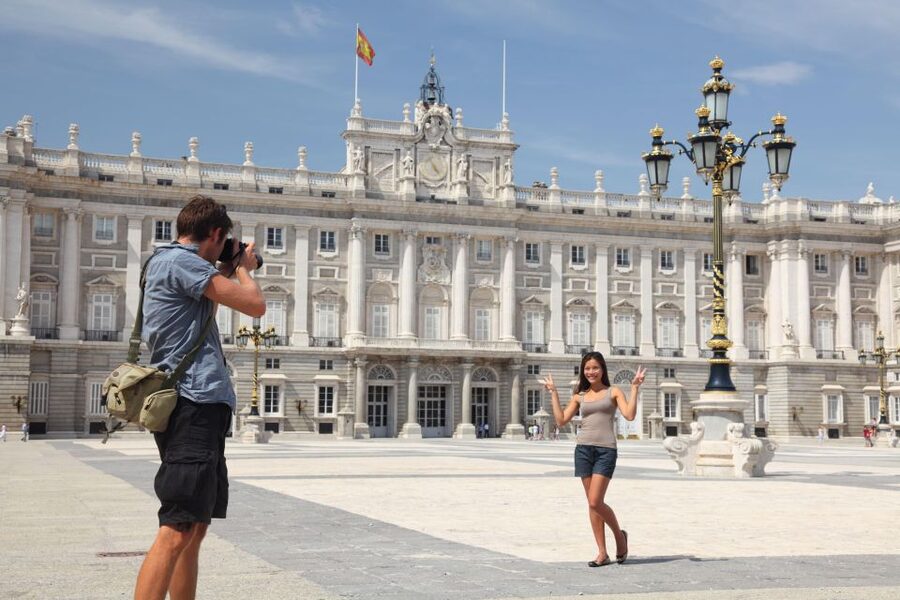
At $38 per person, the price is reasonable for a guided visit that includes palace admission, a small group, and skip-the-line entry. The value is strongest if you want the rooms explained rather than simply photographed.
The skip-the-line feature matters most during busy periods. One person described seeing a large line outside while the guided group entered with its ticket. That can save time, especially if you have only a short stay in Madrid.
The price also becomes more attractive when you consider the guide. A strong guide turns a long sequence of rooms into a story about Spanish kings, ceremony, religion, art, and daily life. Jesús, David, Natalie, and Louis are all praised for clear explanations and a warm manner. One person even ended up with a private tour after a schedule change, though you should not book expecting that outcome.
Families may find the cost easier to justify because one booking included three children under 18 at no charge. The supplied tour information does not promise free admission for every child or every booking, so check the exact price shown for your dates before paying.
An independent palace visit may cost less, but you would give up the guide’s route planning and explanations. I would choose this tour if the difference between entering quickly and waiting in line matters to you.
Timing, bags, and mobility
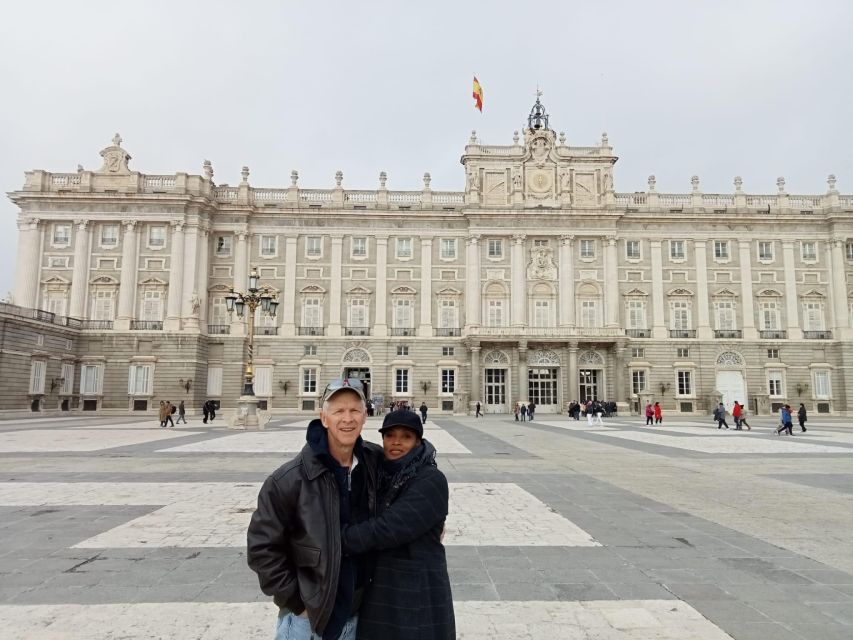
The activity lasts two hours, with start times that vary by date. Check availability before planning the rest of your day. The palace tour itself is the main event, and the Plaza de Oriente stop comes before entry.
Large suitcases and backpacks are not allowed inside. The operator offers free luggage storage for tour clients, which is particularly helpful if you are checking out of a hotel or arriving before check-in. You should still avoid bringing more than necessary.
The activity is listed as wheelchair accessible. One guide received specific praise for taking care with a wheelchair during the visit. Accessibility can depend on the palace’s operating conditions and the exact route on the day, so mention your needs when booking or checking in.
Free cancellation is available up to 24 hours in advance, and you can reserve now and pay later. Those policies are useful if your Madrid schedule is still shifting, but they do not remove the need to check your meeting time carefully.
Who will enjoy this palace tour?
I would recommend it most strongly to first-time visitors to Madrid, families, and anyone who wants a clear introduction to Spanish royal life. The palace is large enough that a guide helps you focus on the rooms with the most meaning.
It is also a good fit if you dislike waiting in admission lines or prefer a compact group instead of a large walking tour. The eight-person limit lets you ask questions and remain connected to the guide.
History fans should enjoy the range of subjects, from Charles III’s private chambers to the monarchy’s religious and military symbols. Art lovers will find plenty in the paintings, tapestries, ceilings, furniture, porcelain, instruments, and royal collections.
I would think twice if you prefer silent, independent visits. You will follow the guide’s route and timing, and the palace may feel crowded around popular rooms. If you want to linger over one object for 20 minutes, a self-guided visit may suit you better.
Should you book the Royal Palace guided tour?
Book it if you want to see the major rooms efficiently, avoid the main ticket line, and hear the palace explained by a lively English or Spanish guide. At $38, the combination of entry, a small group, luggage storage, and two hours of guiding is solid value.
I would choose an early available start time if possible, bring a small bag, and arrive at the Calle de la Independencia meeting point with enough time to check in. If Jesús or David is leading your tour, expect a friendly, story-driven visit. If another guide leads it, the overall route still gives you a strong look at Madrid’s grandest royal interiors.
FAQ
Where does the tour start?
Check in at the Segway Madrid store at Calle de la Independencia 2.
Where does the activity end?
The tour ends back at the Segway Madrid meeting point.
How long does the tour last?
The activity lasts two hours. Check availability for the specific starting times on your chosen date.
Is palace admission included?
Yes. The Royal Palace entry ticket is included in the price.
Does the tour skip the ticket line?
Yes. Skip-the-ticket-line entry is included.
What languages are available?
The live guide is available in English and Spanish.
Can I bring a large suitcase or backpack?
No. Large suitcases and backpacks are not allowed inside the palace. Free luggage storage is offered for tour clients.
Is the tour wheelchair accessible?
Yes, the activity is listed as wheelchair accessible. One guide was also specifically praised for assisting a group with a wheelchair.
What is included besides admission?
A live tour guide and luggage storage service are included. Food and drinks are not included.
Can I cancel the booking?
Yes. You can cancel up to 24 hours in advance for a full refund. You can also reserve now and pay later.
Recently listed in Madrid
- Madrid: Don Quixote de la Mancha Windmills & Toledo Tour★ 4.9 · 254 reviews
- Tour Madrid: Secrets in a Electric Tuk Tuk★ 4.6 · 155 reviews
- Madrid: Toledo Day Trip with Winery Visit and Wine Tasting★ 4.4 · 177 reviews
- Madrid: Guided Tour of Toledo with Cathedral Visit★ 4.3 · 399 reviews
- Madrid: 6-Hour Day Trip to Toledo with Guided Walking Tour★ 4.0 · 865 reviews
- Madrid: Tasty Tapas Tour & Visit to a Terrace with Views★ 4.5 · 118 reviews
- Madrid: Flamenco Show&Drink at Tablao 1911 (World’s Oldest)★ 4.7 · 253 reviews
- Madrid: Street Art Tour with Local Graffiti Hunter★ 4.8 · 270 reviews
Royal Palace Tours, compared.

Royal Palace Expert Guided Tour with Skip-the-Line
Read our review →
Madrid Essential: Historic Center, Plaza Mayor & Royal Palace
Read our review →

Madrid Old Town & Royal Palace Walking Tour Skip the Line Ticket
Read our review →
Royal Palace Guided Tour with Skip the Line Ticket
Read our review →
Royal Palace & Prado Museum Skip the Line Guided Tour
Read our review →Browse the lists this tour appears in