
Reviewed · MUSEUMS
Picasso Small Group Walking Tour with Museum Skip the Line Ticket
Picasso makes old Barcelona feel newly legible. I like the way this small-group walk links real city streets to the artist’s early years, and I like that the Picasso Museum visit comes with skip-the-line entry. The main drawback is pace: two hours is enough for an introduction, but not enough for a leisurely look at every museum room.
The tour costs $48.06 per person and is limited to 10 people, a useful size for asking questions and keeping together in the old city. Guides such as Alex, Sylvia, Pilar, Danielle, Iris, and Alli have been praised for making the art clear and personal. One practical caution: English is offered, but at least one booking went wrong with a French guide, so confirm your language before setting out.
In This Review
- Key points to know before you book
- Why Picasso’s Barcelona is worth seeing on foot
- Starting at Plaça de Catalunya
- El Quatre Gats and the young artist’s circle
- Llotja Mar and Picasso’s artistic training
- The Frisos del Col·legi d’Arquitectes
- Through La Ribera toward the museum
- Entering Museu Picasso with skip-the-line admission
- What the two-hour timing really means
- Is $48.06 good value?
- Who will enjoy this experience most?
- How to prepare for a better visit
- Should you book the Picasso walking tour?
- FAQ
- How long does the Picasso walking tour last?
- What is included in the price?
- Is skip-the-line museum entry included?
- Where does the tour begin?
- Where does the tour end?
- Is the tour offered in English?
- How many people can join the group?
- Can I cancel for a full refund?
Key points to know before you book
- Picasso’s Barcelona runs from 1895 to 1905: You follow the places connected with his education, friendships, work, and early artistic development.
- The walk ends at Museu Picasso: This gives the tour a clear finish and puts the paintings into context before you explore more on your own.
- El Quatre Gats is a key stop: The café was a meeting place for Barcelona’s creative crowd and helps explain the artistic world Picasso entered.
- The group has a maximum of 10 people: That is small enough for conversation, though the exact feel depends on the guide and the group.
- The price includes the museum ticket and guide: You do not need to buy a separate Picasso Museum admission ticket.
- Book ahead if your dates are fixed: The tour is booked an average of 32 days in advance, suggesting that popular times can fill early.
Why Picasso’s Barcelona is worth seeing on foot
Picasso lived in Barcelona during important periods between 1895 and 1905. He arrived as a young artist, studied, painted, made friends, and absorbed the city’s creative energy before moving on to the wider European art scene.
That period matters because this is not simply a tour about a famous painter’s greatest hits. It is about the young Picasso learning how to look. Barcelona gives you the setting: old lanes, cafés, art schools, studios, friends, and the cultural circles that helped shape his work.
I like this approach for a first visit to the Picasso Museum. The paintings can be difficult to place when you see them without context, especially when the museum focuses heavily on his early years. A guide can point out changes in technique and explain how family, friends, education, and events in Barcelona affected his artistic choices.
The walk also gives you a useful introduction to the Gothic Quarter and La Ribera. You are not simply being led from one museum door to another. You are moving through the parts of the old city associated with Picasso’s daily life and artistic development.
More Museum Tours in Barcelona
- Barcelona: FC Barcelona Museum “Barça Immersive Tour” Ticket
★ 4.4 · 10,944 reviews - Barcelona: Park Güell and Gaudí House Museum Entry Ticket
★ 4.5 · 6,326 reviews - Barcelona: Picasso Museum Skip-the-Line Guided Tour
★ 4.5 · 3,355 reviews
Starting at Plaça de Catalunya
The meeting point is the Oficina d’Atenció Turística at Plaça de Catalunya, 17. This is a central location in Barcelona and a sensible place to begin, but you should allow time to find the office and arrive early.
From there, the route heads toward the older parts of the city. The walk is presented as a history of Picasso’s Barcelona, so the guide’s explanation matters as much as the buildings themselves. Some locations connected with an artist’s life may not look dramatic at first glance. Their value comes from knowing what happened there and why the place mattered.
This is one reason I would choose a guided walk instead of trying to copy the route from a map. You can pass through old streets on your own, but you may not recognize which café, school, or public artwork connects to Picasso. A good guide turns those ordinary-looking corners into part of a story.
The group size of no more than 10 is helpful here. In narrow streets, a huge group can feel awkward and easy to lose. A small group also gives you a better chance to hear the explanation and ask about Picasso’s family, friends, training, or paintings.
El Quatre Gats and the young artist’s circle
One of the most appealing stops is El Quatre Gats, a café associated with Barcelona’s avant-garde artistic community. Picasso socialized there with other creative people, and the café helps you picture the young artist as part of a network rather than as an isolated genius.
This detail adds personality to the tour. You are not only hearing dates and movements. You are learning about the people and places around Picasso during his formative years.
The café is also a reminder that artists develop through conversation and contact. Picasso’s Barcelona was filled with new ideas, arguments, friendships, and influences. The guide uses these settings to explain how the city affected him before his later fame.
Do not expect a long café stop with food included. Food and drinks are not part of the tour. El Quatre Gats is a historical point along the walk, not a meal break.
Llotja Mar and Picasso’s artistic training
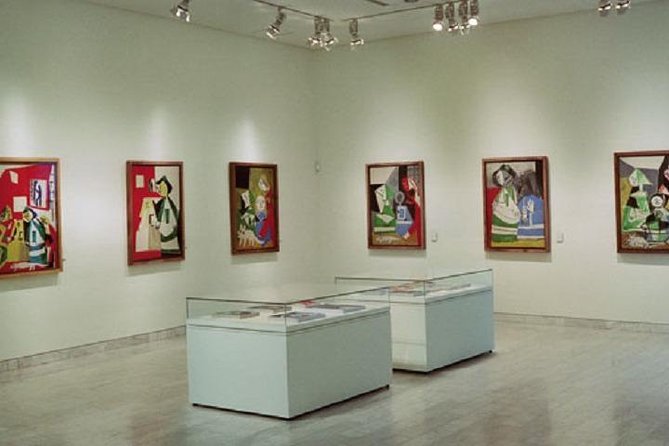
The route continues to Llotja Mar, the art school where Picasso studied. This is an important stop because it deals with his education as a painter, not just his social life.
The tour presents Picasso as a young artist working through formal training and learning the skills that would support his later experiments. That background is useful inside the museum, where you can see his work changing over time.
A guide can help you connect academic practice with the more individual style Picasso later developed. You may not agree with every interpretation, but the explanation gives you a framework for looking at the early works rather than treating them as a random collection of student paintings.
This section may be most rewarding if you enjoy art but do not know much about Picasso’s early life. It also suits people who have seen his famous later work and want to understand how he got there.
More Walking Tours in Barcelona
- Barcelona Tapas and Wine Experience Small-Group Walking Tour
★ 5.0 · 5,804 reviews - Barcelona: Tapas Walking Tour with Food, Wine, and History
★ 4.8 · 4,261 reviews - Barcelona Tapas Walking Tour: Food, Wine & History
★ 4.5 · 1,928 reviews - Barcelona: Tapas Food Crawl Walking Tour with Tastings
★ 4.9 · 1,798 reviews
The Frisos del Col·legi d’Arquitectes
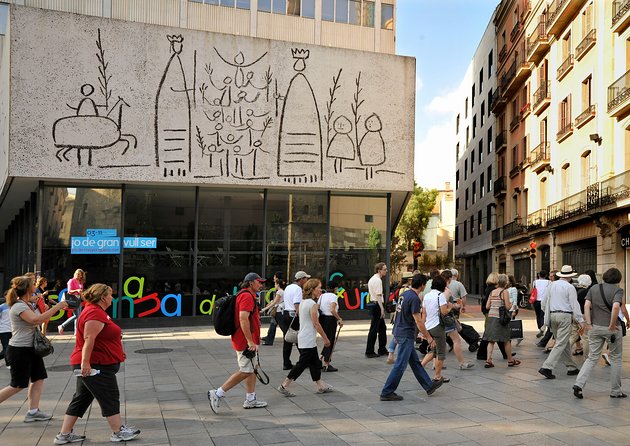
The walk includes the three friezes at the Frisos del Col·legi d’Arquitectes. They are significant because they are described as Picasso’s only open-air works.
That makes this a particularly useful stop for anyone interested in how art interacts with the city. In a museum, a painting is separated from daily life by walls, labels, and careful lighting. These friezes are encountered as part of Barcelona itself.
The stop is also easy to miss without a guide. You might walk past the site without realizing its connection to Picasso. The guide explains what you are looking at and why these works have a special place in his career.
The tour does not turn every stop into a long visit. Expect a walking commentary with pauses at significant places, rather than an extended art lecture at each location. That keeps the route moving, but it means you should ask questions when the guide pauses if you want more detail.
Through La Ribera toward the museum
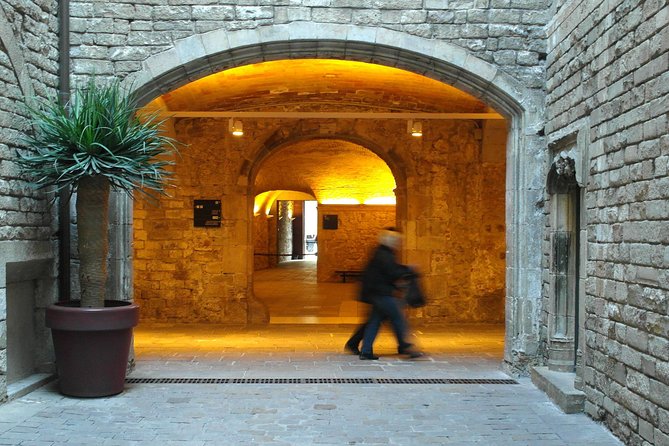
The route continues through La Ribera, one of the old city quarters connected with the final approach to Museu Picasso. This part of the experience works on two levels.
First, you are seeing a historic section of Barcelona on foot. Second, you are following the route toward the museum while the story of Picasso’s early life is still fresh.
I especially like this transition because it prevents the museum from feeling detached from the city. Picasso’s paintings were not created in a vacuum. The streets, schools, cafés, and people around him formed part of the setting, and the walk gives you that setting before you view the collection.
The old quarters require attention to the guide and the route. The group needs to stay together, and the surfaces and streets may not always feel easy for someone who has difficulty walking. Most people can participate, and the tour is near public transportation, but the experience is still a walking tour through historic Barcelona rather than a seated museum visit.
Entering Museu Picasso with skip-the-line admission
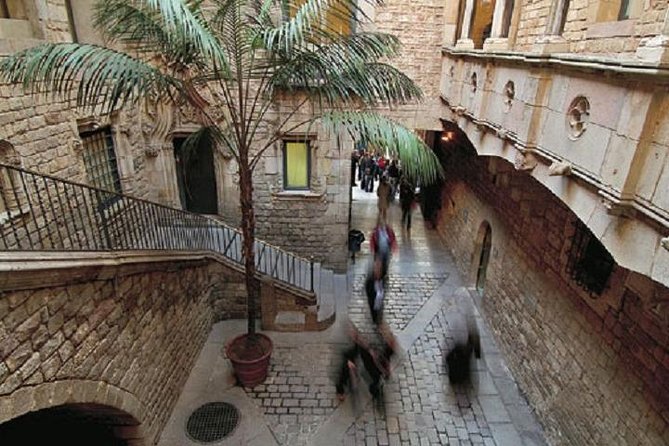
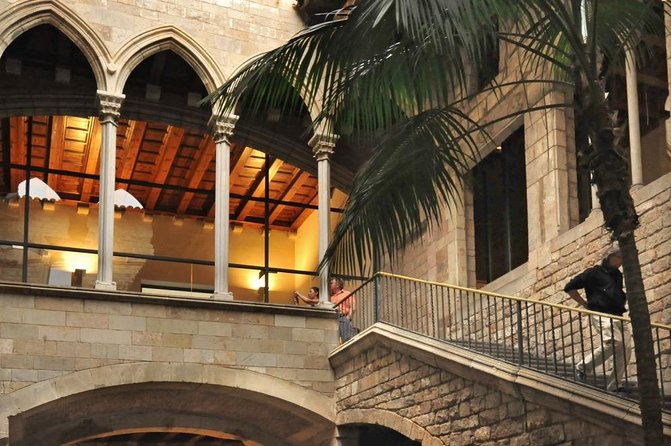
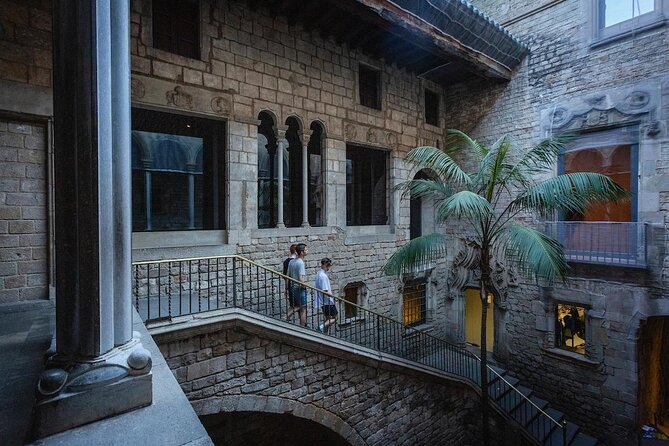
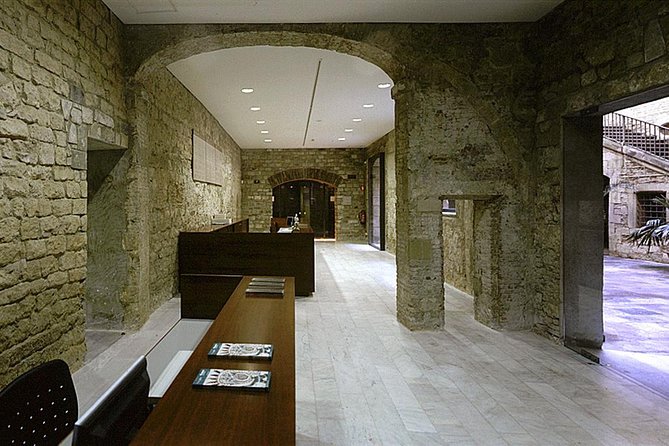
The tour finishes at Museu Picasso on Carrer de Montcada, 23. The museum holds more than 4,000 Picasso works, with a particularly strong focus on his early years.
Skip-the-line admission is a real advantage here. The museum can have long queues, and having the ticket included saves you from arranging a separate visit and then waiting outside. It also gives the tour a clear payoff after the walk.
Inside, the guide points out the main highlights and explains Picasso’s techniques and artistic development. The strongest part of this format is the combination of place and painting: you have just heard about the young Picasso in Barcelona, and then you see works from the period when he was learning and changing.
Several guides have been praised for their passion and ability to explain the art in a way that is easy to follow. Alex is noted for keeping a good pace and inviting questions. Sylvia is praised for her friendly approach and for explaining both the Gothic Quarter and the museum. Danielle is described as giving a thorough museum tour, while Alli has been singled out for strong art-history guidance.
The guide’s quality matters a lot here. A museum with thousands of works can become tiring or confusing, especially if you try to see everything. The guide helps you focus on a manageable selection and understand why certain paintings matter.
You should not expect to inspect all 4,000 works during a two-hour experience. The purpose is to see key pieces and gain a usable framework for exploring the collection afterward.
What the two-hour timing really means
Two hours is a good length for an introduction. It is short enough to fit into a busy Barcelona day and long enough to cover several outdoor sites plus the museum’s main highlights.
The tradeoff is that the schedule may feel brisk if you want extended time at each painting. One experience was made less comfortable by warm conditions inside the museum, so you should be prepared for the museum portion to feel tiring, particularly if the building is crowded or warm.
The best strategy is to treat the guided portion as your orientation. Listen closely to the explanation, note the rooms or works you want to revisit, and then continue exploring after the official tour ends. You are allowed to leave when you are ready, or remain at the museum at your own pace.
The tour ends at the museum rather than returning you to Plaça de Catalunya. That is convenient if you plan to continue in the Gothic Quarter or La Ribera, but you should not expect hotel pickup or drop-off. Food and drinks are also not included.
Is $48.06 good value?
At $48.06, the tour is more than the cost of simply wandering through the old city. You are paying for a guide, a planned route, and admission to Museu Picasso.
The value is strongest if you want help making sense of the artist’s early work. The museum’s collection is large, and the city has many Picasso connections that are easy to overlook. A guide saves research time and gives you a story that links the outdoor stops to the paintings.
The price is less attractive if you prefer complete independence or want to spend several hours inside the museum. In that case, a separate museum visit may give you more time, though you would lose the guided walk and skip-the-line convenience included here.
For a first Barcelona visit, I consider the price reasonable when you value both art and neighborhood history. The tour also works well near the start of your stay because it provides an introduction to the Gothic Quarter and La Ribera, not just Picasso.
Who will enjoy this experience most?
I would recommend this tour to:
- First-time visitors who want a guided introduction to Picasso and the old city
- People who know Picasso’s famous work but want to understand his early development
- Art lovers who prefer explanations to reading every museum label alone
- Visitors who value a small group and the chance to ask questions
- Anyone hoping to avoid the museum queue
- Families or mixed-age groups who want a structured two-hour activity
It may be less suitable if you dislike walking, want a slow museum visit, or need to control the pace closely. The tour is offered in English, but the language issue deserves attention. One booking resulted in a French guide even though the customer expected English. Confirm the language when you book, especially if you cannot follow French.
Service animals are allowed, and most people can participate. The experience is near public transportation, but hotel transfers are not included.
How to prepare for a better visit
Arrive at the Plaça de Catalunya meeting point with time to spare. Bring comfortable shoes and water, since the experience includes an outdoor walk and does not provide food or drinks.
Keep your expectations focused. This is not a full biography of Picasso and not an exhaustive museum tour. It is a carefully shaped introduction to his Barcelona years, followed by selected museum highlights.
If you have a particular interest in Picasso’s family, friends, education, or techniques, ask about it during the walk. Guides such as Alex, Pilar, Iris, and Sylvia have been praised for encouraging questions and making the subject personal rather than dry.
After the tour, consider staying at the museum to look again at the works that caught your attention. The guided portion gives you the basic map. Your extra time lets you follow your own interests.
Should you book the Picasso walking tour?
Book it if you want Picasso’s early Barcelona explained in context, not just a ticket to a museum. The walk adds streets, cafés, schooling, friendships, and public art to the paintings, while skip-the-line admission removes one common nuisance.
I would especially choose it for a first visit, a short stay, or anyone who feels unsure how to approach a large Picasso collection. If you already know the museum well and prefer to spend hours studying every room, go independently instead.
Before paying, verify that your selected departure is in English and remember that the tour begins at Plaça de Catalunya and ends at the museum. With that simple check, $48.06 buys a focused introduction, a small group, and a useful way to see Barcelona through the eyes of its most famous young artist.
FAQ
How long does the Picasso walking tour last?
The experience lasts approximately two hours.
What is included in the price?
The price includes a professional guide and admission to the Picasso Museum.
Is skip-the-line museum entry included?
Yes. The tour includes a Picasso Museum admission ticket with skip-the-line entry.
Where does the tour begin?
The meeting point is the Oficina d’Atenció Turística at Pl. de Catalunya, 17, Barcelona.
Where does the tour end?
The tour ends at Museu Picasso at Carrer de Montcada, 23, Barcelona.
Is the tour offered in English?
English is an offered language. Because one booking had a French guide despite expecting English, confirm your selected language before the tour.
How many people can join the group?
The group has a maximum of 10 travelers.
Can I cancel for a full refund?
Yes. You can cancel at least 24 hours before the experience start time for a full refund. Changes or cancellations made less than 24 hours before the start time are not accepted.
Recently listed in Barcelona
- Transfers From Cruise Port to Barcelona Airport★ 4.5 · 155 reviews
- Bohemian Barcelona Neighborhood Evening Tapas & Wine Tour★ 5.0 · 419 reviews
- Park Guell Guided Tour with Skip the Line Tickets★ 4.0 · 739 reviews
- Barcelona Sunset Cruise with Light Snacks and Open Bar★ 5.0 · 476 reviews
- Montserrat very early : Hiking, Abbey, very small group★ 5.0 · 127 reviews
- Barcelona: Sagrada Familia, Park Guell & Tapas Private Tour★ 5.0 · 903 reviews
- Authentic Flamenco Show Barcelona : Intimate Casa Sors Experience★ 5.0 · 809 reviews
- Barcelona Expert Tour with Local Guide in Eco Tuk Tuk Private★ 5.0 · 216 reviews
Museums, compared.

FC Barcelona Museum “Barça Immersive Tour” Ticket
Read our review →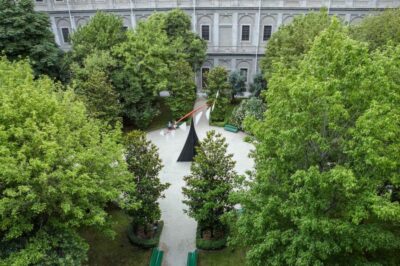
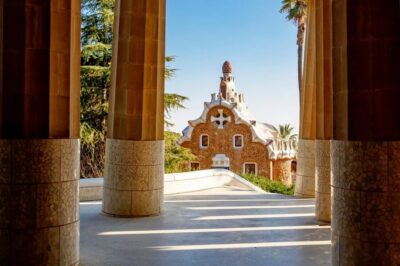
Park Güell and Gaudí House Museum Entry Ticket
Read our review →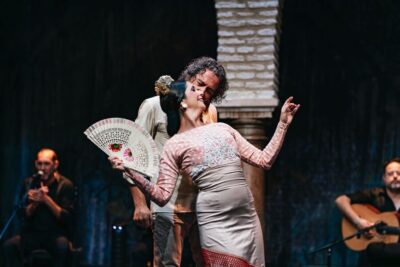
Puro Flamenco Show with Optional Museum Ticket
Read our review →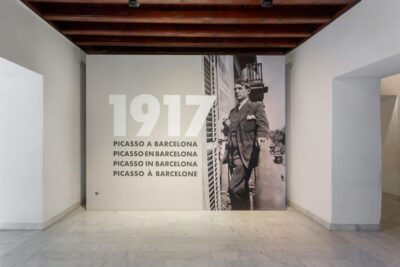
Girona & Dali Museum Small Group Tour with Pick-up from Barcelona
Read our review →
Oceanogràfic, Hemisfèric & Science Museum Combo
Read our review →Browse the lists this tour appears in