
Reviewed · SEVILLE TOURS
Seville: 2-Day Hop-on Hop-off Bus Ticket
Seville opens up from the top deck. This two-day bus ticket is useful for getting your bearings, linking far-flung sights, and seeing the city from a 360-degree view. I especially like the freedom to hop off for lunch or a wander, then continue later, and the two included walking tours add a welcome close-up look at Santa Cruz and Triana. The main drawback is that the recorded commentary can be out of sync, and some buses may lack working WiFi or screens.
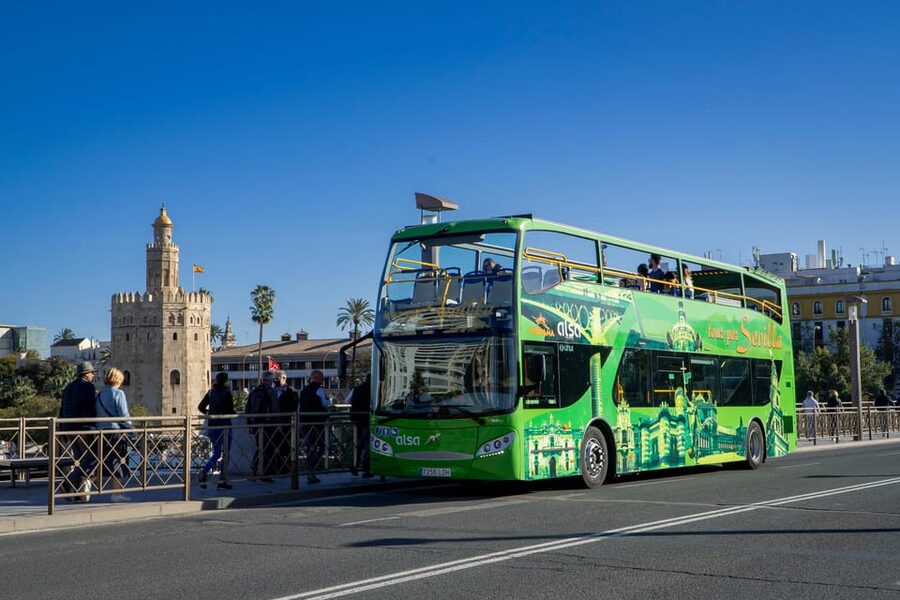
The route begins at the Torre del Oro and runs through 14 stops, with a full circuit lasting about 1 hour and 15 minutes. At $32 per person, it makes the most sense if you use both days, leave the bus several times, and treat it as both transport and a sightseeing ride rather than a single loop.
In This Review
- Key points to know before you board
- Starting at the Torre del Oro
- Acuario de Sevilla and the riverfront
- Plaza de América, Plaza de España, and María Luisa Park
- The University of Seville and Plaza de Cuba
- San Jacinto and the Triana side
- Crossing the Guadalquivir toward the Cartuja
- Isla Mágica and the northern route
- Macarena walls and the city center
- What the audio guide adds, and where it falls short
- Comfort, frequency, and weather
- Is $32 a fair price for two days?
- Who will get the most from this bus ticket?
- Practical tips for using the two days well
- Should you book the Seville bus ticket?
- FAQ
- Where does the Seville hop-on hop-off bus start?
- How long is the complete bus route?
- How long is the ticket valid?
- How many stops does the route have?
- Can I get on and off more than once?
- Are walking tours included?
- What languages are available for the audio guide?
- Is WiFi available on the bus?
- Is the bus accessible for people with reduced mobility?
- Can I cancel the booking?
Key points to know before you board
- Two days change the value: You can spread the route over two consecutive days instead of rushing through Seville in one sitting.
- Fourteen stops cover wide ground: The bus links the river, Plaza de España, Triana, Cartuja, Isla Mágica, Macarena, and the city center.
- The open-top view is the star: You get broad views of Seville’s streets, bridges, monuments, and river crossings without navigating city traffic yourself.
- Two walking tours are included each day: Santa Cruz and Triana give you a chance to explore on foot after seeing the larger picture from the bus.
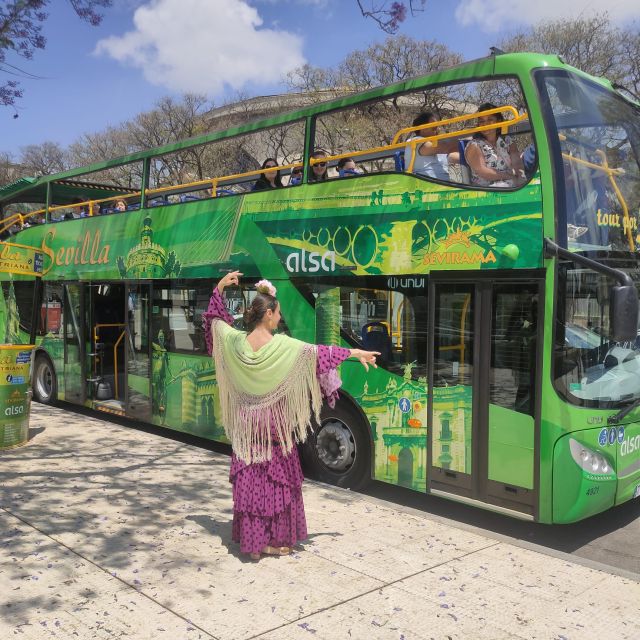
- Buses are designed for comfort: Vehicles have heating and air conditioning, plus headphones and recorded commentary in eight languages.
- Service is reported as frequent: Several recent users found buses arriving about every 15 minutes, though actual waits can vary.
Starting at the Torre del Oro
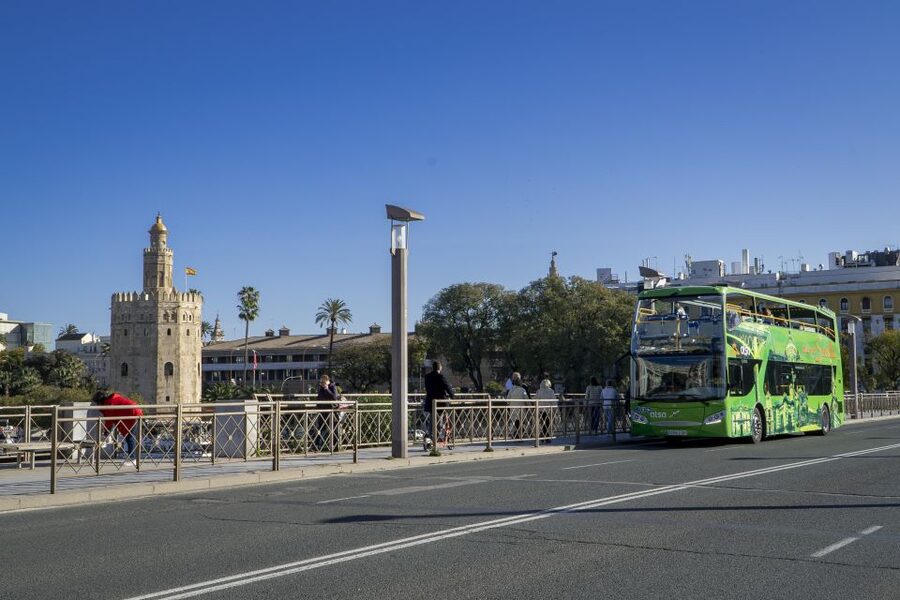
The Torre del Oro is a sensible place to begin. This historic riverside tower gives you an immediate introduction to Seville’s relationship with the Guadalquivir River, and it is a clear meeting point for a first ride.
From here, you can choose to remain on board for the entire circuit or use the ticket as a flexible city shuttle. The complete route takes about 75 minutes, so a full first loop is useful if you want a quick orientation before deciding where to get off.
I would start with that uninterrupted circuit if you are new to Seville. Listen for the stop announcements, note the places you want to revisit, and resist the temptation to hop off at the first attractive sight. The city can look deceptively compact on a map, while the bus helps you see how its districts fit together.
The ticket is valid for two consecutive days from first activation. That matters more than it may seem. You can use one day for the western and southern sights, then return the next day for Triana, Macarena, or the central stops without repeating the whole route on foot.
A few more Seville ideas to compare
- Seville: Royal Alcázar Entry Ticket
★ 4.6 · 28,378 reviews - Seville: Cathedral and La Giralda Entry Ticket
★ 4.5 · 24,592 reviews - Seville: Live Flamenco Dancing Show Ticket at the Theater
★ 4.7 · 16,396 reviews
Acuario de Sevilla and the riverfront
The bus passes by the Acuario de Sevilla, near the river and the Torre del Oro. Since the itinerary identifies this as a pass-by point rather than a regular stop for a visit, you should not plan on using the bus ticket as admission to the aquarium.
The useful part here is the setting. The riverfront gives the open-top bus a fine first view of Seville’s broad skies and long historic waterfront. You can also see how quickly the city shifts from major monuments to quieter river-facing spaces.
The two Guadalquivir crossings are among the ride’s most enjoyable details. From the upper deck, bridges become part of the experience rather than something you simply pass under or over in a taxi.
Plaza de América, Plaza de España, and María Luisa Park
The route passes Plaza de América and Plaza de España, two of Seville’s most photogenic sights. Plaza de España is the major stop to plan around, even though the bus description presents it as a pass-by point on the route.
You should expect impressive architecture, open space, and plenty of people stopping for photographs. The nearby Parque de María Luisa offers a calmer change of pace, with room to walk after sitting on the bus.
I like this part of the route because it shows Seville at its grandest. Yet there is a practical point: the bus only gives you a view and transport. If you want to study the tiled alcoves, details, and long curve of Plaza de España, get off and allow yourself time on foot.
The upper deck gives you a useful first look, but it is not a substitute for walking through the plaza. Use the bus to decide how much time you want to spend there.
The University of Seville and Plaza de Cuba
The next section links the University of Seville with Plaza de Cuba. The university occupies the former Royal Tobacco Factory, one of the city’s major historic buildings, and the bus gives you a chance to take in its large scale as you pass.
Plaza de Cuba sits on the Triana side of the Guadalquivir. It is a useful point for getting closer to the river and for continuing toward the Triana neighborhood, one of the two areas included in the walking tours.
This is where the route becomes particularly useful as transport. Crossing between central Seville and Triana on foot is pleasant, but the bus saves time if you want to cover more ground in two days. You can also stay aboard and get a broad view before choosing a return stop.
The exact audio experience may not always be perfect. One recent account found the commentary out of sync with the sights, with some landmarks not mentioned and the stop numbers unclear. I would use the audio as a helpful layer, not as your only source of information.
Same base, a different kind of afternoon:
- Seville: Casa de la Memoria Flamenco Show
★ 4.8 · 12,964 reviews - Seville: 1-Hour Guadalquivir River Sightseeing Eco Cruise
★ 4.2 · 10,281 reviews - Seville: Cathedral, Giralda, and Royal Alcázar Guided Tour
★ 4.7 · 9,165 reviews - Seville: Setas de Sevilla Entry Ticket
★ 4.6 · 8,901 reviews
San Jacinto and the Triana side
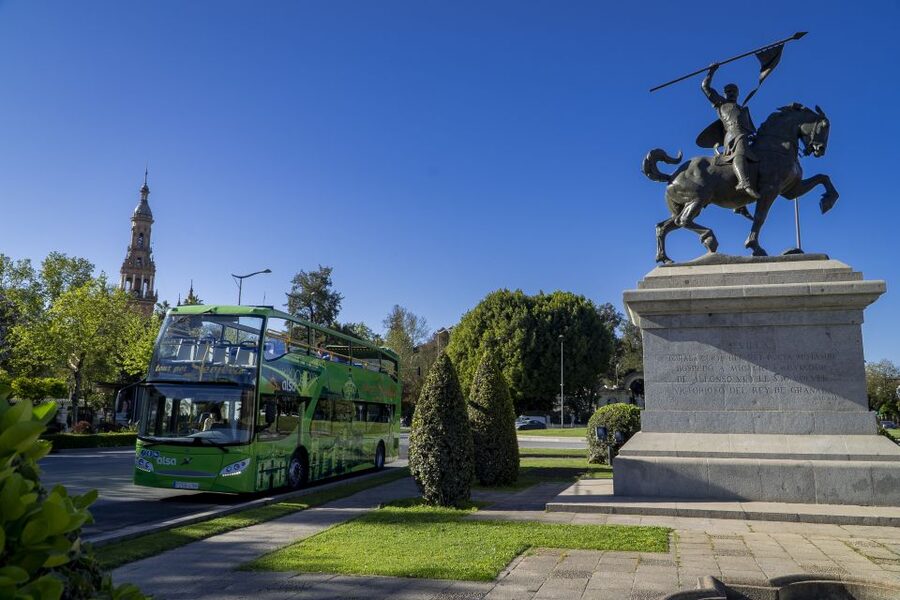
San Jacinto takes you farther into Triana, the district across the river. This is one of the strongest reasons to keep the ticket active for two days, since you can see the area from the bus and then return for the included walking tour.
Triana is best approached at a slower pace. Get off if you want to explore on foot, then use the walking tour to add structure. The supplied information confirms that Santa Cruz and Triana walking tours are included each day, but it does not give their exact departure times, so check those details when you activate your ticket.
The bus itself cannot show you every small street or local detail. That is fine. Its job here is to carry you into the district and help you decide where to spend time.
Several people found the stops easy to locate, and staff were described as friendly and helpful. That is reassuring if you are unsure where to board after walking around Triana.
Crossing the Guadalquivir toward the Cartuja
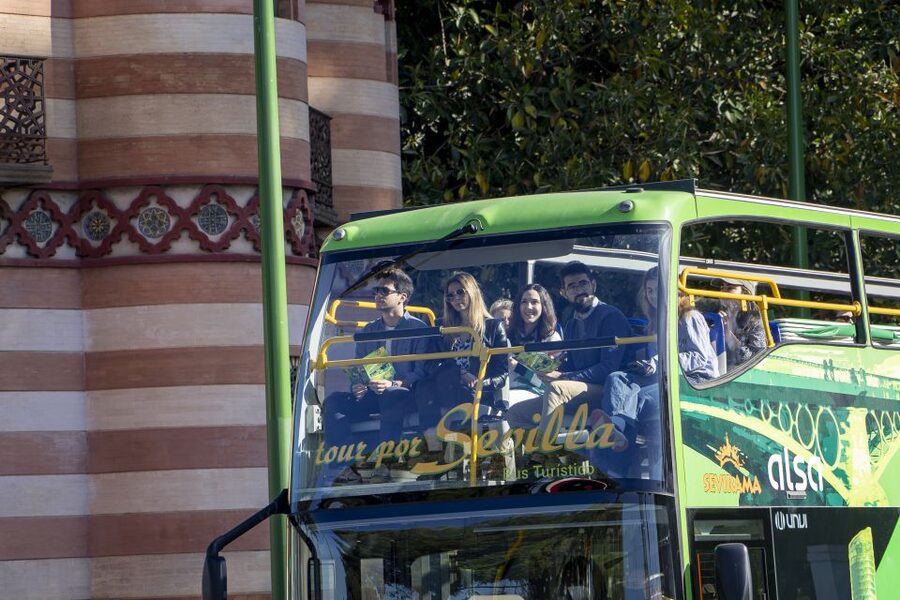
The route continues toward the Puente del Cristo de la Expiración and the Monasterio de la Cartuja. These crossings give you a different sense of Seville, with the river acting as a natural divider between neighborhoods and attractions.
The Cartuja is linked with Christopher Columbus, who lived at the monastery before setting out on his voyage of discovery. It is one of the more unusual parts of the circuit because it sits away from the classic Plaza de España and cathedral area.
The bus is particularly handy here. Walking from the central sights to the Cartuja would take time, and the ticket lets you see this part of Seville without arranging another form of transport.
The route also continues to Urb. Ciudad Expo, 92. This is less likely to be a first priority for a short city break, but it shows that the tour reaches beyond the postcard center. If your main goal is monuments, you might prefer to remain on board only long enough to complete the loop.
Isla Mágica and the northern route

Isla Mágica is another pass-by point. It is a useful marker on the northern section of the circuit, but the ticket details do not include entry to the theme park.
This part of the ride helps you understand Seville’s wider layout. It also gives you a break from the tight historic streets, where an open-top double-decker bus may not provide the same close views as it does along the river and larger avenues.
The route is not designed only for first-time sightseeing. It can also help you connect areas that are awkward to combine in a short visit. I would use this section as a scenic extension rather than building an entire day around the stops that are listed as pass-bys.
Macarena walls and the city center
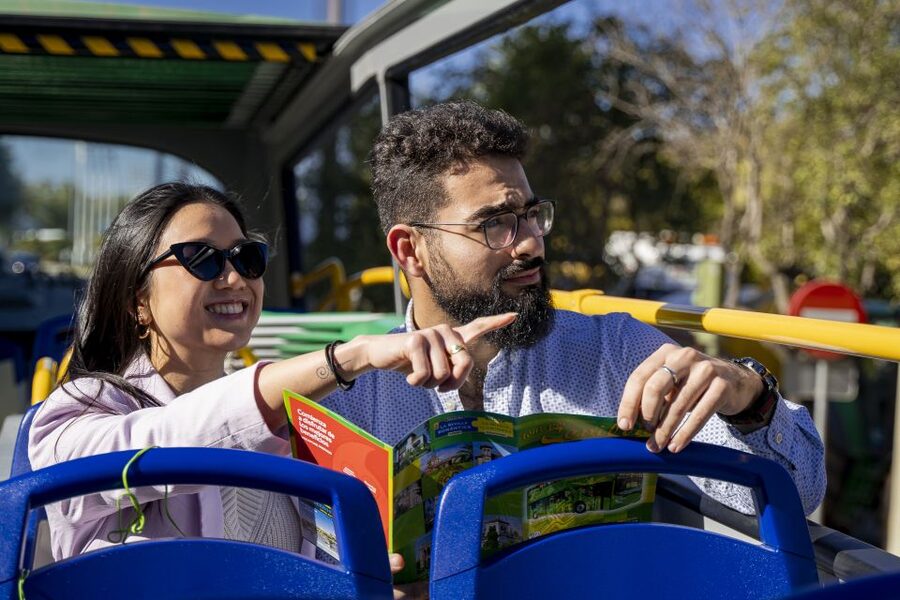
The Macarena walls bring you back toward Seville’s historic northern side. The route also passes the Macarena, one of the city’s best-known churches devoted to the Virgin Mary, along with the remains of the Almohad walls.
This is an important stop for anyone interested in Seville’s older defenses and religious traditions. The bus gives you the broad outline, while an off-board visit lets you appreciate the walls and church at a slower pace.
From there, the bus continues to Plaza del Duque de la Victoria and Plaza de Armas. These central stops are practical for shopping, eating, and returning to the heart of the city after the longer outer loop.
Plaza de Armas is also a good place to end a ride if you have had enough sightseeing for the moment. The useful rhythm is simple: ride while the bus covers distance, then walk when you reach an area that deserves your attention.
What the audio guide adds, and where it falls short
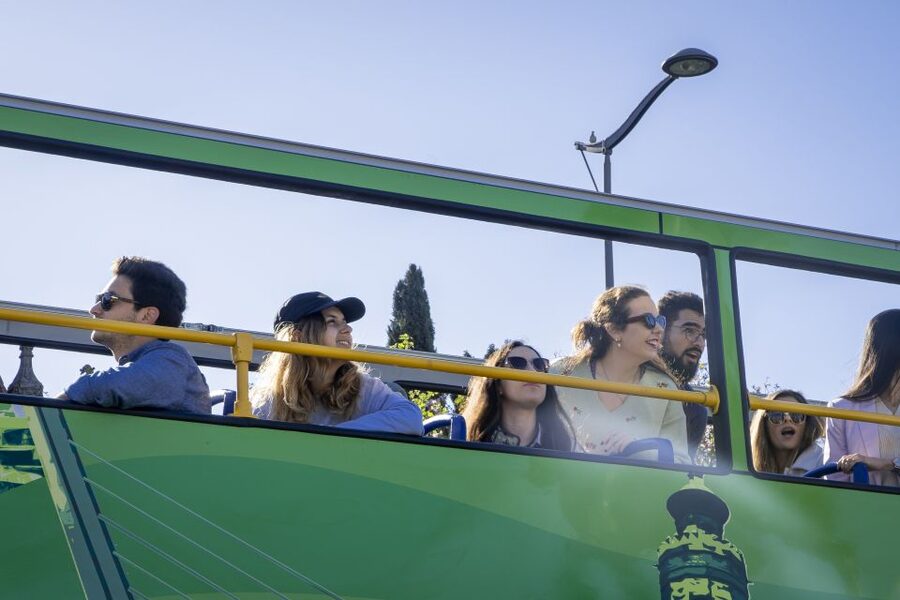
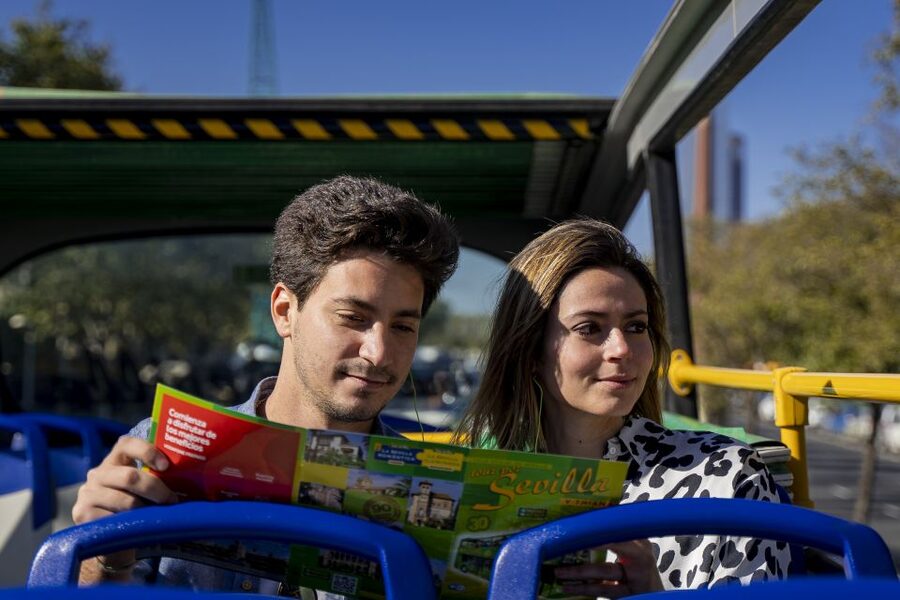
Recorded commentary is available in Spanish, English, French, German, Italian, Russian, Dutch, and Portuguese. Headphones are provided, and one positive detail is that the English announcements identify stops and points of interest.
That stop information can make a real difference on a first ride. You do not have to guess where you are or keep checking a map every minute.
Still, do not expect a perfectly synchronized narration every time. The audio may lag behind the building you are looking at, and some attractions may receive little or no mention. The equipment can also vary from bus to bus: one recent account reported no WiFi, no working onboard screen, and no stop numbers.
I would bring your own sense of direction and use the bus map as a backup. The audio works best as background context while you enjoy the view.
Comfort, frequency, and weather
The buses have open-top seating, heating, and air conditioning. That combination is important in Seville, where the weather can change the comfort of an exposed upper deck quickly.
On a sunny day, the top deck gives you the best views. On a rainy day, the lower deck becomes more useful. One person used the bus as a dry sightseeing platform during rain, staying aboard to listen to the commentary and learn about the city.
The bus is adapted for people with reduced mobility. Smoking is not allowed, and pets are not permitted, except for assistance dogs.
Service frequency is one of the most praised practical features. Several recent accounts describe buses arriving roughly every 15 minutes, which makes hopping off less risky than it would be with a limited daily service. Even so, leave room for variation and avoid planning a timed attraction around an exact bus departure.
Is $32 a fair price for two days?
At $32 per person, the ticket is not the cheapest way to move around Seville. If you only ride once and stay on for the full circuit, you will probably not get the best value.
The price becomes easier to justify when you use the ticket in three ways:
- Take one full orientation loop.
- Hop off at major sights such as Plaza de España, Triana, or the Macarena area.
- Use the second day to reach places you skipped or revisit a favorite district.
The two walking tours help the calculation. They add guided time on foot in Santa Cruz and Triana, rather than leaving you with only a bus ride and recorded narration.
I also like the flexibility of booking without immediate payment and being able to cancel up to 24 hours before the activity for a full refund. Those terms make it easier to fit the ticket into a changing itinerary, though you should still confirm the final conditions when booking.
Who will get the most from this bus ticket?
I would recommend it most to you if:
- You have two days in Seville and want an easy overview.
- You want to reach Triana, Cartuja, Macarena, and the riverfront without arranging separate transport.
- You enjoy seeing a city from above before exploring specific areas on foot.
- You prefer flexible sightseeing rather than a fixed group schedule.
- You are traveling with someone who benefits from an adapted bus.
- You want a weather-proof option when rain or heat makes long walks less appealing.
You may want a different plan if you are staying close to the historic center and prefer walking everywhere. Seville’s central sights are often best experienced at street level, and the bus cannot replace visits inside the city’s monuments.
Practical tips for using the two days well
Start at the Torre del Oro and take notes during the first loop. Mark the stops that deserve a return visit instead of trying to see everything immediately.
Use the first day for the long outer sections, such as Cartuja, Isla Mágica, or the route toward Macarena. Save the second day for the neighborhoods where you want more walking time.
Choose the upper deck for views, but keep the lower deck in mind for rain or strong sun. Headphones are available on the buses, and it is worth testing the audio before the bus leaves the starting point.
Do not assume every feature will work on every vehicle. The audio is available in eight languages, but WiFi and onboard screens have not always functioned. Bring a phone map if you need reliable stop tracking.
Most important, do not measure value by the number of stops you visit. The best use of this ticket is to combine long rides with unhurried walks. Seville rewards that balance.
Should you book the Seville bus ticket?
Book it if you want a flexible two-day overview and plan to use the bus as both sightseeing and transport. The 14-stop route, frequent service, two walking tours each day, and river crossings make it a practical choice for a first visit or a short stay.
Skip it if your plans center only on the walkable historic core or if you expect a fully synchronized, highly detailed audio presentation. At $32, you need to ride more than once to make the price work.
For most visitors, the strongest plan is simple: take the full loop first, hop off at Plaza de España or Triana, return for the walking tours, and use the second day to reach the farther corners of Seville.
FAQ
Where does the Seville hop-on hop-off bus start?
The starting point is the Torre del Oro.
How long is the complete bus route?
A complete circuit takes about 1 hour and 15 minutes.
How long is the ticket valid?
The ticket is valid for two consecutive days from the time you first activate it.
How many stops does the route have?
The route has 14 stops around Seville.
Can I get on and off more than once?
Yes. You can get on and off as many times as you like during the two-day validity period.
Are walking tours included?
Yes. Two walking tours are included each day, covering the Santa Cruz and Triana neighborhoods.
What languages are available for the audio guide?
Recorded commentary is available in Spanish, English, French, German, Italian, Russian, Dutch, and Portuguese.
Is WiFi available on the bus?
WiFi is included in the activity details, although one recent account reported that it was not working on the bus used that day.
Is the bus accessible for people with reduced mobility?
Yes. The bus is adapted for people with reduced mobility.
Can I cancel the booking?
You can cancel up to 24 hours in advance for a full refund. The activity also allows you to reserve now and pay later.
Recently listed in Seville
- Seville: Small Group Jewish Quarter Tour with Tapas & Drinks★ 5.0 · 119 reviews
- Seville: Alcázar Fast-Track Access with Guided Tour★ 4.2 · 432 reviews
- Seville: Small-Group Jewish Quarter Discovery Walking Tour★ 4.9 · 499 reviews
- Seville: VIP Exclusive Early Access Tour of The Alcazar★ 4.8 · 276 reviews
- Seville: Sunset Roof Top Walking Tour★ 4.5 · 122 reviews
- Seville: 3.5-Hour Spanish Cooking Class & Triana Market Tour★ 4.9 · 751 reviews
- Seville: Flamenco Show at Tablao Almoraima in Triana★ 4.6 · 483 reviews
- Seville: Authentic and Romantic Horse-Drawn Carriage Ride★ 4.5 · 341 reviews
Seville Tours, compared.


Live Flamenco Dancing Show Ticket at the Theater
Read our review →

1-Hour Guadalquivir River Sightseeing Eco Cruise
Read our review →
Cathedral, Giralda, and Royal Alcázar Guided Tour
Read our review →
Cathedral, Giralda & Alcazar Entry With Guided Tour
Read our review →Browse the lists this tour appears in