
Reviewed · SEVILLE TOURS
Seville: Casa de Pilatos Ground Floor Entry Ticket
Casa de Pilatos rewards curiosity. I like its Mudejar-Gothic and Renaissance design, and I like how the palace feels calmer and more personal than Seville’s grandest sights. The $14 ticket also gives you time to wander at your own pace, with an audio guide in seven languages. The main drawback is clear: this ticket covers only the ground floor, so you may want more after seeing it.
The tilework and courtyard sculptures are the stars here, from Roman busts to Andalusian fountains and glazed walls that seem to appear around every corner. The audio guide explains a great deal, though some visitors find it too long or occasionally confusing. Go early or around mid-afternoon if you want a quieter visit.
In This Review
- Casa de Pilatos at a glance
- Why Casa de Pilatos deserves a place in Seville
- Entering through the Renaissance marble gate
- The Andalusian courtyard and 24 Roman busts
- Tilework that rewards slow looking
- The Chapel of Flagellation and the palace’s oldest layer
- Pallas Pacifera, Apollo, and the sculpture collection
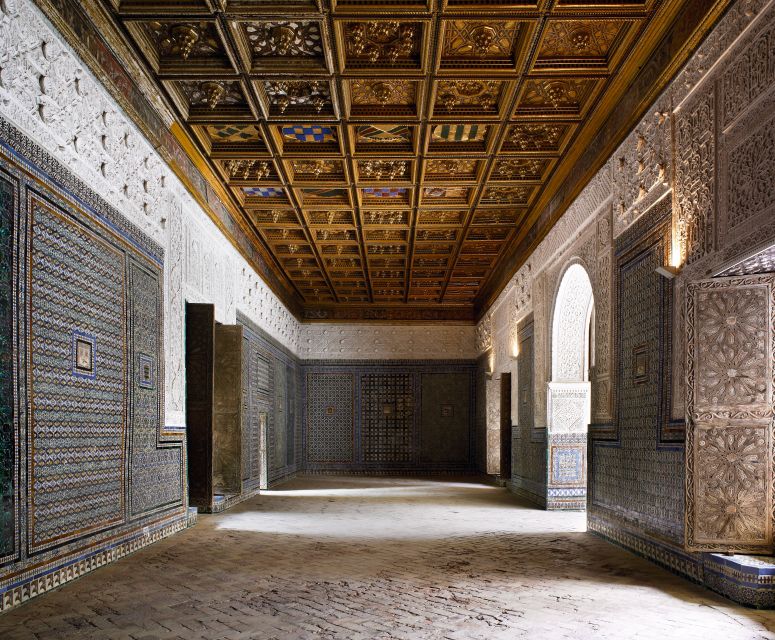
- Salón del Pretorio and the decorated ceilings
- Gardens that change the pace
- How the audio guide works in practice
- Ground floor only: what the $14 ticket buys
- Best times, booking flexibility, and practical tips
- Who will enjoy Casa de Pilatos most?
- Should you book Casa de Pilatos?
- FAQ
- What does the Casa de Pilatos ticket include?
- Is access to the upper floor included?
- What languages are available for the audio guide?
- Is this a live guided tour?
- What are the last entry hours?
- Can I enter Casa de Pilatos for free?
- Can I cancel the booking?
Casa de Pilatos at a glance
- A 15th-century aristocratic palace: See the former Enríquez de Ribera residence, once the largest private home in Seville.
- A remarkable style meeting point: Mudejar-Gothic decoration sits beside Renaissance architecture, showing how Seville changed through the centuries.
- A courtyard filled with Roman sculpture: Look for 24 busts of Roman emperors, along with figures such as Hadrian, Aphrodite, and Apollo.
- The Chapel of Flagellation: Visit the oldest part of the palace, where Christian and Islamic design meet in one compact space.
- Ground-floor gardens included: Walk between courtyards, rooms, sculpture, fountains, and Renaissance-style garden spaces.
- Audio guide, but no live guide included: Choose Spanish, French, English, Portuguese, German, Japanese, or Italian.
Why Casa de Pilatos deserves a place in Seville
Seville has no shortage of famous monuments. The Royal Alcázar gets the grandest crowds, and the cathedral dominates the skyline. Casa de Pilatos offers something different: a smaller palace where you can examine details without feeling rushed from one room to the next.
I especially like the way the building explains Seville’s cultural crossroads. This is not a palace built in one clean style. Its decoration reflects Christian Spain, Islamic artistic traditions, Roman antiquity, and the arrival of Renaissance taste. That mixture is the point.
The palace was developed by the Enríquez de Ribera family in the 15th century. It became the largest private residence in Seville at the time, and its rooms still show the ambition of that family. The building also reflects the city’s changing fortunes. Power, wealth, religion, overseas connections, and artistic fashion all left their mark here.
The visit is self-guided. You receive access to the ground floor and an audio guide, accessed through the site’s system or QR codes according to the information provided. Clear signs help match the audio sections to each area. That arrangement gives you freedom, but it also means you must manage the pace yourself.
A few more Seville ideas to compare
- Seville: Royal Alcázar Entry Ticket
★ 4.6 · 28,378 reviews - Seville: Cathedral and La Giralda Entry Ticket
★ 4.5 · 24,592 reviews - Seville: Live Flamenco Dancing Show Ticket at the Theater
★ 4.7 · 16,396 reviews
Entering through the Renaissance marble gate
Your visit begins at a detailed Renaissance-style marble entrance. It sets the tone immediately. This is not a plain doorway leading into a quiet historic house. The entrance announces a family with money, taste, and a desire to make an impression.
From there, the palace unfolds through drawing rooms, courtyards, chapels, and garden spaces. The route is not about one single knockout room. It is about repeated discoveries: a new tile pattern, a carved ceiling, a Roman bust, or a view through an arch toward flowers and fountains.
I recommend resisting the urge to hurry through the entrance area. The palace can look almost restrained from outside, but the interior opens into a much more decorative world. The contrast between the exterior streets and the interior courtyards is part of its charm.
The Andalusian courtyard and 24 Roman busts
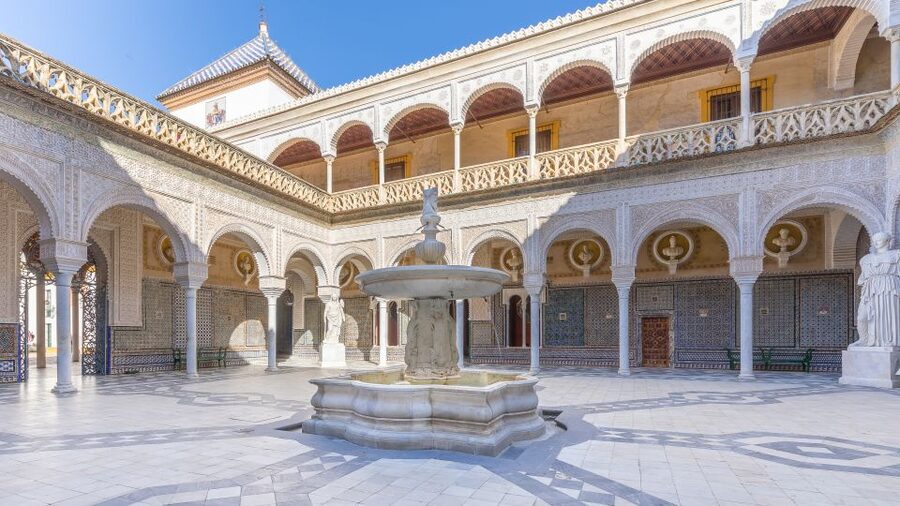
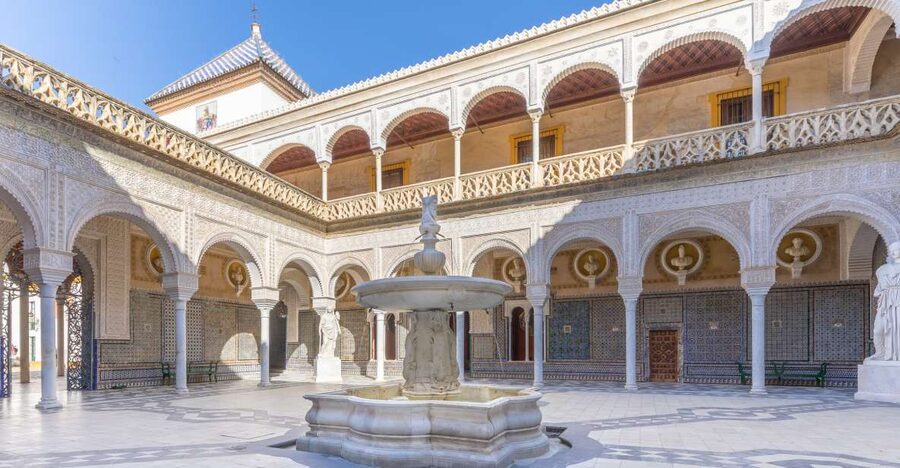
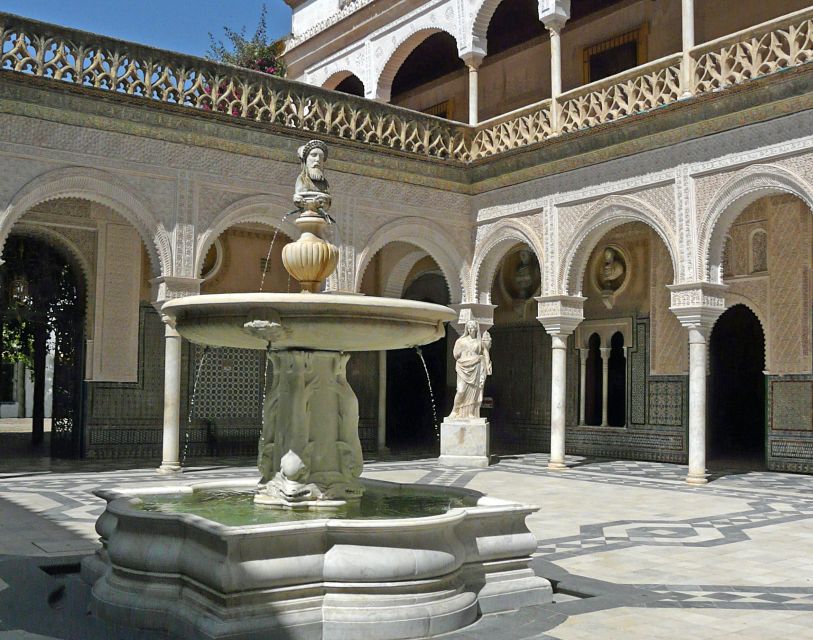
The main courtyard is one of the strongest parts of the visit. Its fountains, columns, tiles, and balanced proportions create the serene feeling that many people value most here. It is a typical Andalusian courtyard in spirit, designed to offer shade, water, and a sense of order.
Around it, you will see 24 busts of Roman emperors. These sculptures connect the palace to the classical world, while the surrounding tilework and architecture keep you firmly in Seville. Look for busts of Emperor Hadrian, Aphrodite, and Apollo, the god associated with music, poetry, and art.
This is where the palace’s design makes most sense. The Roman sculpture collection is not displayed in a separate museum-like hall. It forms part of the architecture. You see ancient figures framed by later Spanish design, which makes the whole courtyard feel like a conversation between different periods.
Take your time here before starting the audio guide in earnest. The courtyard is also a useful place to get your bearings. If you listen to every explanation without pausing to look, you may miss the visual relationships between the sculpture, fountain, walls, and arches.
Tilework that rewards slow looking
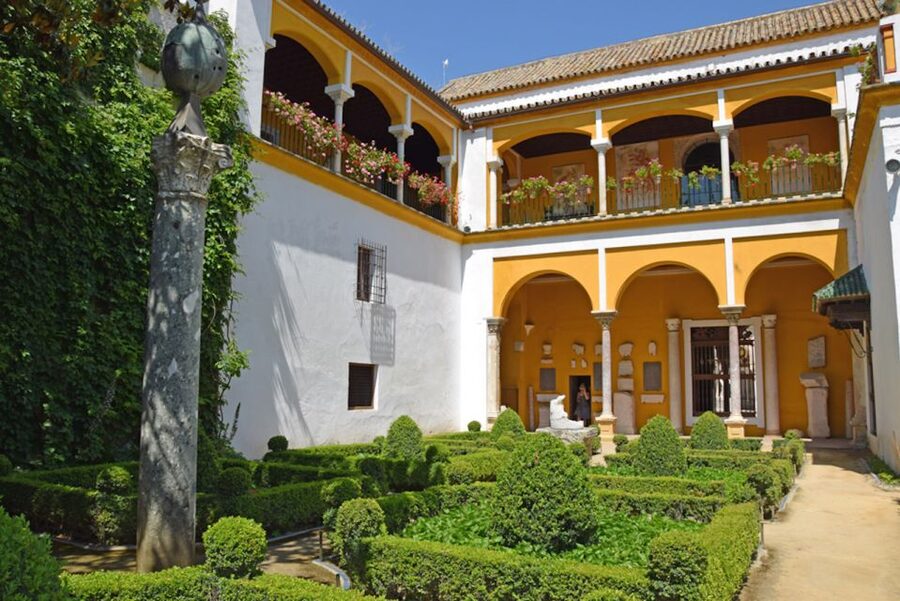
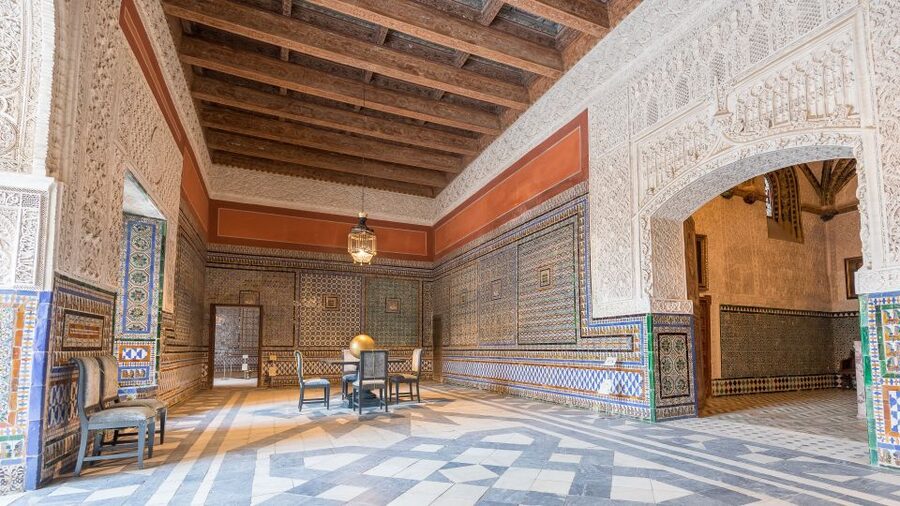
The glazed tiles are likely to be your most memorable sight. They cover walls and floors in detailed patterns, adding color and texture to rooms that might otherwise feel severe. The palace offers a wide range of mosaic and ceramic work, so this is a particularly good stop if you enjoy decorative arts.
The tiles are not just background decoration. They alter the mood of each room. Some spaces feel formal and grand, while others feel cool and restful. In the courtyard, the patterned surfaces help tie the sculpture and architecture together.
You will find traditional glazed tiling throughout the palace. I suggest looking at the details from different distances. Stand close enough to see the small patterns, then step back to notice how the designs organize an entire wall or passage.
The audio guide gives useful information about construction and design. Still, it can be more detailed than some people want. One visitor found the explanations overlong, and another noticed that certain descriptions did not always seem to match the room. You do not need to listen to every word. Use the guide when you want context, then pause it and simply look.
Same base, a different kind of afternoon:
- Seville: Casa de la Memoria Flamenco Show
★ 4.8 · 12,964 reviews - Seville: 1-Hour Guadalquivir River Sightseeing Eco Cruise
★ 4.2 · 10,281 reviews - Seville: Cathedral, Giralda, and Royal Alcázar Guided Tour
★ 4.7 · 9,165 reviews - Seville: Setas de Sevilla Entry Ticket
★ 4.6 · 8,901 reviews
The Chapel of Flagellation and the palace’s oldest layer
The Chapel of Flagellation is the oldest part of Casa de Pilatos. It is a compact but important stop because it shows the crossing of Christian and Islamic influences more clearly than many of the palace’s grander spaces.
Look for the ornate basket-handle arch and the combination of Mudejar-Gothic and Renaissance features. The chapel helps explain why Casa de Pilatos feels so distinct from a purely Renaissance residence. Its design records a period when architectural ideas from different traditions existed side by side.
This is also one of the best places to think about the palace as a historical document. The family did not erase every earlier layer to create a fashionable new home. Instead, older forms remained visible while newer Renaissance elements were added.
The room may not take long to see, but it deserves a proper pause. Listen to the relevant audio section if you want the background, then look closely at the arch and the transitions between architectural styles.
Pallas Pacifera, Apollo, and the sculpture collection
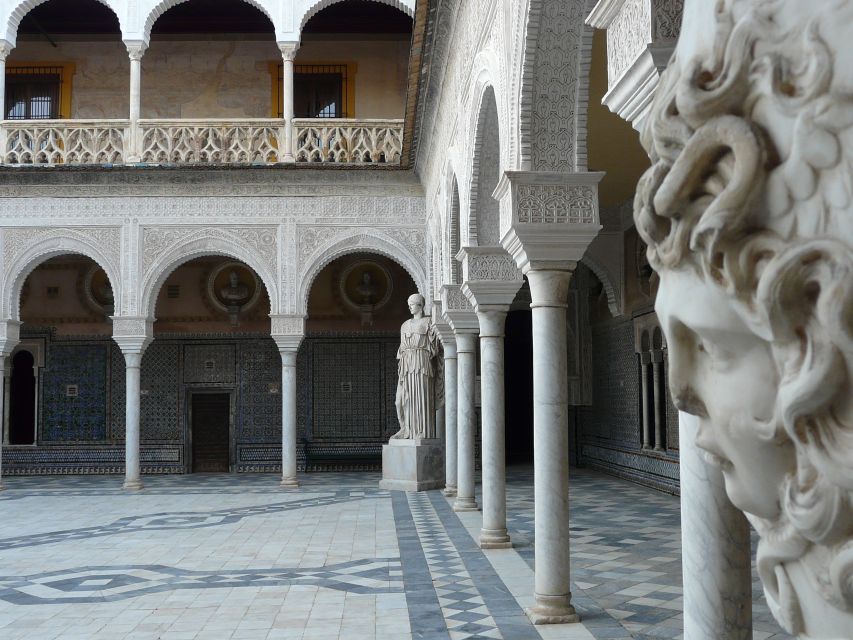
The palace’s sculpture collection gives the visit a museum-like quality, but the setting keeps it from feeling like a conventional gallery. Along the route, you will see classical figures and decorative pieces tied to the building’s wider themes.
Pallas Pacifera is a notable example. Look for her war ornaments, including a shield and helmet carved from stone. The image combines martial symbols with the name Pacifera, associated with peace. Details like this reward you if you enjoy iconography, but the guide is useful if you want to understand what you are seeing.
Apollo provides another connection to the arts. His association with music, poetry, and art fits the palace’s Renaissance taste, when educated aristocratic families collected classical subjects to signal learning and status.
You do not need a specialist background to enjoy the sculpture. The figures are visually strong even when you know little about them. The audio guide helps connect them to the palace’s original owners and the period’s fascination with antiquity.
Salón del Pretorio and the decorated ceilings
Continue to the Salón del Pretorio for one of the palace’s most attractive ceilings. The coffered design is decorated with ornamental bows, creating a patterned surface that rewards looking upward.
Ceilings can be easy to miss in a palace full of tiles and sculpture. Make a point of scanning above doorways and across the upper parts of rooms. Casa de Pilatos uses its ceilings to balance the busy walls and floors, and the combination gives the rooms their finished look.
The coffered ceilings also show how the Renaissance style was introduced to Seville. Casa de Pilatos was among the places where this newer taste took root, but it did not replace the city’s existing Mudejar traditions. Instead, the two styles appear together.
This is another area where the audio guide may give you more information than you need. If you are traveling with children or have limited time, select the main sections and keep moving. If architecture is your interest, slow down and use the guide room by room.
Gardens that change the pace
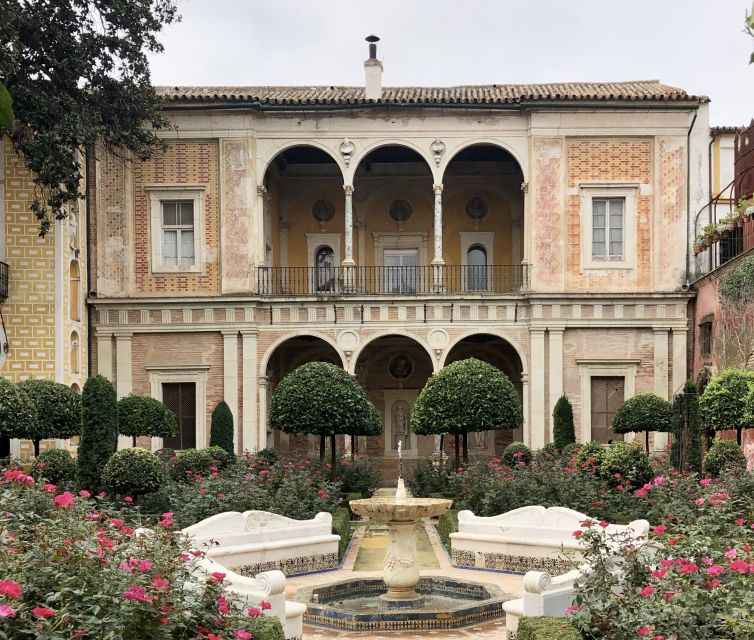
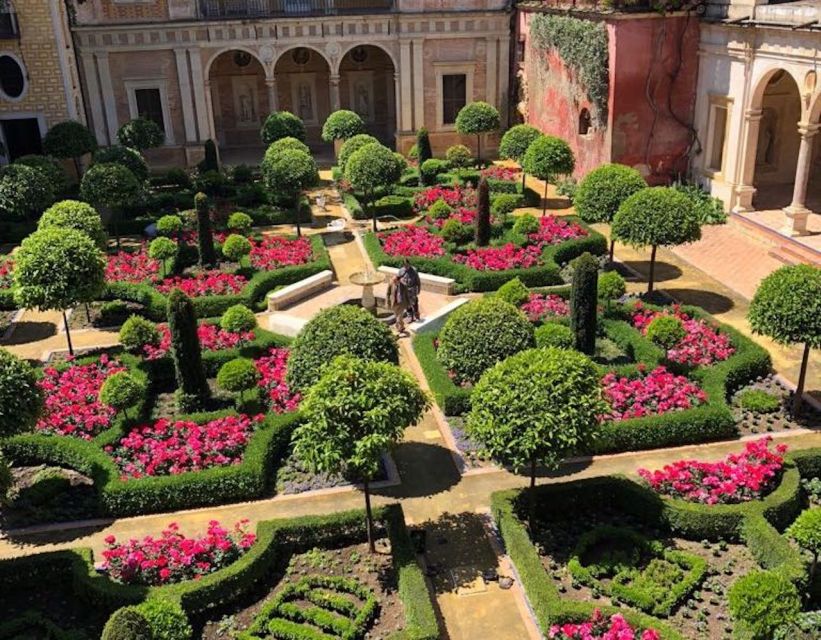
The palace gardens provide a welcome shift after the decorated interiors. You move from enclosed rooms and tiled courtyards into open Renaissance-style garden spaces with sculptures and flowers.
The gardens are not enormous, so do not expect a sprawling park. Their value is in the transitions between house and garden. A doorway leads outside, a courtyard frames a fountain, and another passage brings you back into the palace. This steady movement makes the visit feel relaxed rather than like a straight line through exhibition rooms.
The rose garden is especially appealing when flowers are in season. Other garden areas offer space to pause and absorb the building’s design. Several people have found the palace peaceful, and that is one of its strongest qualities.
Timing matters. Visits around 11 AM and early afternoon have often been quiet, while tour groups can arrive later, around 4 PM. In August, the palace may be hot around 3 PM, but the lower visitor numbers can make that a pleasant time for a slow visit if you can tolerate the heat.
How the audio guide works in practice
The audio guide is included and available in Spanish, French, English, Portuguese, German, Japanese, and Italian. Spanish is also listed as the language for the host or greeter, but this is not a live guided tour in English. The experience is primarily self-guided.
The system is easy to use once you understand the route. QR codes and clear signs can help you select the right information for each space. You can stop, skip sections, or listen only to the rooms that interest you.
The strength of the guide is its breadth. It covers the construction, family, artistic details, and history of the palace. The weakness is that it can feel over-detailed. Some descriptions may be difficult to follow if you try to absorb every fact while also photographing and studying the rooms.
My advice is simple: use it selectively. Listen before entering a room, pause while you examine the details, and skip ahead when the explanation becomes repetitive. That approach gives you context without turning a beautiful palace visit into an audio course.
Ground floor only: what the $14 ticket buys
At $14 per person, the ticket is reasonable if you value architecture, decorative art, and a slower visit. You are paying for access to a substantial ground-floor route with courtyards, drawing rooms, the chapel, sculptures, ceilings, and gardens. The audio guide adds useful context without requiring you to join a fixed group.
The value is strongest when you allow enough time to look properly. A rushed visit makes the ticket feel expensive because Casa de Pilatos is built around small details rather than one huge spectacle. A relaxed visit feels more worthwhile, especially if you enjoy photography, tilework, or historic interiors.
The important limitation is that the upper floor is not included. The ground floor is fascinating enough to fill a visit, but you may find yourself wanting to see more of the family’s home after finishing the route. One person added an upstairs tour on arrival and found it worthwhile even though the tour was in Spanish, using the opportunity to see more of the house independently.
If the upper floor matters to you, ask about adding it when you arrive. Do not assume the $14 ticket covers the entire palace.
Best times, booking flexibility, and practical tips
The ticket is valid for one day, with available starting times shown when you check. Last entry from Tuesday through Sunday is at 5:30 PM, so do not plan to arrive at the last minute.
Monday offers a useful money-saving option: entry is free between 3 PM and 5:30 PM. Check the current conditions before planning around that window, since free entry can affect how busy the palace feels.
Advance tickets make entry smoother, and electronic tickets are accepted. Free cancellation up to 24 hours in advance and the reserve-now, pay-later option are useful if your Seville plans may change.
For the best experience, I would:
- Visit in the morning or early afternoon if you want quieter rooms.
- Leave time for the gardens instead of treating them as a quick exit route.
- Look up at ceilings and down at floors, not only straight ahead.
- Use the audio guide in sections rather than listening continuously.
- Bring patience for the tilework, since the best details are easy to rush past.
- Consider the upper-floor option if family history and domestic rooms interest you.
Who will enjoy Casa de Pilatos most?
This palace suits you if you like architecture, sculpture, historic homes, and decorative detail. It is also a good choice if you want a quieter cultural stop between Seville’s more crowded headline sights.
Photographers will appreciate the tiled walls, arches, fountains, gardens, and changing views through the courtyards. History-minded visitors will enjoy seeing how Islamic, Gothic, Renaissance, and classical influences overlap in one building.
It is less suitable if you want a short, simple attraction with very little explanation. The audio guide contains a lot of information, and the palace rewards slow observation. You can keep the visit brief, but you will miss much of what makes it special.
Families may appreciate the freedom of a self-guided route, since you can move at your own pace. Children who enjoy statues, gardens, or colorful tiles may find plenty to look at, while the long audio sections are best used selectively.
Should you book Casa de Pilatos?
Yes, if you want a beautiful and calmer counterpoint to the Royal Alcázar. The palace gives you remarkable tilework, classical sculptures, Renaissance ceilings, a historic chapel, and gardens for $14, with no need to follow a live group.
I would hesitate only if you want access to every floor or dislike audio guides. The ground-floor ticket has a firm limit, and the guide can be too detailed for some people. For most visitors interested in Seville’s art and architecture, though, Casa de Pilatos is an easy recommendation, especially in the morning or during a quiet mid-afternoon visit.
FAQ
What does the Casa de Pilatos ticket include?
The ticket includes entry to the ground floor and an audio guide.
Is access to the upper floor included?
No. The listed ticket covers the ground floor only. Upper-floor access is not included.
What languages are available for the audio guide?
The audio guide is available in Spanish, French, English, Portuguese, German, Japanese, and Italian.
Is this a live guided tour?
No. The experience is self-guided with an audio guide. The host or greeter language is Spanish.
What are the last entry hours?
From Tuesday through Sunday, the last entry is at 5:30 PM.
Can I enter Casa de Pilatos for free?
Entry is free on Mondays between 3 PM and 5:30 PM.
Can I cancel the booking?
Yes. You can cancel up to 24 hours in advance for a full refund.
Recently listed in Seville
- Seville: Small Group Jewish Quarter Tour with Tapas & Drinks★ 5.0 · 119 reviews
- Seville: Alcázar Fast-Track Access with Guided Tour★ 4.2 · 432 reviews
- Seville: Small-Group Jewish Quarter Discovery Walking Tour★ 4.9 · 499 reviews
- Seville: VIP Exclusive Early Access Tour of The Alcazar★ 4.8 · 276 reviews
- Seville: Sunset Roof Top Walking Tour★ 4.5 · 122 reviews
- Seville: 3.5-Hour Spanish Cooking Class & Triana Market Tour★ 4.9 · 751 reviews
- Seville: Flamenco Show at Tablao Almoraima in Triana★ 4.6 · 483 reviews
- Seville: Authentic and Romantic Horse-Drawn Carriage Ride★ 4.5 · 341 reviews
Seville Tours, compared.



Live Flamenco Dancing Show Ticket at the Theater
Read our review →

1-Hour Guadalquivir River Sightseeing Eco Cruise
Read our review →
Cathedral, Giralda, and Royal Alcázar Guided Tour
Read our review →

Cathedral, Giralda & Alcazar Entry With Guided Tour
Read our review →Browse the lists this tour appears in