Reviewed · MADRID TOURS
Street Art Guided Tour in Madrid
Madrid’s walls tell stories. This two-hour walk takes you beyond the grand boulevards into Lavapiés, where political murals, stencils, legal festival pieces, and rough-edged graffiti share the same streets. I like the tour’s local focus and its access to places such as La Tabacalera and Esta es Una Plaza, spaces you could easily miss on a standard city tour. The main drawback is that the art changes, and one stop may be less impressive if you expect a parade of perfect murals.
I also like the small group size, capped at 13 people, and the guides’ clear connection to the scene. Santi, Julia, and other guides have earned praise for their humor, enthusiasm, and ability to explain why the work matters. Still, you need to stay close enough to hear every explanation, especially in a busy neighborhood, and La Tabacalera can have limited weekday hours.
In This Review
- Key points to know before booking
- Why Madrid’s street art deserves a walking tour
- Starting near Teatro Valle-Inclán at 11:15
- The short walk toward La Neomudéjar
- La Tabacalera, from tobacco warehouse to art center
- Esta es Una Plaza and the value of shared space
- Walking through Lavapiés for a full hour
- Campo de Cebada and Madrid’s 15-M legacy
- Guides, group size, and the listening challenge
- Is $30.38 a fair price?
- Who should book this Madrid street art walk?
- Final verdict: a smart choice for curious walkers
- FAQ
- Where does the street art tour begin?
- Where does the tour finish?
- How long does the tour last?
- What language is the tour offered in?
- Is admission included?
- Can I cancel for a full refund?
Key points to know before booking

- Lavapiés is the real subject: The tour uses street art to explain one of Madrid’s most multicultural districts.
- La Tabacalera offers more than exterior graffiti: Its former tobacco warehouse includes exhibition and performance areas, plus a basement lined with stencils and street art.
- Esta es Una Plaza adds a community angle: This urban garden shows how residents have reclaimed city space for shared use.
- La Neomudéjar connects art with industry: The former power plant near Atocha now houses work by artists from Spain and abroad.
- The group stays small: A maximum of 13 people makes questions and conversation easier.
- The art is temporary: New murals may appear, older pieces may fade, and opening times can affect what you see.
Why Madrid’s street art deserves a walking tour
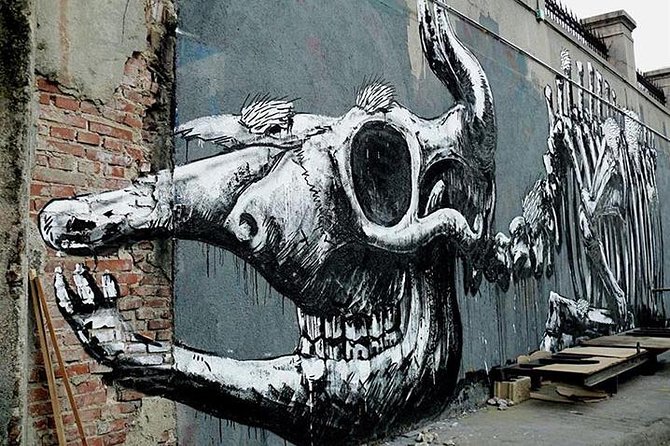
Madrid has plenty of famous art inside museums, but its street art asks you to look in a different way. A painted shutter, basement stencil, or wall beside a vegetable garden can reveal as much about the city as a formal gallery.
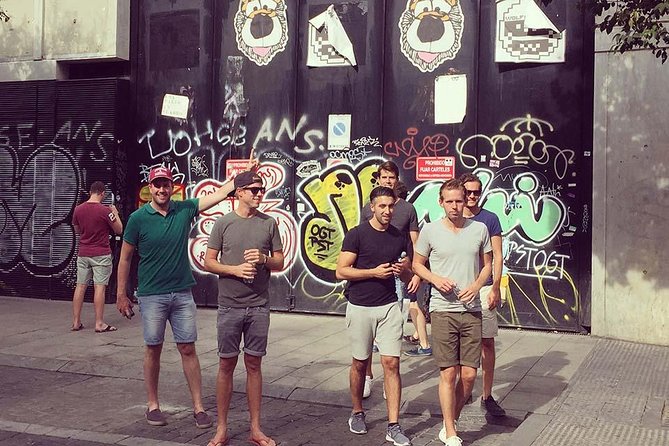
The tour focuses on Lavapiés, a district known for its cultural mix and its strong connection to street art. You will walk through ordinary streets while your guide points out artists, techniques, messages, and the difference between sanctioned work and unauthorized graffiti.
That context is the main reason to book. On your own, you may notice color and scale but miss the political references or the local stories behind the walls. A guide can explain why a piece was created, how a festival helped bring artists into the neighborhood, or why some creators object to laws that penalize graffiti.
The tour also avoids treating street art as decoration alone. The work is tied to protest, public space, neighborhood identity, and collaboration. That makes the experience useful even if you know little about spray paint or contemporary art.
A few more Madrid ideas to compare
- Madrid: Tour Bernabéu Entry Ticket
★ 4.5 · 21,573 reviews - Madrid: Prado Museum Entry Ticket
★ 4.6 · 17,509 reviews - Madrid: Royal Palace Fast-Access Admission Ticket
★ 4.6 · 13,856 reviews
Starting near Teatro Valle-Inclán at 11:15
The meeting point is Teatro Valle-Inclán, at Plaza de Ana Diosdado, in central Madrid. The listed start time is 11:15 in the morning, so plan to arrive a little early and locate the theater before the group gathers.
The walk finishes at Plaza de Cascorro, near La Latina and Tirso de Molina metro stations. That ending is handy because you can continue exploring Lavapiés, grab a meal, or connect with other parts of central Madrid without arranging a return transfer.
The tour does not include hotel pickup, food, or drinks. Bring water and wear comfortable shoes. The walk lasts about two hours, and it operates in all weather, so a light rain layer or sun protection can make a real difference.
You receive a mobile ticket, and the experience is offered in English. The listed inclusions also mention French and Spanish, so check the available language when booking if English is not your first choice.
The short walk toward La Neomudéjar
The experience is described as beginning with a short walk from the start point toward La Neomudéjar, about five minutes away. Along the way, you pass the big-headed babies monument near Atocha train station and the avant-garde art center located in the station’s Mediodía metro area.
This opening helps set the tone. Madrid’s contemporary art is not locked inside one building. It appears in transport hubs, old industrial sites, warehouses, squares, and neighborhood walls.
La Neomudéjar once served as a power plant connected to the railway system in the 19th century. Today, it is used by artists from Spain and other countries. The old industrial setting suits street art well, since the rough structure gives the work a less polished and more experimental setting.
Artists associated with the space include Himen, Ze Carrión, and Laguna626. Some of the work addresses Article 626, a Spanish law linked to penalties for graffiti creators. Your guide can help explain the tension between public art, private property, civic rules, and artistic freedom.
The exact balance between La Neomudéjar and the Lavapiés stops may depend on timing and access. The tour information gives special notice that La Tabacalera has restrictive weekday hours, so you should not expect every interior space to operate in exactly the same way every day.
La Tabacalera, from tobacco warehouse to art center
La Tabacalera is one of the most interesting stops because the building itself carries the story. The former 19th-century warehouse once employed more than 1,000 people to chop, shred, and roll tobacco.
Today, the space serves Madrid’s creative community. It can host painting exhibitions, dance, music, and other performances. The exterior walls are a major part of the city’s urban art scene, and the tour gives you time to study the artists, messages, and spray-paint techniques rather than simply walk past.
The basement is especially atmospheric. Hundreds of street art projects and stencils cover its walls, creating a dense record of different styles and ideas. It may feel less tidy than a conventional gallery, but that is part of its appeal. The work is layered, temporary, and connected to the building’s use by local artists.
There is a practical catch. La Tabacalera has restrictive opening times during the week. If interior access is limited on your date, the guide can still focus on the outside walls and the surrounding district, but you should not book this tour solely for a guaranteed basement visit.
Same base, a different kind of afternoon:
- Madrid: “Emociones” Live Flamenco Performance
★ 4.8 · 12,866 reviews - Madrid: Panoramic Route City Tour
★ 4.1 · 12,259 reviews - Madrid: Live Flamenco Show with Food and Drinks Options
★ 4.5 · 9,901 reviews - Avila & Segovia Tour with Tickets to Monuments from Madrid
★ 5.0 · 9,762 reviews
Esta es Una Plaza and the value of shared space
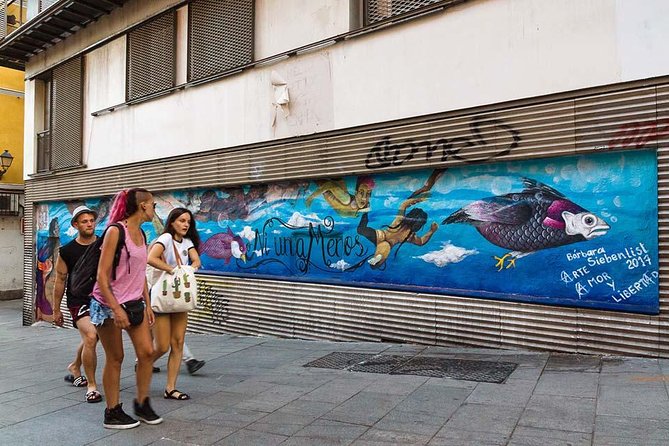
The itinerary includes about 30 minutes at Esta es Una Plaza, one of Madrid’s urban gardens. The visit to its wall art is only guaranteed if the site is open.
That condition matters. This is not a normal museum with fixed hours and a guaranteed sequence of rooms. The tour works with active community spaces, and access can change. The upside is that you see how residents use and reshape an urban site. The downside is that a closed gate can alter the experience.
Esta es Una Plaza helps you understand why street art fits Lavapiés so well. The art is part of a broader effort to make public areas useful, social, and local. The garden is not merely a backdrop for photographs. It represents neighborhood participation and shared responsibility.
If you enjoy seeing how a city functions at street level, this stop adds real value. If you are mainly looking for large, polished murals, it may feel quieter and less dramatic than La Tabacalera.
Walking through Lavapiés for a full hour
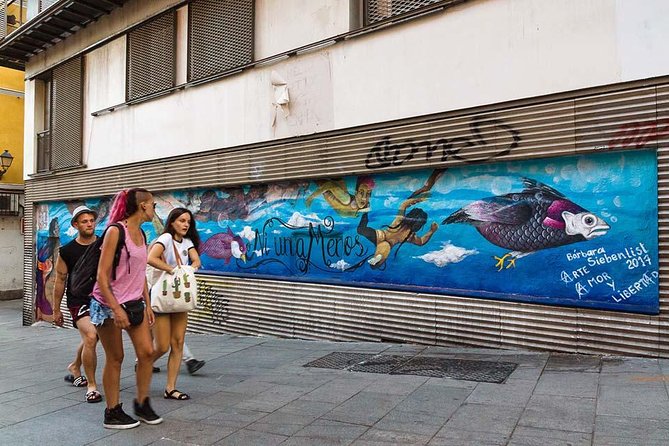
About an hour is devoted to Lavapiés itself. This is the heart of the tour, not just the route between art sites.
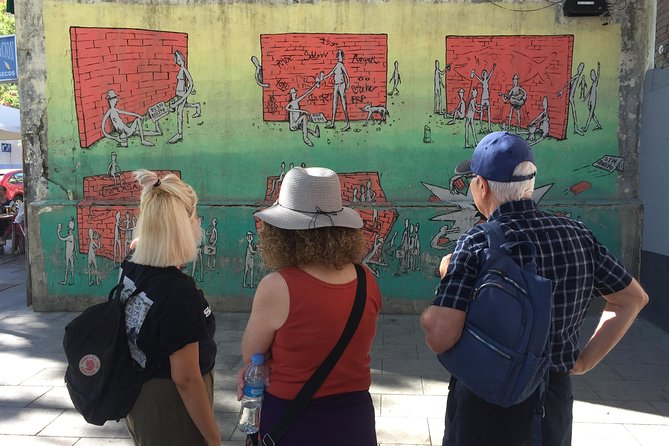
Your guide explains the district’s development, multicultural character, and connection to graffiti and public art. You will see walls covered with both sanctioned murals and unauthorized work. Some pieces may be bright and carefully planned, while others may be small, rough, or partly erased.
That range is useful. It shows you that street art is not one style. You may encounter stencils, lettering, painted figures, political messages, festival murals, and quick tags. The guide’s job is to help you read the choices.
Several guides have received strong praise for making this walk personal. Santi is noted for his warmth, humor, and close knowledge of the neighborhood. Julia is praised for being informative and friendly. One particularly appealing feature is the chance, depending on the guide and schedule, to learn from someone who also works as a street artist and may point out personal work.
A festival can change the day completely. During the Calle Lavapiés festival, the walk included artists painting new pieces for an upcoming event, with a chance to speak with them about their work. That kind of encounter cannot be promised, but it shows why a street art tour can feel different from one visit to the next.
Campo de Cebada and Madrid’s 15-M legacy
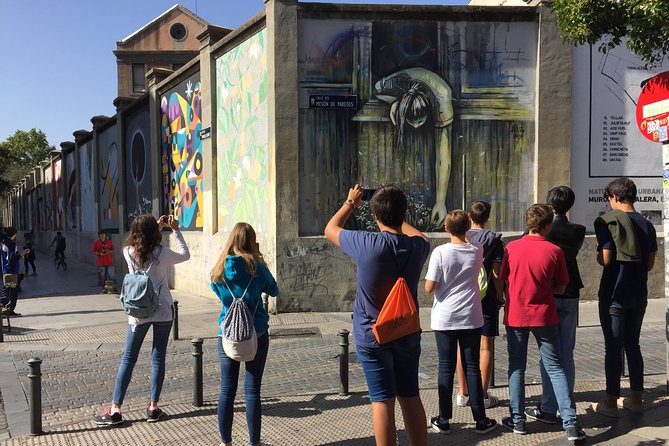
The route is also described as finishing at Campo de Cebada, known as The Barley Field. This community gathering place grew from Spain’s 15-M Movement, when citizens reclaimed public streets and squares for communal use.
The site once held a swimming pool. It was later reorganized by local associations as a place for films, music, and collective gardening. The story gives street art a wider setting: public creativity is not only about painting walls. It can also mean deciding how an empty or neglected space should serve its neighborhood.
Depending on the final route, Campo de Cebada may be the ending point, while the detailed stop list places the walk’s finish at Plaza de Cascorro. Treat the published meeting and ending information as the practical guide, and confirm the final route if this stop is especially important to you.
Either way, the community-space theme is one of the tour’s best features. It connects murals with civic action, local organizing, and the idea that residents can shape their surroundings.
Guides, group size, and the listening challenge

A small group of no more than 13 people is a strong advantage. You can ask questions without shouting, and the guide can respond to the group’s interests. The best comments about the experience focus on guides who are passionate, funny, and willing to explain the neighborhood rather than recite facts.
That said, street art tours require active listening. One complaint described difficulty hearing while also looking around at the walls. This is a fair concern. A guide cannot always walk backward while watching traffic and speaking to everyone.
Stay near the guide during explanations, then step back when you want to study a wall. If you have trouble hearing in a group, tell the guide early. A private tour may suit you better if you need a slower pace or more individual attention, but this standard experience keeps the cost lower.
The guides may be multilingual, with English, French, and Spanish listed as available languages. Confirm your preferred language when you reserve.
Is $30.38 a fair price?
At $30.38 per person, the tour is priced reasonably for a two-hour guided walk in central Madrid. You are paying for local interpretation, not admission to a major museum or a long list of paid attractions. The included stops have free admission, so the value depends almost entirely on the guide.
I think the price works best for first-time visitors to Madrid who want help finding the art and understanding its setting. It also suits returning visitors who have already seen the Prado, Royal Palace, and main plazas and want a different side of the city.
The value is weaker if you are happy to walk around Lavapiés alone and inspect walls without background. It may also disappoint you if you expect every stop to deliver large, freshly painted murals. Street art changes, interior access is not always certain, and some pieces will be rough or partially covered.
The 96 percent recommendation rate and 4.8 rating from 175 reviews suggest that the guide-led format usually works well. Still, the lower ratings point to a real issue: the appeal depends on your taste, the day’s art, and how clearly you can hear the guide.
Who should book this Madrid street art walk?
I would choose this tour if you enjoy local neighborhoods, public art, and social history more than formal sightseeing. It is a good match for curious adults, older children who can walk for two hours, photographers, and anyone who wants to see Madrid beyond its best-known monuments.
You will get the most from it if you ask questions. Ask about the difference between legal and illegal work, the artists’ techniques, the role of festivals, or how local residents view graffiti. The experience rewards attention.
I would hesitate if you need a fixed indoor itinerary, guaranteed access to every site, or a large collection of famous works. La Tabacalera and Esta es Una Plaza have access limits, and the street art itself is temporary.
Book at least 24 hours ahead if you want the option of a full refund after cancellation. Changes or cancellations made within 24 hours are not refundable. Service animals are allowed, and the tour is near public transportation, but the experience remains a walking tour through city streets.
Final verdict: a smart choice for curious walkers
I recommend the Street Art Guided Tour in Madrid for its neighborhood focus, small groups, and strong guides. Santi, Julia, and other guides have been praised for making the walk engaging and personal, and the route gives you more than a collection of colorful walls.
The best reason to book is the connection between art and community. La Tabacalera shows creativity in an old industrial building. Esta es Una Plaza shows residents making space for gardens and gathering. Lavapiés brings the themes together through murals, stencils, and everyday city life.
Choose it with the right expectations. You are not guaranteed a perfect mural at every corner, and weekday access may affect La Tabacalera. But if you want to understand why Madrid’s street art matters, and you are willing to walk, listen, and look closely, this is a worthwhile two-hour addition to your city plans.
FAQ
Where does the street art tour begin?
The tour begins at Teatro Valle-Inclán, Plaza de Ana Diosdado, in central Madrid. The listed start time is 11:15 am.
Where does the tour finish?
The listed end point is Plaza de Cascorro in central Madrid, near La Latina and Tirso Molina metro stations. The route information also describes Campo de Cebada as a finishing stop, so confirm the final route when booking.
How long does the tour last?
The experience lasts approximately two hours.
What language is the tour offered in?
English is listed as an available language. The included information also lists French and Spanish multilingual guiding.
Is admission included?
The local guide and the visit to the Muros La Tabacalera project are included. Food, drinks, hotel pickup, and hotel drop-off are not included.
Can I cancel for a full refund?
Yes. You can cancel at least 24 hours before the local start time for a full refund. Cancellations or changes made less than 24 hours before the start are not refunded.
Recently listed in Madrid
- From Madrid: Ribera del Duero Tour of 3 Wineries w/ Tastings★ 4.9 · 150 reviews
- Madrid: Royal Palace VIP Tour with Skip-the-Line Ticket★ 4.3 · 645 reviews
- Madrid: Las Ventas Bullring VIP Private Guided Tour★ 5.0 · 151 reviews
- Photographic tour of Madrid with a professional photographer★ 5.0 · 104 reviews
- Zarzuela Opera and Dinner at La Castafiore Restaurant in Madrid★ 5.0 · 143 reviews
- Madrid Local’s Wine and Tapas Lunch Tour with a side of History★ 5.0 · 101 reviews
- Tapas and history tour ending with churros with chocolate★ 5.0 · 119 reviews
- Atletico de Madrid Stadium & Interactive Museum Admission Ticket★ 4.5 · 183 reviews
Madrid Tours, compared.





Live Flamenco Show with Food and Drinks Options
Read our review →
Avila & Segovia Tour with Tickets to Monuments from Madrid
Read our review →