

Reviewed · CITY TOURS
Córdoba: City Sightseeing Hop-On Hop-Off Bus Tour
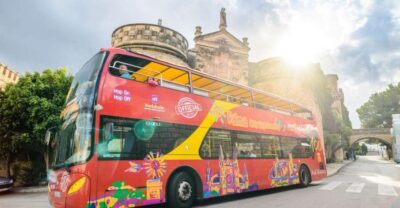
Córdoba reveals itself in layers. This full-day bus pass makes that easier, especially if you want to connect the Mosque-Cathedral, Roman Temple, and riverside gates without wearing out your feet. I like the choice of a full-size panoramic bus and a smaller minibus, plus the included Judería walking tour.
I also like the clear audio commentary in nine languages, with a Spanish audio option for children. The main drawback is the timetable: buses can run only every 70 minutes, so missing one can cost you a large part of the day.
At $32, this is useful for a first look at Córdoba or a short visit. It is less compelling if you are happy walking and plan to stay only around the compact old quarter.
In This Review
- Key points to know before you board
- Why Córdoba works well from the top deck
- Red Route: from the Guadalquivir to Santa Marina
- Blue Route: the 30-minute trip through narrow streets
- The gates, towers, and palaces along the way
- The Mosque-Cathedral and the Judería connection
- Timing, waiting, and the one-day limit
- Is the $32 price fair?
- Who should book this Córdoba bus tour?
- FAQ
- How long is the Córdoba hop-on hop-off pass valid?
- How long do the two bus routes take?
- How often do the buses run?
- What time do the buses start and finish?
- Is the Judería walking tour included?
- Are attraction entrance tickets included?
- Is the bus wheelchair accessible?
Key points to know before you board
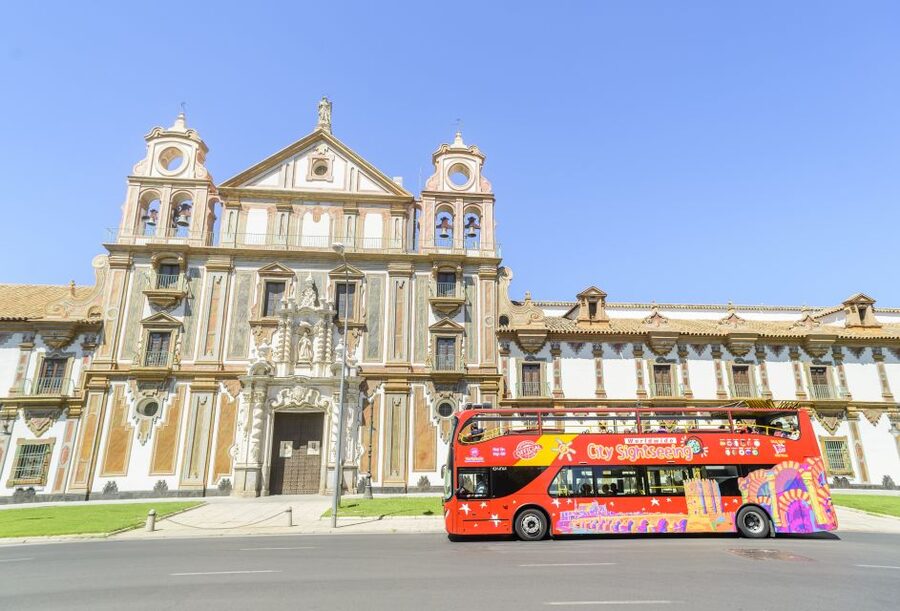
- Two routes serve different parts of Córdoba: The red panoramic route handles broader roads, while the blue Intima route uses a smaller minibus through narrow streets.
- The red route takes 70 minutes: Buses leave the first stop from 9:30am to 6pm, generally every 70 minutes.
- The blue route takes 30 minutes: It follows a tighter circuit around the old center, with the same first and last departure times.
- The Judería walk is included: Meet at the Roman Bridge stop at 6pm for a one-hour walk in Spanish or English.
- Attractions cost extra: Your pass covers transportation, commentary, headphones, and the walking tour, but not entrance tickets.
- The pass suits limited mobility: The bus is wheelchair accessible and can link stops near major sights, though you should still allow time for boarding and waiting.
Why Córdoba works well from the top deck

Córdoba grew beside the Guadalquivir River, and its position helped draw Romans, Arab rulers, Jewish communities, and Christian kingdoms. The city’s major sights are not all in one neat cluster, so a bus can save time between the river, railway station, northern districts, and historic center.
The tour gives you a broad view before you choose where to spend your time. I find that useful in Córdoba because the old quarter can feel like a maze of white lanes, courtyards, walls, and small squares. From the bus, you can get a sense of how the city fits together.
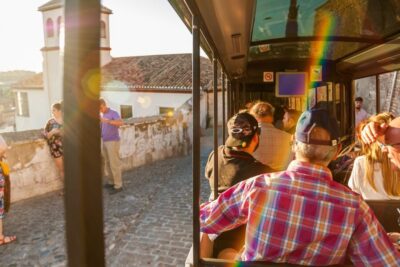
The red bus is the better first ride if you want an overview. Its route lasts 70 minutes and passes parks, monuments, city gates, palaces, towers, and transport links. The open upper deck gives you a clear view for photographs, though Córdoba’s sun can be fierce. The lower level offers shade, but working audio outlets have been an issue on some buses.
Keep the included headphones. The commentary is offered in Spanish, Chinese, English, French, German, Italian, Japanese, Arabic, and Russian. The content is generally clear and helpful, though the narration may occasionally lag behind the building or stop it is describing.
A few more Cordoba ideas to compare
- Córdoba: Skip-the-Ticket-Line Mosque-Cathedral Guided Tour
★ 4.6 · 9,634 reviews - Cordoba Mosque-Cathedral: Skip-the-Line Guided Tour
★ 4.7 · 6,610 reviews - Córdoba: Jewish Quarter, Mosque, and Alcázar Tour
★ 4.7 · 4,279 reviews
Red Route: from the Guadalquivir to Santa Marina
The Panoramica del Rio route begins at Avenida Fray Albino 2, Stop 1. You can also board at another designated stop, and both mobile and printed vouchers are accepted. This flexibility matters because the bus stops near the railway and bus station, as well as the main sights.
The early part of the route includes the Botanical Garden, Zoological Garden, and Ciudad de los Niños. These stops give families and park lovers a reason to leave the old center. The gardens also offer a break from stone streets and church interiors, especially during a hot afternoon.
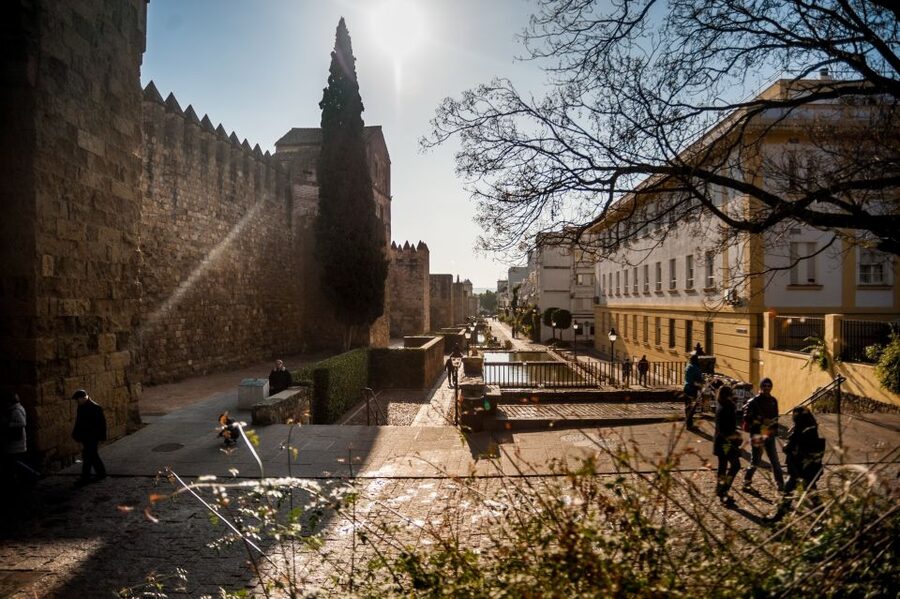
The bus then reaches San Basilio and the Puerta de Almodóvar. San Basilio is known for its traditional courtyards, while the Puerta de Almodóvar is one of the surviving historic entrances to the city. Córdoba once had 13 city gates, and this gate, along with the Puerta de Sevilla and Puerta del Puente, helps you picture the old defensive boundary.
At Mercado de la Victoria, you can pause near a food market and park area. The route continues to Gran Capitán and the railway and bus station. If you arrive in Córdoba by train or coach, the station stop makes this pass especially practical. You can start sightseeing without first arranging a taxi across town.
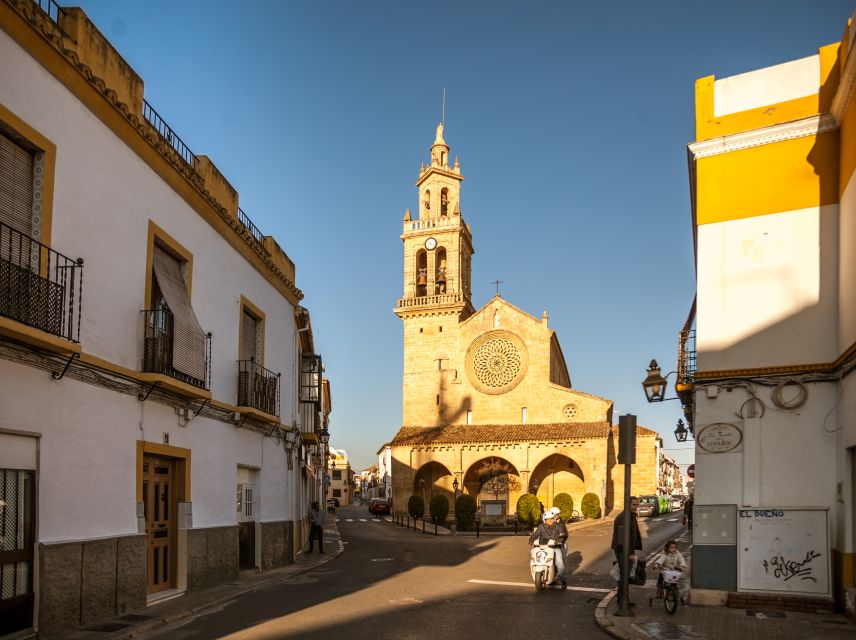
Next come the Palacio de la Merced and the Diputación, followed by the Malmuerta and Santa Marina area. The Malmuerta Tower is one of the city’s notable historic towers. Santa Marina adds another look at Córdoba’s religious architecture and quieter northern streets.
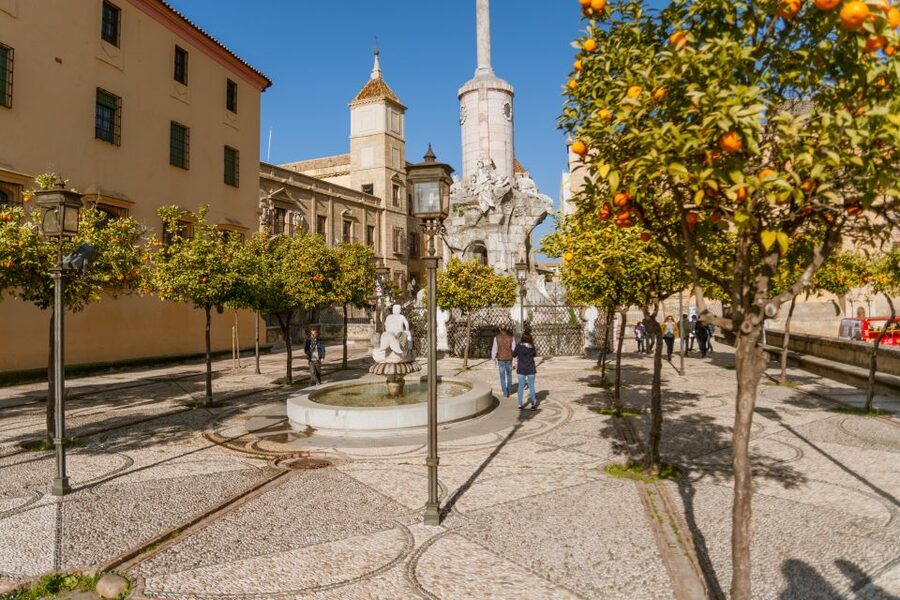
The route continues through Plaza Corazón de María, San Lorenzo, Realejo and San Andrés, then reaches the Ayuntamiento and Roman Temple. The Roman Temple is one of the clearest reminders that Córdoba’s story began long before the caliphate period. You see monumental remains beside modern civic buildings, a useful visual lesson in how the city’s eras overlap.
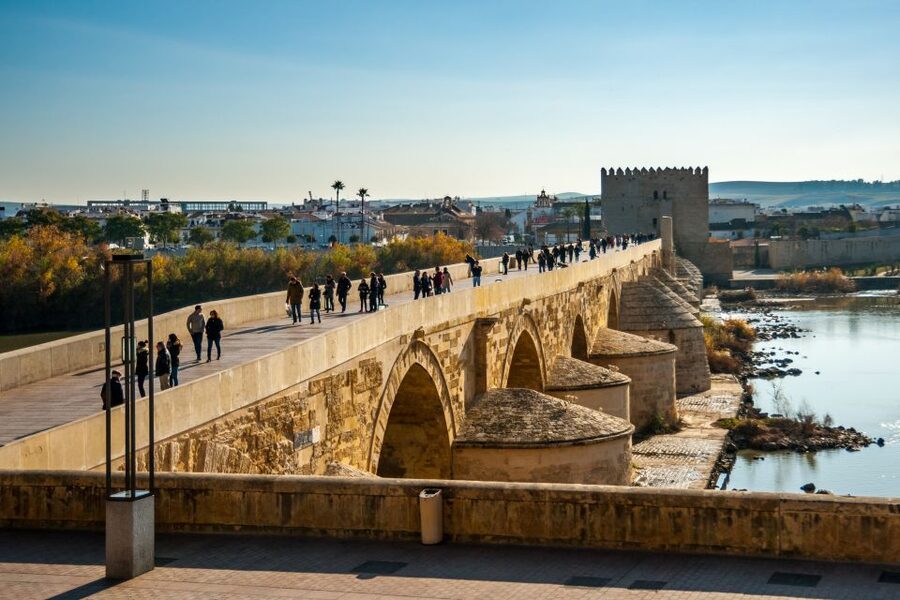
At Arco del Portillo, the route turns toward the Roman Bridge. This is one of the best places to get off if you want to connect the river, the Mosque-Cathedral, the old Jewish quarter, and the Alcázar. The bridge also provides broad views toward the city walls and riverbanks.
The final section includes the Caliphal Baths and the Alcázar. These stops place you near the Alcázar de los Reyes Cristianos, a fortified royal complex with gardens and strong links to Córdoba’s Christian period. Entry is not included, so check your priorities before you step off. The bus gets you close, but the pass itself is not an attraction ticket.
Blue Route: the 30-minute trip through narrow streets
The Intima route starts at Calle Caballerizas Reales, Stop 1, beside the Alcázar de los Reyes Cristianos. This is a minibus rather than a double-decker, and that difference is the point. It can handle streets where a large sightseeing bus cannot go.
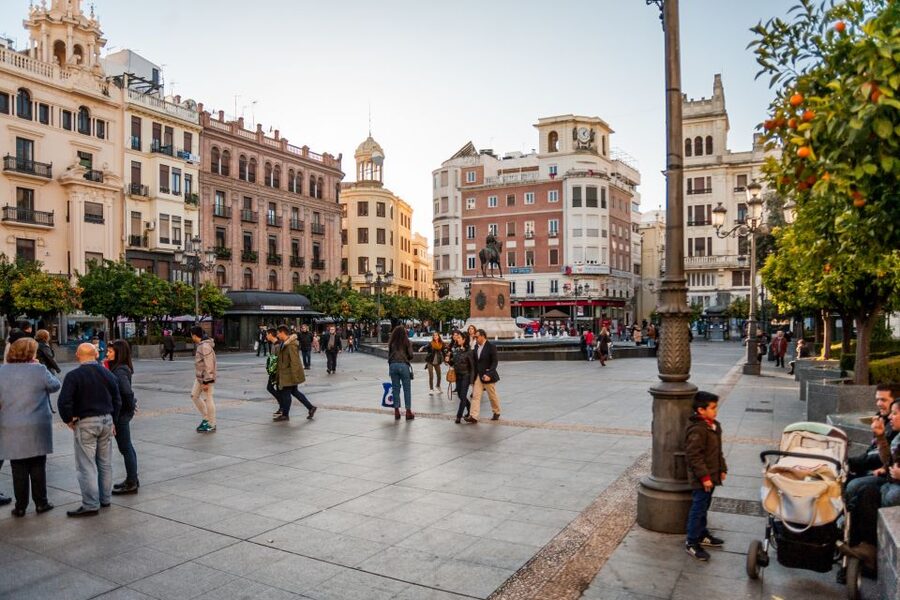
The route includes the Alcázar, Mosque-Cathedral, San Pedro, Realejo and San Andrés, Palacio de Viana, Palacio de la Merced, Ayuntamiento and Roman Temple, Plaza de las Tendillas, Arco del Portillo, and the river viewpoint. It takes 30 minutes without getting off.
I would choose this route for atmosphere rather than distance. The smaller vehicle moves through tighter streets and gives you a closer look at Córdoba’s old neighborhoods. It is a good way to understand why the city feels intimate once you leave the broad avenues.
The tradeoff is capacity. The minibus can become full, especially near the most popular stops, so you may have to wait for the next one. Since departures are listed every 70 minutes, that wait can be frustrating. The practical move is to ride the blue route early, or board at its first stop if possible.
Some passengers prefer the blue minibus because it travels through small streets and offers a more personal view of the city. Others find the red route easier because of its larger capacity and longer circuit. I would not treat the routes as rivals. They show two different versions of Córdoba, and the pass works best when you use both.
The gates, towers, and palaces along the way
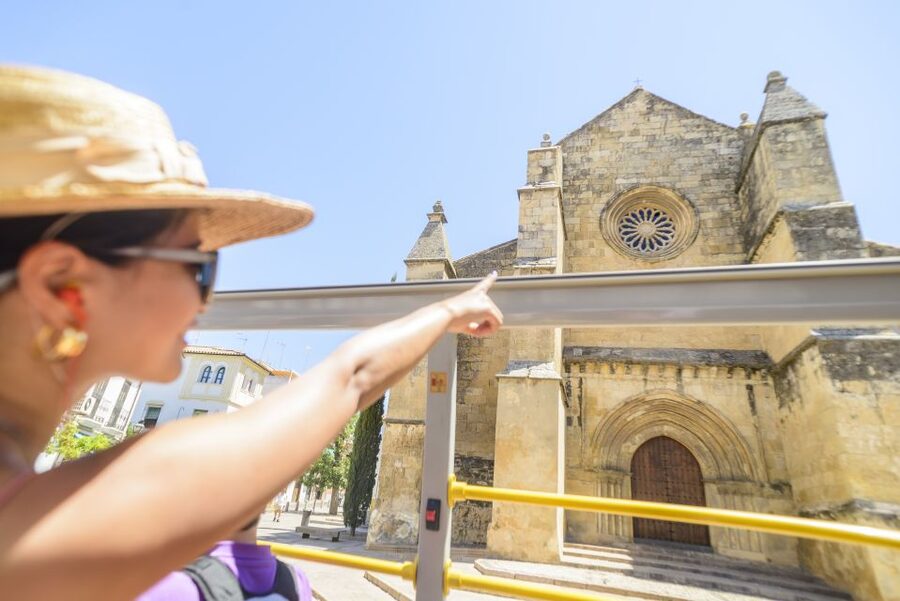
The bus commentary helps connect individual buildings to Córdoba’s wider story. The three historic gates are particularly useful reference points. The Puerta de Almodóvar and Puerta de Sevilla are tied to the old city walls, while the Puerta del Puente sits near the Roman Bridge and the river.
The towers add another layer. Look for Malmuerta, Belén, Puerta del Rincón, Calahorra, and Donceles. You may not want to get off at every one, but hearing their names while seeing their positions helps you understand how Córdoba was defended and organized.
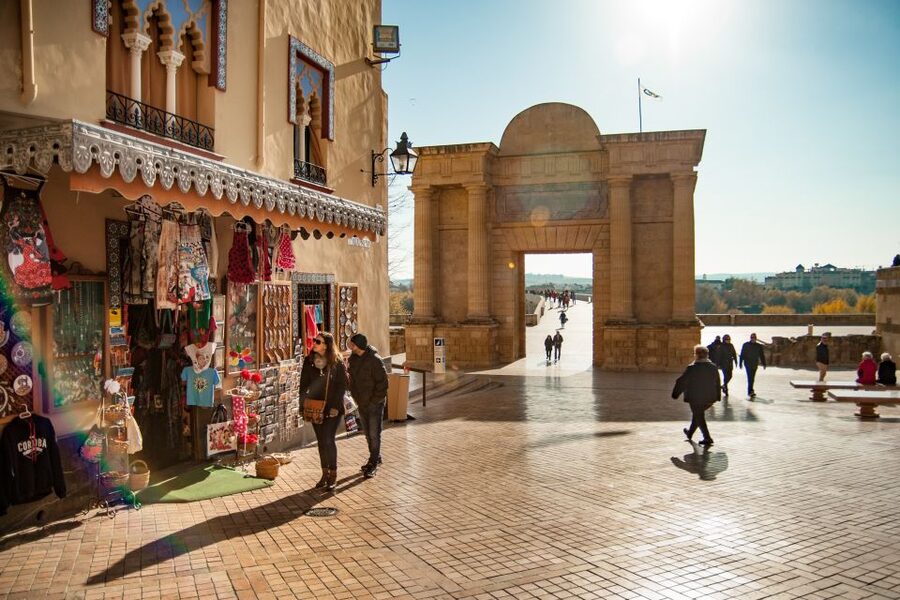
The Torre de la Calahorra is especially easy to combine with the Roman Bridge. It faces the historic center across the river and makes a natural stop before walking toward the Mosque-Cathedral. The bridge itself is a pleasant place to stretch your legs after the bus ride.
The Palacio de Viana is another worthwhile stop if you enjoy courtyards and decorative interiors. The Palacio de la Merced offers a different setting, linked to the provincial government and surrounded by a broader urban district. These palaces show a side of Córdoba that can be missed if you focus only on the Mosque-Cathedral.
The bus also passes gardens and parks, including the Botanical Garden and the gardens near the Alcázar. Córdoba’s outdoor spaces matter because the city’s great monuments can fill a full day with stone, shade, and formal architecture. A short garden stop gives your eyes a rest.
Same base, a different kind of afternoon:
- Cordoba: Equestrian Show General Entry
★ 4.5 · 2,333 reviews - Cordoba: Mosque-Cathedral E-Ticket with Audio Guide
★ 4.1 · 2,124 reviews - Cordoba Mosque & Jewish Quarter Tour with Tickets
★ 4.6 · 1,996 reviews - Cordoba: Alcazar Guided Tour and Skip-the-Line Ticket
★ 4.2 · 1,792 reviews
The Mosque-Cathedral and the Judería connection
The Mosque-Cathedral is the main reason many people come to Córdoba, and the bus is most useful as a way to place it within the city. The commentary explains its religious changes, from the Islamic period through its later Christian use. You still need a separate admission ticket to enter.
Get off near the Mosque-Cathedral and allow time for the surrounding streets. The Judería, or Jewish quarter, is best explored on foot, where narrow lanes and small courtyards replace the broad views from the bus. The included Judería walking tour begins at 6pm from the Roman Bridge stop on the Panoramica route and lasts one hour.
The walk is offered in Spanish and English. Its timing makes it a good evening activity after using the bus during the day, although it does mean you need to plan around the fixed start. Do not assume you can join at any hour.
The bus and walking tour work well together. The bus gives you orientation, then the walk slows things down in the oldest quarter. If the walking tour is a priority, arrive at the Roman Bridge stop early enough to avoid confusion about where to wait.
An additional walking tour near Mercado de la Victoria is mentioned with the activity, but one scheduled walk did not appear for a passenger. I would treat the Judería tour as the safer included option and confirm any other walking departure locally.
Timing, waiting, and the one-day limit
The pass is valid for one day, not a rolling 24-hour period. The listed first departure from the route starting points is 9:30am, and the last is 6pm. The red route runs for 70 minutes, and the blue route takes 30 minutes. Buses generally arrive every 70 minutes.
That timetable requires some planning. If you get off at a stop and miss the next bus, you may wait longer than expected. At some stops, finding a clear timetable can be difficult, and a stop without waiting passengers may be passed by the driver.
I would use the bus as a framework rather than a nonstop taxi. Start with one complete route if you want the commentary and city overview. Then get off at two or three sights that match your interests, rather than trying to visit every stop.
The railway and bus station stop is a useful starting point for arrivals. If you are staying near another stop, you can board there too, but it helps to identify the stop in advance. A printed route map or a photo of the route information can save you an unnecessary walk.
The schedule can change. One listed date has buses running every 60 minutes instead of every 70, so check the current timing before you build a tight itinerary. Do not plan a monument entrance with only a few minutes between the bus arrival and your timed entry.
Is the $32 price fair?
At $32 per person, the value depends on how you use the ticket. If you ride both routes, listen to the commentary, use the bus to reach distant areas, and join the Judería walk, the price is reasonable. You are paying for orientation, transport, and convenience, not just a loop around the center.
The pass is especially helpful if you arrive by train, have limited time, or need to reduce walking. One stop near an apartment helped a passenger with crutches reach several parts of the city, and the wheelchair-accessible bus adds another practical advantage.
It is weaker value for a confident walker spending one relaxed day around the Mosque-Cathedral, Roman Bridge, and Judería. Córdoba’s central sights are close enough to connect on foot, and attraction tickets remain separate.
Families may appreciate the child’s audio commentary in Spanish, while international visitors benefit from the broad language choice. The headphones are included, but check the outlet when you board. Some lower-deck audio connections have not worked, and the upper deck can be hot in full sun.
Who should book this Córdoba bus tour?
I would book it for a first visit, a short stop, a hot day, or a trip where walking needs to be limited. It is also a good first activity because the commentary gives you a city layout before you decide which monuments deserve your time.
I would be more cautious if you dislike waiting, need exact connections, or want a carefully guided visit inside the main monuments. The bus does not replace an entry ticket or a specialist guide at the Mosque-Cathedral, Alcázar, or other paid sights.
Book it when you value a broad view and flexible stops. Skip it when your plans already center on a small walking area and you prefer to set your own pace.
FAQ
How long is the Córdoba hop-on hop-off pass valid?
The pass is valid for one day. The activity is described as a 24-hour hop-on hop-off ticket, but the operating information specifies validity for one day, so check the current schedule when booking.
How long do the two bus routes take?
The Panoramica red route takes 70 minutes. The Intima blue minibus route takes 30 minutes.
How often do the buses run?
The listed schedule says buses run every 70 minutes on both routes. On one specified Friday, service is scheduled every 60 minutes, so check the date-specific timetable.
What time do the buses start and finish?
The first departure from Stop 1 on both routes is at 9:30am. The last departure from Stop 1 is at 6pm.
Is the Judería walking tour included?
Yes. It starts at 6pm from the Roman Bridge, Stop 16 on the Panoramica route, and lasts one hour. It is available in Spanish and English.
Are attraction entrance tickets included?
No. The pass includes the bus, audio commentary, headphones, and the Judería walking tour, but admission to attractions is not included.
Is the bus wheelchair accessible?
Yes, the activity is listed as wheelchair accessible. You can redeem a mobile or printed voucher at any designated stop along the routes.
Recently listed in Cordoba
- Sights, Sounds, and Scents of Córdoba’s Patios★ 4.4 · 109 reviews
- Medina Azahara Guided Tour at Night★ 4.6 · 142 reviews
- Cordoba: Half-Day Medina Azahara Guided Tour★ 4.6 · 288 reviews
- Cordóba: Gardens & Fortress of Catholic Monarchs Guided Tour★ 4.3 · 336 reviews
- Córdoba: Viana Palace Gardens and Patios Entry Ticket★ 4.5 · 880 reviews
- Cordoba: Medina Azahara Museum and Archaeological Site Tour★ 4.8 · 199 reviews
- Patios of Cordoba Walking Tour★ 4.4 · 199 reviews
- Córdoba: Tablao Flamenco at Doble de Cepa with Optional Meal★ 4.4 · 197 reviews
City Tours, compared.



City Sightseeing Barcelona Hop-On Hop-Off Bus Tour: 24 or 48-Hour
Read our review →
Granada City Train 1 or 2-Day Hop-On Hop-Off Ticket
Read our review →
Barcelona City Tour Hop-On Hop-Off with Optional Boat
Read our review →Browse the lists this tour appears in