
Reviewed · HORSES
Andalusian Horses Dance Show
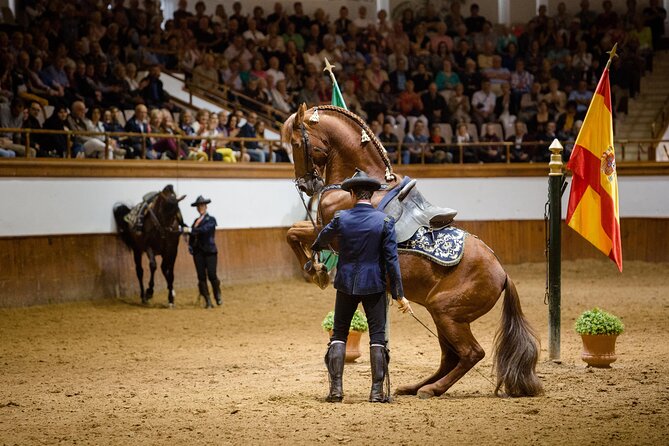
The horses do far more than trot in circles. At the Royal Andalusian School of Equestrian Art in Jerez, you’ll see riders guide polished Andalusian horses through classical dressage, cattle-herding techniques, carriage driving, and high-school movements set to music. I like the variety of the 90-minute show and the clear sense of tradition behind every maneuver. I also like that the performance works well for families, even if not everyone in your group knows much about horses.
The main catch is seating. Tickets are sold by price category, not by chosen row or seat, and a few positions can have a restricted view of the arena. The Spanish-only explanations can also leave international visitors guessing about the finer points. Plan ahead, arrive early, and treat this as a serious equestrian performance rather than a casual animal attraction.
In This Review
- Key points before you book
- Why this Jerez horse show feels different
- Arriving at the Royal Andalusian School
- Ticket collection, seats, and the first few minutes
- Doma vaquera: Spanish riding with working roots
- Classical dressage set to music
- Carriage driving brings a different kind of drama
- Work in hand and Haute École movements
- The carrousel finishes with teamwork
- What the $33.43 price gets you
- Heat, language, and practical comfort
- Who will enjoy it most
- Should you book the Andalusian Horses Dance Show?
- FAQ
- Where does the Andalusian horse show take place?
- What time does the show begin?
- How long does the performance last?
- What kinds of performances are included?
- Can I choose my exact seat?
- Can I cancel for a full refund?
Key points before you book
- Six to eight choreographies: Each performance combines several routines from classical dressage and traditional Spanish riding.
- Jerez setting: The show takes place at the Royal Andalusian School of Equestrian Art, a short distance from the city’s historic center.
- Traditional riding skills: Doma vaquera shows techniques once used by Spanish cattle herders, including one-handed riding, sharp rhythm changes, pirouettes, and gallops.
- Beautiful finale: The carrousel brings several horses and riders into the arena for coordinated movements.
- Seat allocation matters: You choose a ticket category, but not a specific seat. A higher position can provide a broader view.
- Practical timing: The performance begins at 12:00 pm and lasts about 1 hour 30 minutes. Allow extra time for arrival and ticket collection.
Why this Jerez horse show feels different
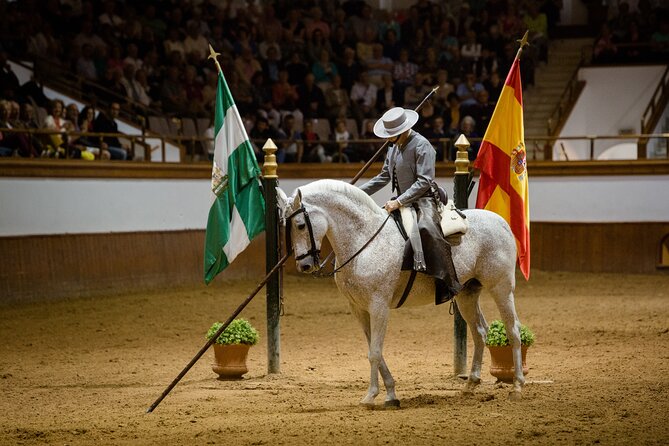
Andalusian horses have an unmistakable presence. They are compact, powerful, and unusually composed, with the poised movement that makes dressage look almost effortless. Here, the appeal is not simply watching beautiful animals. You are watching a carefully trained partnership between horse and rider.
The show is presented by the Royal Andalusian School of Equestrian Art, located on Avenida Duque de Abrantes in Jerez de la Frontera. Jerez is one of the best places in Andalusia to see this equestrian tradition in its proper setting. The performance connects modern exhibition with older working skills, formal dressage, carriage handling, and exercises associated with the Spanish riding school tradition.
The format changes by day. Each show uses between six and eight choreographies selected from the school’s repertoire. The program may include doma vaquera, classical dressage, carriage driving, work in hand, and the final carrousel. The school says the different programs carry a similar level of difficulty and entertainment, so you are not simply hoping for one particular routine.
That variety helps keep the 90 minutes moving. One segment emphasizes speed and control. Another focuses on tiny changes in rhythm and posture. Then the scale shifts as several horses move together. I find this more rewarding than a performance built around one repeated trick.
A few more Cadiz ideas to compare
- Cadiz: Andalusian Horses and Bulls Country Show
★ 4.6 · 189 reviews - Jerez de la Frontera: How the Andalusian Horses Dance
★ 4.6 · 6,168 reviews - El Salobre: Horse Riding Adventure with Transfer Options
★ 4.5 · 1,609 reviews
Arriving at the Royal Andalusian School
You’ll need to make your own way to the school and present your printed receipt at the ticket office. The official meeting point is the Royal Andalusian School of Equestrian Art, Av. Duque de Abrantes, s/n, 11407 Jerez de la Frontera, Cádiz, Spain.
The address matters because Cádiz and Jerez are separate places. If you are staying in Cádiz, check your route carefully and allow a generous margin before noon. If you are coming by train, verify that you are getting off at Jerez de la Frontera, not another station or town with a similar name. A wrong stop can turn a simple outing into an expensive taxi ride.
The school is near public transportation, and some people reach it by train from Seville. That makes the show a realistic day trip for visitors based in Seville, Cádiz, or nearby coastal areas, though you should check the day’s transport schedule before committing to the 12:00 pm start.
Parking advice is less tidy. Nearby parking may be available, and some areas have been reported as free, but people may approach drivers and offer to arrange or supervise parking. Do not assume you need to pay simply because someone waves you toward a space. Check the signs and local rules yourself. If you prefer not to deal with this uncertainty, public transportation or a prearranged taxi may be simpler.
If you are arriving from a cruise ship, allow plenty of time. A taxi from the cruise port can take roughly 30 to 40 minutes, and the fare may be much higher than expected if the driver waits for you. Confirm the cost before setting off and be cautious about agreeing to a return wait. One practical suggestion from past visitors is to compare taxi pricing with Uber, where available.
Ticket collection, seats, and the first few minutes
Bring the printed receipt. This is not the place to rely only on a phone confirmation, since the instructions specifically require a printed receipt at the ticket office.
Discounted tickets come with another condition. If you bought a reduced-price ticket, you must show proof that you qualify. Without the right document, you may need to pay the difference to the standard ticket price, assuming full-price tickets are still available.
The biggest seating issue is that you buy by category rather than by exact row and seat number. Seats are allocated according to the order of purchase or booking. That means booking early can help, but it does not give you a normal seat-selection map.
A broad view is important for this show. The riders cover the full arena, and several routines depend on seeing formations from a distance. A seat very close to the horses can feel exciting, but a higher position may let you follow the patterns more easily. Some people have enjoyed front-row seats, while others found that a restricted view spoiled part of the performance. If you have a choice within your category, favor a central or higher position.
Arrive early enough to find the correct ticket window and settle in. Signage at the ticket office may not make the prepaid-ticket process obvious, and one visitor reported joining the wrong line before being redirected. A few extra minutes can save a needless scramble.
Doma vaquera: Spanish riding with working roots
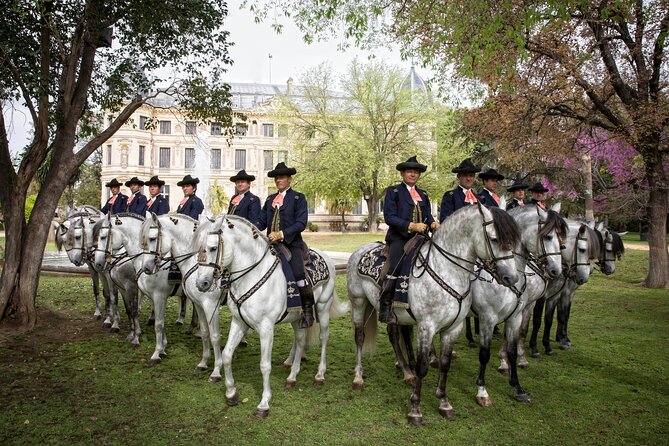
Doma vaquera is one of the most distinctive parts of the program. This is not just formal arena riding. It draws on the techniques used by Spanish horsemen working cattle.
The rider uses one hand while guiding the horse around the arena. The routine begins at a trot and may build to a gallop, with changes in rhythm, pirouettes, and sudden bursts called arreones. The effect is less polished ballet and more controlled working skill. You can see how a horse and rider need to respond quickly when handling livestock.
For you, this section provides useful contrast. Classical dressage can seem measured and almost weightless. Doma vaquera shows a sharper, more practical side of Andalusian horsemanship. It is also a reminder that many display movements began as useful tools before becoming formal equestrian art.
Same base, a different kind of afternoon:
- Tarifa: Whale & Dolphin Watching in the Strait of Gibraltar
★ 4.7 · 835 reviews - Cadiz: City Sightseeing Hop-On Hop-Off Bus Tour
★ 4.1 · 753 reviews - Cultural excursion for one day to Tangier with ferry included
★ 4.0 · 577 reviews - Walking Tour through Cádiz: Stories from the hand of a local guide
★ 5.0 · 532 reviews
Classical dressage set to music
Classical dressage supplies the show’s most graceful moments. The horses perform advanced exercises to classical music, with the rider giving signals that can be so subtle you may not immediately see them.
The repertoire includes The Colts, Airs on Horseback, Pas de Deux, Passage and Piaffe, Domino on Horseback, Airs Above the Ground, and Fantasy. You may not see every named routine in one performance, since the school changes the selection by day.
Passage and piaffe are especially striking because the horse appears to move in place while maintaining an upright, controlled posture. A pas de deux adds another layer, with two horse-and-rider pairs working in relation to each other. The presentation is helped by the music, which gives each movement a formal rhythm rather than making the arena feel like a training yard.
You do not need technical horse knowledge to enjoy this part. Watch the riders’ hands, posture, and timing. The less obvious the cue, the more impressive the result. The horses may appear to act independently, but the precision comes from years of training and close communication.
Carriage driving brings a different kind of drama
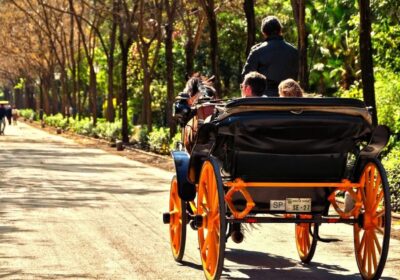
The carriage-driving segment changes the pace and fills the arena with larger equipment. Horses wear classical harness and pull carriages once used for transportation. Today, the skill survives mainly in sport and public exhibition.
The coachmen must control the horses, carriage, and turns as one unit. You are watching more than a handsome old vehicle rolling past. The challenge lies in keeping the team coordinated while guiding a heavier object through the arena.
This is a good section for families because the visual change is immediate. Children who may not follow the finer points of dressage can still understand the challenge of horses drawing a carriage in formation. It also gives you a glimpse of how equestrian traditions extended beyond the saddle.
Work in hand and Haute École movements
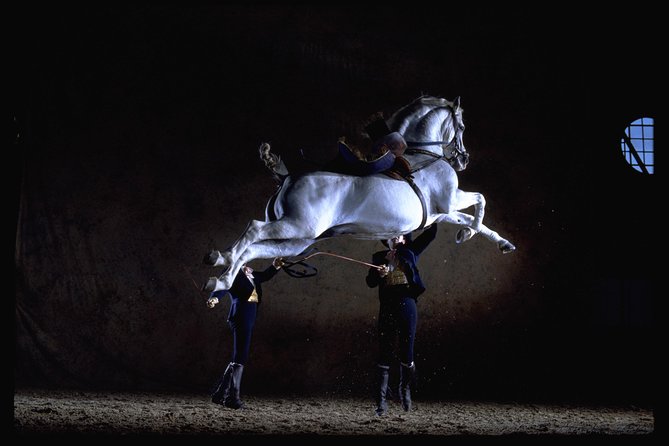
Work in hand shows the horse responding even when the rider is not seated. The horseman gives commands from the ground while the horse performs advanced Haute École exercises.
The listed movements include levades, caprioles, courbettes, piaffe between pillars, the Spanish walk, and work on long reins. Some of these movements involve raised forequarters or powerful jumps, so this section can bring the show’s biggest surprises.
The value here is control. You can see that training is not limited to making a horse move forward, turn, or stop. The horse is expected to understand precise instructions from different positions and carry out movements with balance and composure.
The performance does not provide a full lesson in terminology, especially because the spoken explanations are in Spanish. Announcements may be made in several languages, but descriptions before individual segments can remain Spanish-only. You can still follow the action, though an English guide or printed explanation would make the technical parts easier to appreciate.
The carrousel finishes with teamwork
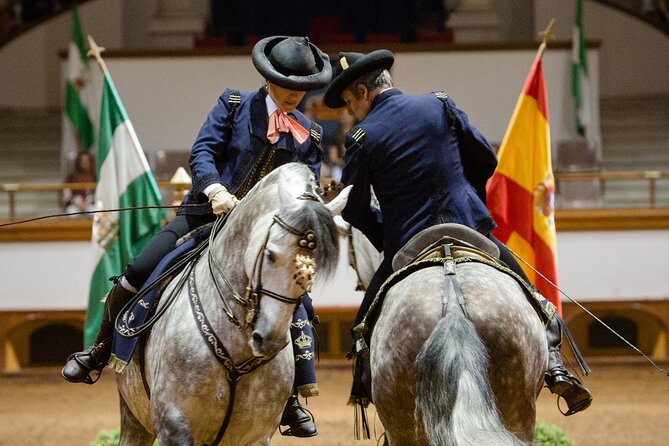
The carrousel is the natural finale. Several horses and riders enter the arena and perform advanced exercises together, working in unison.
After watching individual riders demonstrate control, you get to see the same discipline applied to a group. Spacing, timing, and rhythm all matter. One horse drifting out of position would affect the whole pattern, so the final sequence rewards close attention.
This is also the moment when a good seat pays off. The riders use the central arena, and a wider view helps you understand the formations. If your seat blocks one section, you may miss part of the coordination, which is why I would not treat the lowest ticket price as the only factor.
What the $33.43 price gets you
At about $33.43 per person, the ticket is fair value if you have a real interest in horses, dressage, Spanish culture, or unusual family activities. You are paying for a polished 90-minute performance in a specialist school, not for a quick photo stop.
The strongest value comes from the range of skills shown in one sitting. You see working-style riding, formal dressage, carriage handling, exercises from the ground, and a group finale. A single museum visit might explain these traditions, but it would not give you the same sense of timing, sound, and movement.
The value drops if you mainly want to walk around the school grounds. The ticket covers admission to How the Andalusian Horse Dance, while entrance to other facilities is not included. The grounds can be worth allowing extra time for, and there may be a cafe and shop inside, but do not assume every area or activity is part of this ticket.
The price also makes seat allocation more important. If a slightly higher ticket category gives you a clearer view, it may be money well spent. A cheap seat with a large blocked section can undermine an otherwise excellent show.
Heat, language, and practical comfort
The arena can get warm in summer. Bring a fan and dress for the season, especially since the show lasts about an hour and a half. The performance is not a quick indoor stop where you can simply move on after 20 minutes.
Photography and recording are not allowed unless you are an authorized professional. Leave bottles, cans, animals, and other objects that management considers unsuitable outside the grounds. These rules are strict enough that you should read them before arriving rather than assume you can take a few discreet phone clips.
The venue is suitable for most people, and families are a natural fit. You do not need to ride horses yourself. The show works for anyone who enjoys music, formal movement, animal training, or a distinctly Andalusian cultural experience.
For a fuller visit, arrive 30 to 45 minutes early if possible. You may be able to watch horses and riders warming up, and the grounds give you time to get oriented before the performance. Just remember that access to facilities beyond the show may require a separate ticket.
Who will enjoy it most
I would recommend this experience first to horse lovers and anyone curious about classical riding. It is also a strong choice for families looking for something different from churches, beaches, and city walks.
You will get the most from it if you:
- Like watching skilled movement and fine control
- Enjoy classical music and formal performances
- Want a direct look at Spanish equestrian traditions
- Can manage a short journey to Jerez
- Do not mind following some explanations in Spanish
- Are willing to arrive early and pay attention to seating
I would think twice if you need a fully guided experience in English, dislike fixed seating, or have very limited time before another appointment. The show itself is predictable in length, but transport, parking, and ticket collection can add uncertainty.
Afterward, you’ll be in Jerez, close to historic sites, cafes, and other city destinations. That makes the performance easy to pair with a meal or a walk through town instead of treating it as an isolated outing.
Should you book the Andalusian Horses Dance Show?
Yes, if you want to see horses performing real technical work in a polished setting. The strongest moments are the one-handed doma vaquera riding, the quiet precision of classical dressage, the high-energy work in hand, and the coordinated carrousel.
Book ahead if your dates are fixed, since the experience is often reserved about a month in advance. Print your receipt, bring discount documents if needed, confirm your route to Jerez, and arrive early enough to improve your chances of a good view.
I would not book it simply because the title sounds like a novelty act. This is formal equestrian art, with moments of ballet-like grace and others rooted in practical ranch work. For the right audience, the $33.43 price buys a memorable slice of Andalusia. For everyone else, it may feel more specialized than expected.
FAQ
Where does the Andalusian horse show take place?
It takes place at the Royal Andalusian School of Equestrian Art on Av. Duque de Abrantes, s/n, 11407 Jerez de la Frontera, Cádiz, Spain.
What time does the show begin?
The listed start time is 12:00 pm.
How long does the performance last?
The show lasts approximately 1 hour 30 minutes.
What kinds of performances are included?
The program may include doma vaquera, classical dressage, carriage driving, work in hand, and a final carrousel. Each performance includes six to eight choreographies selected from the school’s repertoire.
Can I choose my exact seat?
No. Tickets are sold by price category, without a choice of specific row or seat number. Seats are allocated according to the order of purchase or booking.
Can I cancel for a full refund?
You can cancel up to 24 hours before the local start time for a full refund. Cancellations or changes made less than 24 hours before the experience are not accepted for a refund.
Recently listed in Cadiz
- Essential Tangier excursion 1 day★ 4.0 · 124 reviews
- Tangier Private Tour with Ferry & Lunch from Tarifa★ 5.0 · 432 reviews
- Semi-private kitesurfing lessons in Tarifa (adapted to every level)★ 5.0 · 214 reviews
- Cadiz Shore Excursion: City Sightseeing Cadiz Hop-On Hop-Off Bus Tour★ 4.0 · 124 reviews
- Cadiz Food Tour: Tapas, Drinks and Delights with a Local★ 5.0 · 174 reviews
- City Sightseeing Cadiz Hop-On Hop-Off Bus Tour★ 3.5 · 163 reviews
- Cadiz Small Group Bike Tour★ 4.5 · 215 reviews
- Sancti Petri: Sunset Catamaran Cruise★ 4.5 · 277 reviews
Horses, compared.
Jerez de la Frontera: How the Andalusian Horses Dance
Read our review →
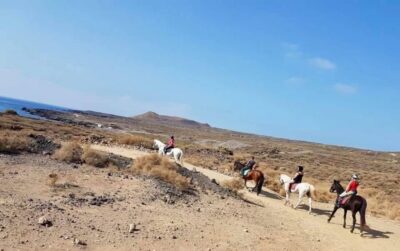
El Salobre: Horse Riding Adventure with Transfer Options
Read our review →
Jerez de la Frontera: Andalusian Horse Dance and Museums
Read our review →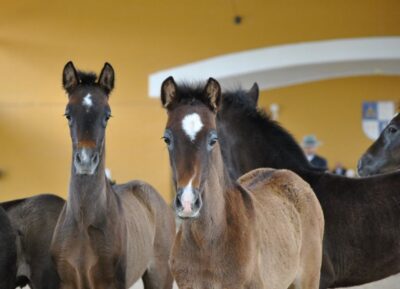
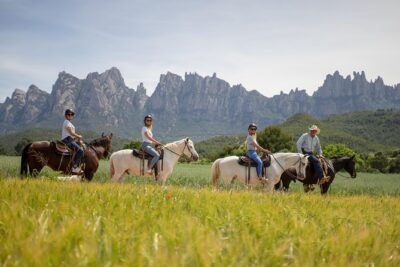
Montserrat Monastery & Horse Riding Experience from Barcelona
Read our review →
Browse the lists this tour appears in