Reviewed · GUIDED
Guided Tour of Roman Tarragona
Tarraco comes alive under your feet. This two-hour walking tour links Tarragona’s Roman walls, circus, amphitheater, towers, and old forum into one clear story. I like the route because it covers the city’s major Roman sights without asking you to plan a complicated sequence, and I like that the Roman Circus and Tarraco model are included with reserved admission.
The guides are another strong point. Ariadna, Georgia, Gemma, Laia, and Marco are praised for clear, lively explanations, with stories about daily life and Roman building methods rather than a dry list of dates. The main consideration is that the tour is not always exactly two hours, and the circus visit may feel shorter than expected if you hope to explore every section.
In This Review
- Key points to know before booking
- Why Tarragona works so well as a Roman history lesson
- Starting at the Roman walls
- The Tarraco model and the missing city
- The cathedral and the old imperial center
- Walking between the cathedral and Plaza del Rey
- The Praetorium tower and layers of power
- The amphitheater above the Mediterranean
- Entering the Roman Circus and its vaults
- How good are the guides?
- The value at $17.44 per person
- Group size, meeting point, and cancellation
- Who should book this Roman Tarragona walk?
- Should you book it?
- FAQ
- How much does the Guided Tour of Roman Tarragona cost?
- How long does the tour last?
- What time does the tour start?
- Where does the tour begin?
- Where does the tour finish?
- Is admission to the Roman Circus included?
- Is admission to the Tarraco model included?
- Are all monument admissions included?
- Can I cancel for a full refund?
Key points to know before booking
- The Roman Circus is the tour’s best practical benefit: Your reserved entry helps you get through the turnstiles without waiting.
- The route covers Tarragona’s essential Roman sights: You see the walls, cathedral area, provincial forum, Praetorium tower, amphitheater, and circus.
- The commentary makes the ruins easier to picture: Guides explain how Tarraco functioned and how Roman people lived.
- The price is modest for the access included: At $17.44 per person, the tour offers a useful introduction to the city’s Roman core.
- The meeting point needs attention: Start at ITINERE Tourism & Culture on Carrer Baixada del Roser at 11:00 a.m., not at the amphitheater.
- The experience suits most people, with some limits: The group can reach 25 people, and one wheelchair user found the circus galleries workable but could not access the cathedral cloister.
Why Tarragona works so well as a Roman history lesson
Tarragona was known in Roman times as Tarraco, and the city still presents its ancient remains in a way you can grasp on foot. The Roman monuments are not isolated behind a single gate. They are mixed into the modern city, with walls, streets, towers, religious buildings, and views toward the Mediterranean appearing one after another.
That setting gives the tour its main strength. You are not simply looking at a detached ruin. You are moving through the old center and seeing how Roman planning shaped the city that followed.
I especially like the comparison between ancient Tarraco and present-day Tarragona. The guide’s job is to help you picture the missing pieces: the scale of the forums, the purpose of the circus vaults, and the way Roman engineering supported public life. Several guides are praised for making these ideas understandable to different ages, including school groups and adults who already know something about Roman history.
The format is also sensible for a first visit. You get a guided framework in about two hours, then you can decide which monument deserves more of your own time later.
A few more Spain ideas to compare
- Barcelona: Sagrada Familia Entry Ticket with Audio Guide
★ 4.6 · 105,312 reviews - Barcelona: Park Guell Guided Tour with Skip The Line Entry
★ 4.7 · 17,563 reviews - Málaga: Caminito del Rey Guided Tour with Transportation
★ 4.8 · 12,183 reviews
Starting at the Roman walls
The tour begins at ITINERE Tourism & Culture, Carrer Baixada del Roser, 8, at 11:00 a.m. The first stop is the Murallas de Tarragona, or Roman walls, with about 15 minutes along the route connected to the Roman Empire.
This is a good opening because the walls introduce the scale and importance of Tarraco before you reach the larger monuments. The guide can set the city into its Roman context, helping you understand that Tarragona was not just a provincial outpost with a few surviving stones.
Admission to the walls is not included, so check what the guide plans to explain from the route and what you may need to visit separately. The starting point is in the old center and close to public transportation, but one complaint specifically mentions difficulty finding the departure location. I would allow extra time and use the exact address rather than heading straight to the amphitheater.
That distinction matters. The tour ends at the amphitheater, but it does not begin there.
The Tarraco model and the missing city
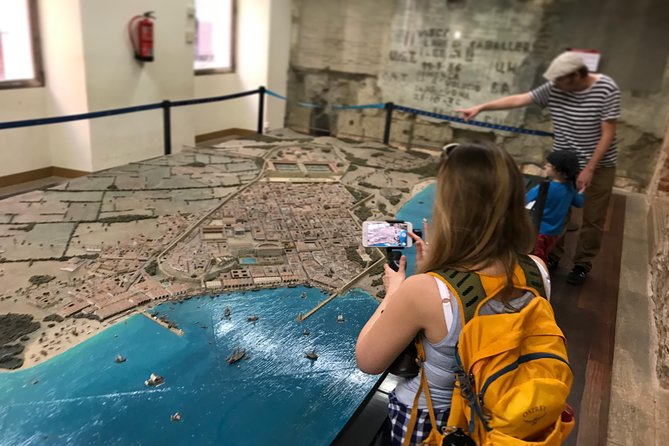
Next comes a 10-minute stop inside the building that houses the model of Tarraco. Admission is included, and this may be one of the most useful short stops on the walk.
Roman ruins can be confusing. You see a wall, a vault, or a fragment of seating, but it is hard to know how the pieces once fitted together. A city model gives you the overview. You can see the relationship between the elevated old center, the public buildings, the circus, and the amphitheater before standing among those remains yourself.
The stop is brief, so do not expect a long museum visit. Its value comes from the timing. The model gives you a mental map early in the tour, and the guide can refer back to it as you move through the streets.
The cathedral and the old imperial center
At Tarragona Cathedral, the guide gives an explanation from outside the old imperial temple area. This stop takes about 15 minutes, and admission is not included.
The cathedral setting adds an important layer to the tour. Tarragona’s Roman and medieval stories occupy the same ground, so the city is not presented as a perfectly preserved ancient site. Instead, you see how later buildings and streets grew over the Roman center.
That can be more interesting than a single untouched ruin, but it also means you need to listen closely. From the outside, you may not get the full interior experience, and the cathedral is not presented as a separate included visit. One accessibility comment notes that the cloister was not reachable by wheelchair, so visitors with mobility concerns should not assume every cathedral-area feature is accessible.
Same base, a different kind of afternoon:
- Barcelona: Park Güell Admission Ticket
★ 4.4 · 76,534 reviews - Seville: Royal Alcázar Entry Ticket
★ 4.6 · 28,378 reviews - Barcelona: Casa Batlló Entry with Self-Audioguide Tour
★ 4.7 · 25,359 reviews - Seville: Cathedral and La Giralda Entry Ticket
★ 4.5 · 24,592 reviews
Walking between the cathedral and Plaza del Rey
The longest part of the walking route is a 30-minute stretch through the streets between the cathedral and Plaza del Rey. Admission is not included because this is mainly an outdoor walk through Tarragona’s old center.
I like this part because it gives the tour breathing room. Instead of rushing from monument to monument, you walk through the city where Roman remains, medieval buildings, and modern life overlap. The guide can explain how Tarragona changed over time while you move between the main archaeological sites.
This is also where a strong guide makes the greatest difference. Laia is praised for giving the Roman story a broad shape, while other guides are noted for adding anecdotes about everyday life. The best commentary here is not just about emperors. It helps you imagine workers, officials, soldiers, families, and crowds using the city’s public spaces.
The walking portion does require comfort with uneven historic streets and a steady route. The exact physical demands are not described in detail, so I would treat this as a normal old-town walking tour rather than a flat, fully accessible route.
The Praetorium tower and layers of power
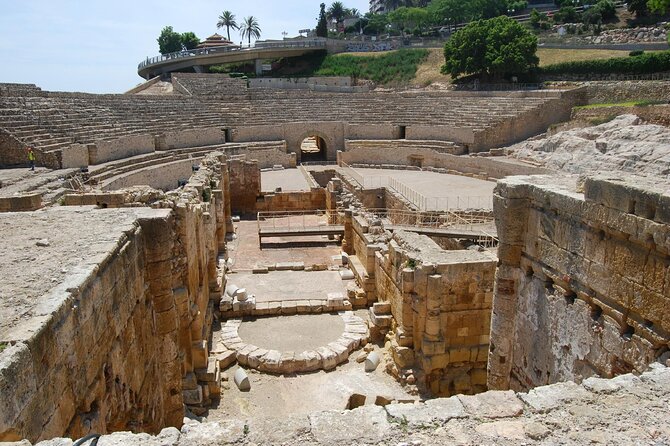
The Torre del Pretorio Romana is a 10-minute stop and one of the two included admissions. The tower sits at a corner of the old Provincial Forum and later served as a medieval royal castle.
This is a compact monument with a useful lesson built into it. The same structure passed through different periods and purposes, showing how Roman construction was reused rather than simply abandoned. A Roman tower becoming part of a medieval castle makes the city’s timeline easier to understand.
The stop is short, but the tower helps connect the public and political parts of ancient Tarraco. It also reminds you that the ruins you see today are not all from one moment. Later generations altered, reused, and built around Roman structures.
The amphitheater above the Mediterranean
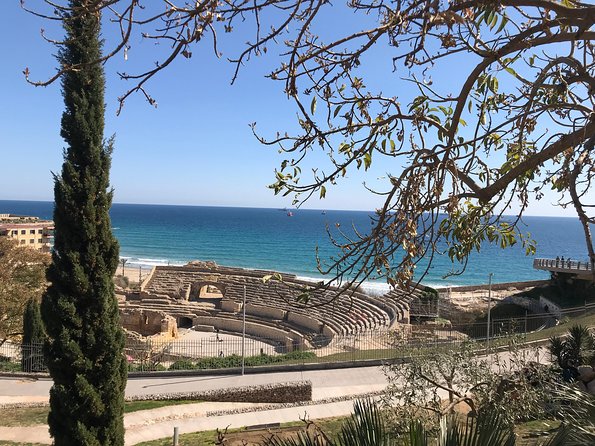
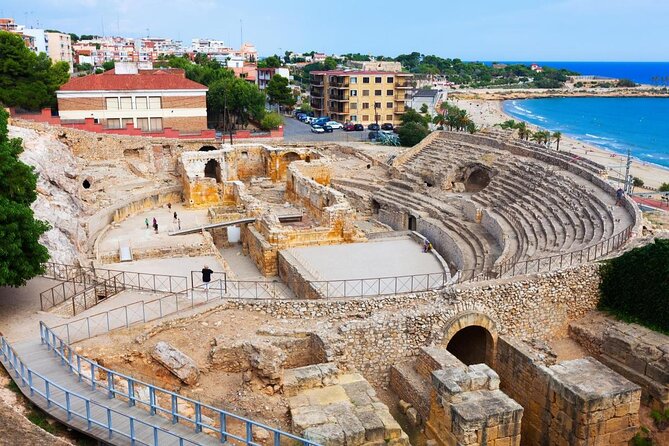
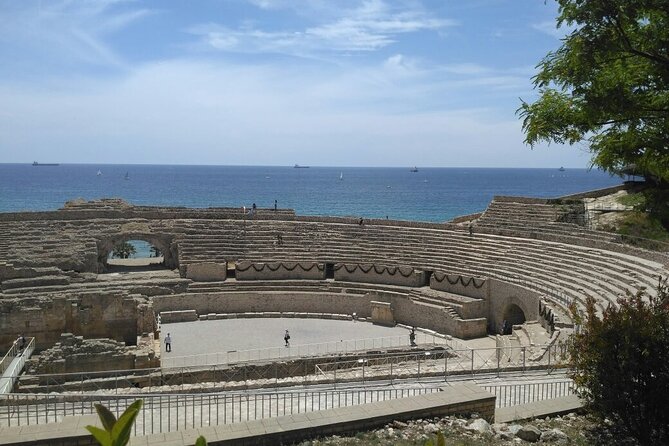
The amphitheater receives about 20 minutes of explanation from a higher terrace. Admission is not included, according to the tour details, so this is primarily an exterior viewing and interpretation stop rather than a full included entry.
This is likely the most photogenic point on the route. The amphitheater sits by the Mediterranean, and the combination of Roman stonework and sea views gives the site its strongest visual moment. Several comments single out the amphitheater and the horizon as highlights.
The terrace viewpoint is useful because it lets you see the shape of the monument before moving on. You can take in the arena, the seating area, and its position beside the sea. But if you want to walk fully inside the amphitheater or study it at length, you may need additional time outside the tour.
The stop is also a reminder to keep expectations precise. The tour covers the amphitheater, but the stated admission is not included. Ask the guide what can be entered on the day, especially if seeing the interior is a priority.
Entering the Roman Circus and its vaults
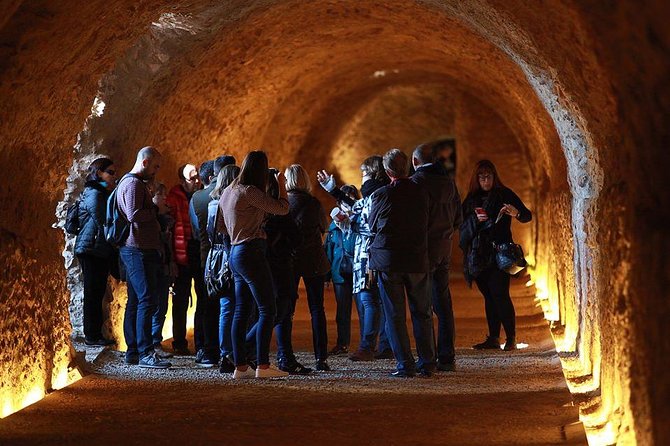
The final major stop is the Circ Roma, or Roman Circus, with about 20 minutes assigned to the vaults beneath the forum and the stadium stands. Admission is included, and the pre-reserved ticket is the clearest practical advantage of booking this experience.
The circus is where the tour feels most physical. You pass through the galleries and vaulted spaces that supported the ancient stadium. One particularly strong feature is the sense of moving below the public monument, through the working structure that held up the stands.
The circus is also the part most likely to affect your buying decision. The tour promises entry, but one participant found that the group stayed mainly at the entrance instead of visiting the entire circus. That does not cancel the value of the stop, especially at this price, but you should not assume you will receive an extended independent exploration of every gallery.
Another useful point is accessibility. A wheelchair user found the passage beneath the circus suitable, though the cathedral cloister was not accessible. Conditions can vary, so anyone with mobility concerns should confirm the current route before booking.
How good are the guides?
The strongest praise is directed at the guides’ delivery. Ariadna is described as didactic and engaging. Georgia is praised for passion, clear speech, and explanations that work for different ages. Gemma is singled out for strong knowledge of Tarraco and an ability to keep the walk lively, while Laia is praised for making the Roman past feel connected and complete. Marco is remembered for detailed explanations and a friendly manner.
That range matters because a Roman site can be either fascinating or exhausting depending on how it is explained. Here, the most successful approach seems to combine construction, daily life, and anecdotes. You are not left with only military dates or architectural labels.
There is one language concern to consider. One unhappy participant reported frustration with the guide’s use of Catalan when Spanish had been requested. The available information does not establish how common that problem is, but language can shape the entire experience. Confirm your preferred tour language when booking, particularly if you need Spanish rather than Catalan.
The value at $17.44 per person
At $17.44 per person, this is an inexpensive way to organize a first look at Tarragona’s Roman center. You receive a guide, a planned route, and included entry to the Tarraco model and Roman Circus. The route also reaches the walls, cathedral area, Praetorium tower, and amphitheater, even though some admissions are not included.
I see the price as particularly good if you have only a short visit to Tarragona. Planning all these stops yourself would require checking opening times, finding the right streets, understanding the ruins, and deciding how the sites fit together. The tour handles the order and supplies the historical link between them.
The value is less clear if you already know Tarraco well or want long visits inside each monument. Twenty minutes at the amphitheater and circus is enough for orientation, not for slow study. The tour gives you a framework. It is not a private archaeological walk.
The usual duration is about two hours, but some participants report nearly three hours. That can be a bonus if you enjoy a relaxed explanation, but it makes the timing less predictable. Do not schedule a tight connection immediately afterward.
Group size, meeting point, and cancellation
The group can include up to 25 people. That is not an intimate private tour, but it is still small enough for a guide to keep the route together and answer some questions. Larger groups may make it harder to hear in busy streets or narrow archaeological spaces.
The start time is 11:00 a.m. at ITINERE Tourism & Culture, Carrer Baixada del Roser, 8, 43003 Tarragona. The tour finishes at Amfiteatre de Tarragona, Parc de l’amfiteatre, s/n. Since the start and finish are different, this is useful for continuing your sightseeing at the amphitheater afterward.
Confirmation arrives when you book. The tour is near public transportation, and most people can participate. Free cancellation is available until 24 hours before the local start time. Within 24 hours, the payment is not refunded and changes are not accepted.
Who should book this Roman Tarragona walk?
I would choose this tour if you want a guided introduction to Tarragona and prefer stories to signboards. It is especially suitable for first-time visitors, families, school-age groups, and anyone who wants the city’s Roman monuments explained in a sensible order.
It also works well for a short stop. The route gathers the main sights without requiring you to study a map in advance, and the included circus entry helps remove one small point of friction.
I would think twice if you want a full interior visit at every site, a very small group, or a fully accessible route through all cathedral and archaeological areas. I would also confirm language arrangements if you are particular about receiving the tour in Spanish.
Should you book it?
Book it if you want good historical orientation at a low price. The Roman walls, Tarraco model, provincial forum area, Praetorium tower, amphitheater, and circus create a strong two-hour introduction, and the guides are the tour’s greatest asset.
Go in expecting a guided overview rather than a slow archaeological examination. Arrive early at the Baixada del Roser meeting point, keep extra time after the tour for the amphitheater and circus, and confirm the language before you pay. For most first visits, this is a practical and enjoyable way to meet ancient Tarraco.
FAQ
How much does the Guided Tour of Roman Tarragona cost?
The tour costs $17.44 per person.
How long does the tour last?
The advertised duration is approximately two hours. Some participants have reported that the visit lasted closer to three hours.
What time does the tour start?
The tour starts at 11:00 a.m.
Where does the tour begin?
It begins at ITINERE Tourism & Culture, Carrer Baixada del Roser, 8, 43003 Tarragona, Spain.
Where does the tour finish?
The tour ends at Amfiteatre de Tarragona, Parc de l’amfiteatre, s/n, 43003 Tarragona, Spain.
Is admission to the Roman Circus included?
Yes. Admission to the Roman Circus is included, and the tour uses a pre-reserved ticket for entry.
Is admission to the Tarraco model included?
Yes. Admission to the model of Tarraco is included.
Are all monument admissions included?
No. Admission is not included for the Roman walls, Tarragona Cathedral, or amphitheater according to the listed tour details.
Can I cancel for a full refund?
Yes, if you cancel at least 24 hours before the experience’s local start time. Cancellations or changes made less than 24 hours before the start are not accepted for a refund.
Recently listed in Spain
- Jávea: Cala Portixol Kayak Tour with Snorkel & Cliff Jumping★ 4.6 · 271 reviews
- From Madrid: Ribera del Duero Tour of 3 Wineries w/ Tastings★ 4.9 · 150 reviews
- Barcelona: Wine Tasting and Tapas 5-Course Pairing Dinner★ 4.8 · 300 reviews
- Cala Granadella: Cala en Caló Sea Cave Snorkel & Kayak Tour★ 4.7 · 172 reviews
- Ronda: Guided Walking Tour with English or Spanish Guide★ 4.5 · 423 reviews
- White Villages and Ronda: Day trip from Seville.★ 4.7 · 171 reviews
- Alicante: Bullring and Bullfighting Museum Entry Ticket★ 4.6 · 326 reviews
- Lanzarote: Puerto del Carmen & Puerto Calero Boat Transfer★ 4.6 · 148 reviews
Guided, compared.
Sagrada Familia Entry Ticket with Audio Guide
Read our review →
Park Guell Guided Tour with Skip The Line Entry
Read our review →
Caminito del Rey Guided Tour with Transportation
Read our review →
Caminito del Rey: Guided Tour and Entry Ticket
Read our review →
Skip-the-Ticket-Line Mosque-Cathedral Guided Tour
Read our review →
Cathedral, Giralda, and Royal Alcázar Guided Tour
Read our review →