
Reviewed · SANTIAGO DE COMPOSTELA TOURS
Santiago de Compostela: Finisterre, Costa da Morte, Ézaro, Muros & Carnota
The Atlantic is the star here. This nine-hour outing gives you a simple way to reach Galicia’s far western coast, with round-trip bus transport from Santiago and seven well-chosen stops. I especially like the mix of fishing villages, waterfalls, sacred sites, and Camino landmarks. I also like that guides such as Lucia, Noelle, Ana, and Alexis have been praised for clear bilingual explanations and useful lunch advice.
The main drawback is the pace. You cover a lot of ground, so some stops feel brief, and a poor pickup experience has caused real frustration for some people. Rain can also change the day completely, especially at the exposed lighthouse and coastal viewpoints.
In This Review
- Key points to know before booking
- Why this Costa da Morte day trip works
- Muros: a quick taste of an old fishing village
- Carnota’s enormous granite horreo
- Ézaro Waterfall: the day’s most distinctive natural sight
- Fisterra: lunch and a little breathing room
- Faro de Fisterra and the end of the Roman world
- Muxía: pilgrimage, stone, and sea
- Ponte Maceira and the medieval finish
- The guide, bus, and bilingual format
- Weather, timing, and the real pace of the day
- Who should book this tour?
- Should you book the Finisterre and Costa da Morte tour?
- FAQ
- How long does the tour last?
- Where does the tour start?
- What time does the tour begin?
- Where does the tour end?
- Is lunch included?
- Which places does the tour visit?
- Is the tour offered in English?
- What happens if the weather is poor or the tour is canceled?
Key points to know before booking
- Cape Finisterre marks the day’s big moment: You reach the lighthouse and the traditional end of the Roman world, as well as kilometer zero for many Camino pilgrims.
- Ézaro offers the most unusual natural sight: The Xallas River drops directly into the sea, a rare feature in southern Europe.
- Seven stops fill roughly nine hours: You see a lot, but this is a touring day rather than a slow village holiday.
- Lunch is on your own in Fisterra: You get about 90 minutes, enough for a proper meal and a short walk.
- The guide makes a big difference: The strongest experiences came with guides who explained Galicia in both Spanish and English and helped with food choices.
- Pickup details deserve care: The stated meeting point is Capela do Pilar, but one booking confusion involved a second address about six minutes away. Check your final instructions closely.
Why this Costa da Morte day trip works
The Costa da Morte, or Coast of Death, is Galicia at its most open and weather-shaped. The road links small fishing communities, granite monuments, Atlantic headlands, pilgrimage sites, and green inland valleys. You could piece this route together by car, but the distances, bus connections, and scattered sights make a guided day trip much easier.
At $59.28 per person, the value is strong if you want to see the region in one day. Transport, a bilingual guide, and insurance are included. You still pay for lunch, but that gives you freedom to choose your own restaurant in Fisterra rather than being tied to a fixed menu.
I would not choose this outing if you want long walks, extended time at each village, or a quiet day beside the ocean. I would choose it if you are based in Santiago, have limited time, or have just finished a section of the Camino and want to reach the western edge without arranging a car.
The group can reach as many as 55 people. That is a sizable coach group, so getting off the bus promptly matters. Sitting near the front or close to the bus door can save you a few minutes at each stop, and those minutes add up.
A few more Santiago de Compostela ideas to compare
- Santiago: Cathedral & Museum Tour + Pórtico of Glory Option
★ 4.7 · 2,116 reviews - From Santiago: Finisterre, Muxia & Costa da Morte Excursion
★ 4.7 · 1,481 reviews - Excursion to Finisterre + Muxia + Costa da Morte (7 stops)
★ 5.0 · 1,367 reviews
Muros: a quick taste of an old fishing village
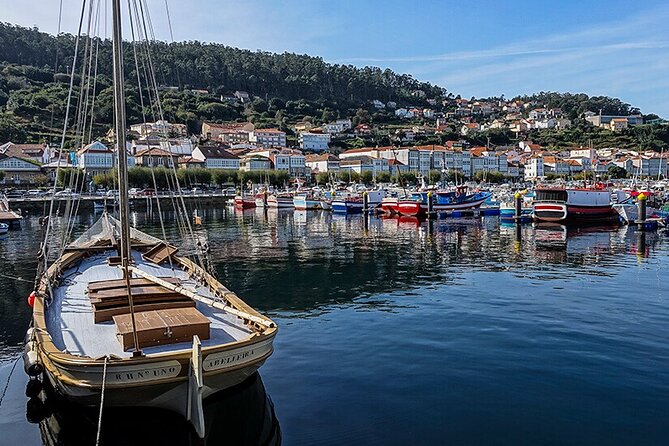
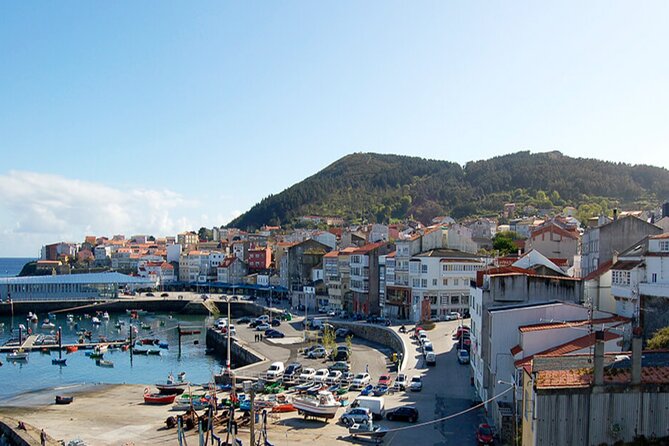
The first stop is Muros, one of Galicia’s attractive fishing villages. You have about 30 minutes to walk its narrow streets or look around the small fish stalls.
This is an orientation stop rather than a full visit. I like it because it introduces the working side of the coast before the day turns toward major viewpoints and pilgrimage sites. The village setting gives you a quick sense of Galicia’s maritime character, with lanes that are better explored on foot than from a coach window.
Thirty minutes is enough for a short walk and a few photographs, but not enough for a detailed visit. If you want to browse every lane or stop for a leisurely coffee, you will need to return another day. Keep an eye on the time, since the bus schedule depends on everyone returning promptly.
Carnota’s enormous granite horreo
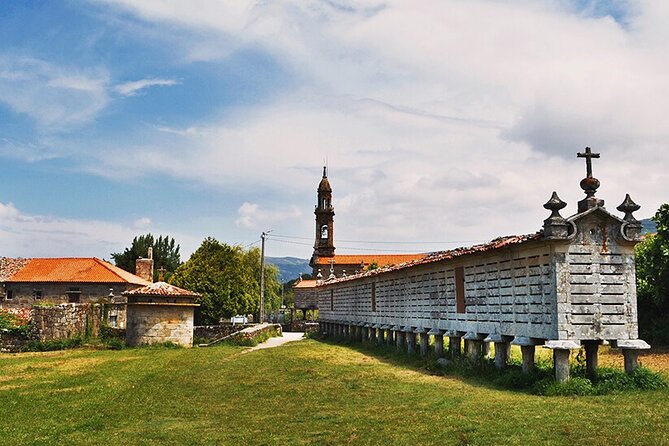
Next comes the Horreo de Carnota, a large 18th-century granite grain store near Carnota’s long beach. An horreo is a raised agricultural storage building, designed to keep grain dry and away from animals. This one is among the longest in Galicia.
The stop lasts about 20 minutes, which is enough to appreciate its size and unusual construction. The setting near the coast adds to the appeal, since the monument makes more sense when you see it as part of rural Galicia rather than as an isolated stone structure.
This is a short photo and context stop. You will not have time for a broad walk along the beach, and the monument itself is the focus. Still, it is one of the day’s useful details because it shows how much of Galicia’s identity comes from granite, farming, and practical local architecture.
Ézaro Waterfall: the day’s most distinctive natural sight
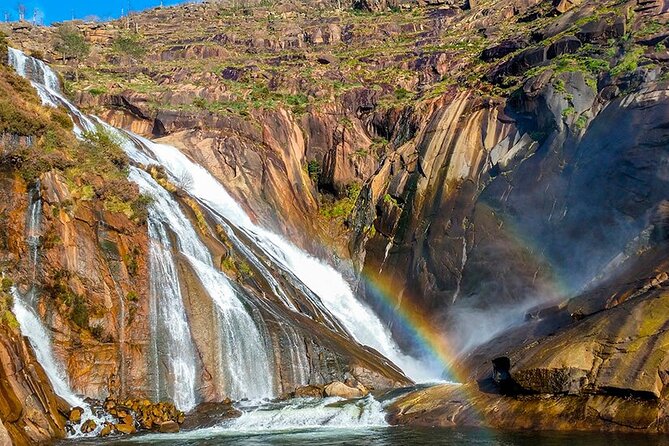
At Fervenza de Ézaro, the Xallas River falls directly into the sea. The tour describes it as the only river in southern Europe with a waterfall flowing into the ocean, and the setting is framed by Mount Pindo, fishing villages, and beaches.
You get around 45 minutes here, making it one of the more generous nature stops. I would rank Ézaro among the strongest parts of the day because it is visually different from the lighthouse and villages. The combination of moving water, granite, and open coast gives you something to look at from several angles.
The word waterfall can create the wrong expectation, since the force of the water may vary. Weather also matters. Rain can make the stop wet and uncomfortable, while cloud and mist may hide some of the surrounding views. Bring a rain layer even if Santiago looks dry when you leave.
Same base, a different kind of afternoon:
- Finisterre and Costa da Morte: The Most Complete Tour of Santiago
★ 5.0 · 733 reviews - From Santiago: Finisterre, Muxia, Ézaro – 7 stops day tour
★ 4.6 · 553 reviews - Santiago de Compostela: Finisterre, Muxia & Costa da Morte
★ 4.7 · 526 reviews - Santiago de Compostela Cathedral and Museum Guided Tour
★ 4.6 · 511 reviews
Fisterra: lunch and a little breathing room
Fisterra, also written as Finisterre, is where you have the longest free period, about an hour and a half. You can eat, walk through the small streets, and see the fishing port.
This is the practical center of the day. After several short stops, you finally have enough time to sit down and enjoy Galicia’s seafood culture. Guides have been praised for recommending restaurants and even suggesting what to order, which can be especially useful when menus are unfamiliar.
Lunch is not included, so plan for that cost separately. The tour does not specify a restaurant or meal price. I would use the guide’s suggestions, then allow a few minutes to walk by the port before meeting the group.
The free time is welcome, but it is not a full afternoon in Fisterra. You are there to eat and get a first feel for the town before heading uphill to the lighthouse. If you want a slow seafood meal, keep track of the clock.
Faro de Fisterra and the end of the Roman world
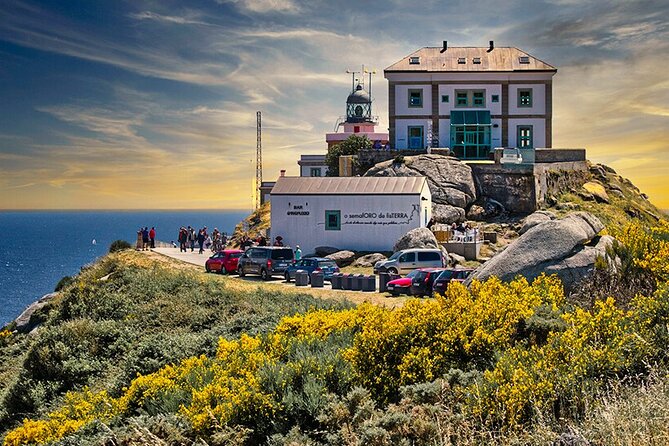
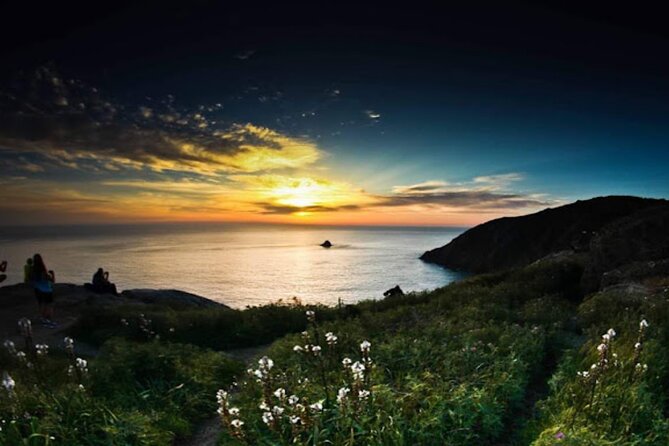
The lighthouse at Faro de Fisterra is the emotional high point for many people, especially if you have walked the Camino de Santiago. The headland was once seen as the end of the known Roman world, and the area also carries older pre-Christian associations with the Ara Solis, or altar of the sun.
The site is also described as kilometer zero of the Camino. For anyone who has finished a Camino route, that marker gives the day a personal edge. You are not simply checking off another viewpoint. You are reaching a place long tied to journeys, endings, and the Atlantic.
You have about 40 minutes at the lighthouse and its viewpoints. That is enough to take in the headland and photograph the coast, but conditions can change the experience. Several comments describe rain or poor visibility limiting the coastal views. On a clear day, this should be one of the most memorable stops. On a wet day, it may be more about the meaning of the place than the panorama.
Wear shoes with a good grip and bring a waterproof layer. The tour does not promise an indoor alternative, and this part of the coast is exposed. If the weather forecast is poor, pay attention to the provider’s cancellation rules, since the experience requires suitable conditions.
Muxía: pilgrimage, stone, and sea
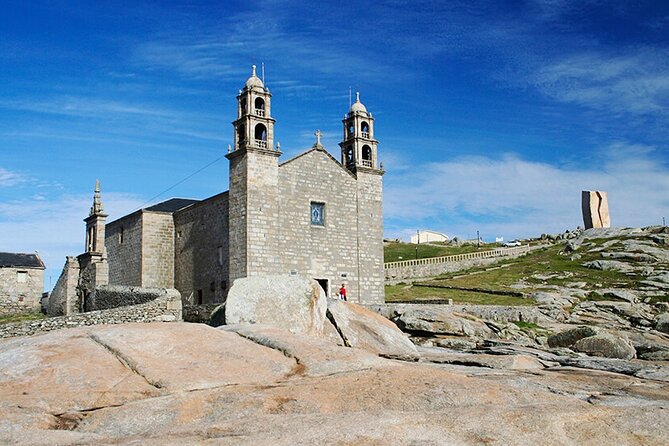
The route then goes to Muxía and the Sanctuary of Nuestra Señora de la Barca. This is a pilgrimage site linked with the Camino, set beside the Atlantic and associated with several holy stones and the Skin Way.
You have about 40 minutes here. The stop is less about shopping or wandering through town and more about the sanctuary, the coastal setting, and the traditions connected to the stones. A guide adds real value because the religious and pre-Christian layers are not always obvious if you arrive without context.
Some people consider this church the most meaningful stop after Finisterre. Others may find 40 minutes enough but not generous. I like the contrast with Fisterra: one is a port and lighthouse destination, while Muxía brings pilgrimage and local belief to the foreground.
Listen carefully to the meeting instructions. At several stops, the walk from the bus to the main sight may take part of your allotted time. A guide who gives clear directions, such as Lucia or Noelle, can make this much easier.
Ponte Maceira and the medieval finish
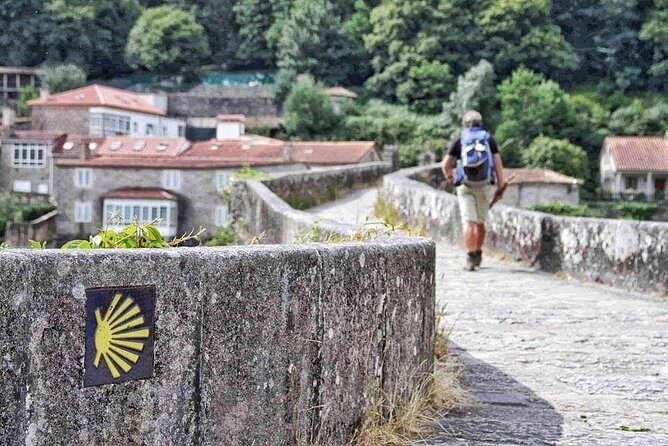
The final stop is Ponte Maceira, a small medieval settlement associated with the Camino de Santiago. You walk beside its Gothic bridge and old mills, with about 30 minutes to see the village.
This is a fine way to finish because the setting is calmer than the exposed capes. The bridge, river, and mills offer a compact view of older Galicia, and the stop gives you a chance to stretch your legs before returning to Santiago.
The time limit is the weak point. One comment noted that half an hour was barely enough to walk from the meeting point into the town and back. Stay close to the guide and do not wander too far down side streets. If you move efficiently, you can see the bridge and mills without rushing badly.
For me, Ponte Maceira is not a filler stop. It has a different mood from the coast and adds a medieval Camino connection. Still, if you are exhausted or mainly want more time at Finisterre, you may wish the return to Santiago began sooner.
The guide, bus, and bilingual format
The coach is repeatedly praised for being comfortable, a useful feature on a day with long stretches between stops. You are not driving unfamiliar coastal roads, searching for parking, or watching the clock at every turn.
The guide speaks Spanish and English. Strong guides have included Lucia, Noelle or Noel, Ana, and Alexis. The best comments describe clear instructions, good local explanations, help with photographs, and practical restaurant advice. One person found the English narration difficult to follow, so the quality of delivery can vary.
The driver matters on this route, too. Antonio and Vicente have been praised for friendly service and skilled driving. That is not a small point when the day involves winding roads and a full coach schedule.
Pickup needs extra attention. The published starting point is Capela do Pilar, Av. de Xoán Carlos I, 6, Santiago de Compostela, with a 9:00 a.m. departure and a return to the same meeting point. A past mix-up involved two addresses, with one hotel roughly six minutes from the stated location. I would check the confirmation carefully and arrive early. If the provider contacts you through WhatsApp, keep an eye on it.
Weather, timing, and the real pace of the day
The route is ambitious for nine hours. You see seven places, but most visits are short. The schedule works best when you treat the day as a sampler, not as seven complete town visits.
The balance is fairly sensible:
- Muros: 30 minutes
- Carnota horreo: 20 minutes
- Ézaro waterfall: 45 minutes
- Fisterra: 90 minutes
- Faro de Fisterra: 40 minutes
- Muxía: 40 minutes
- Ponte Maceira: 30 minutes
Fisterra gets the longest break because it is the lunch stop. Ézaro gets enough time to appreciate the water and setting. The other stops are brief by design.
Rain is the biggest variable. Several experiences were pleasant but limited by heavy rain, with some people staying on the bus. Cloud can also block the views from the lighthouse. If your schedule allows flexibility, a dry day is worth favoring, although the operator may offer another date or a full refund if bad weather forces cancellation.
Who should book this tour?
I think this is best for you if you:
- Have one free day in Santiago
- Want to see Finisterre and Muxía without renting a car
- Have completed the Camino and want to reach the traditional western endpoint
- Enjoy short walks, historic sites, villages, and coastal views
- Prefer a guide to explain local traditions and organize the transport
- Want strong value at a modest per-person price
I would be more cautious if you need long, unhurried visits. Independent travelers with a car could spend far longer at Muros, Carnota, or Ponte Maceira. A person who dislikes coach groups may also find a maximum of 55 people too many, especially at narrow village stops.
Service animals are allowed, the tour is near public transportation, and most people can participate. The exact walking demands are not detailed, so anyone with mobility concerns should ask the provider before booking.
Should you book the Finisterre and Costa da Morte tour?
Book it if your priority is coverage. In one organized day, you reach the end of the Camino world, see Ézaro’s sea-bound waterfall, visit Muxía’s sanctuary, walk through Muros and Ponte Maceira, and view Carnota’s famous granite horreo.
Skip it if your priority is depth. The schedule gives you a useful introduction, not a leisurely coastal retreat. I would also avoid committing to a fixed date if the forecast calls for heavy rain and you have another option.
For most people based in Santiago, the price makes sense. The strongest guides turn the long bus day into a coherent story, and the route has enough variety to keep it moving. Arrive early at Capela do Pilar, confirm the pickup details, carry rain protection, and use your Fisterra hour and a half wisely. With those precautions, this is a practical and rewarding way to see Galicia beyond Santiago’s old town.
FAQ
How long does the tour last?
The experience lasts approximately nine hours.
Where does the tour start?
It starts at Capela do Pilar, Av. de Xoán Carlos I, 6, 15701 Santiago de Compostela, A Coruña, Spain.
What time does the tour begin?
The scheduled start time is 9:00 a.m.
Where does the tour end?
The activity ends back at the meeting point in Santiago de Compostela.
Is lunch included?
No. Lunch is not included, but you have about one hour and 30 minutes of free time in Fisterra to eat.
Which places does the tour visit?
The route includes Muros, the Horreo de Carnota, Fervenza de Ézaro, Fisterra, Faro de Fisterra, Muxía, and Ponte Maceira.
Is the tour offered in English?
Yes. The guided tour is offered in Spanish and English.
What happens if the weather is poor or the tour is canceled?
The experience requires good weather. If it is canceled because of poor weather or because the minimum number of participants is not reached, you can receive a different date or experience, or a full refund. You can also cancel for a full refund up to 24 hours before the start time.
Recently listed in Santiago de Compostela
- Tapas Tour of Santiago de Compostela★ 4.5 · 191 reviews
- Guided tour of Bodegas Granbazán★ 5.0 · 101 reviews
- From Santiago: Lugo & Cathedrals Beach Guided Excursion★ 4.5 · 174 reviews
- Masaje del Peregrino★ 5.0 · 243 reviews
- Private tours Santiago de Compostela : choose your option★ 5.0 · 120 reviews
- Visit to the Cathedral of Santiago + Portico de la Gloria Option★ 4.5 · 503 reviews
- Guided Tour Historic Town in small group★ 5.0 · 113 reviews
- Excursion From Santiago to: Lugo, Catedrais Beach and Asturias★ 5.0 · 158 reviews
Santiago de Compostela Tours, compared.
Santiago: Cathedral & Museum Tour + Pórtico of Glory Option
Read our review →
From Santiago: Finisterre, Muxia & Costa da Morte Excursion
Read our review →
Excursion to Finisterre + Muxia + Costa da Morte (7 stops)
Read our review →
Finisterre and Costa da Morte: The Most Complete Tour of Santiago
Read our review →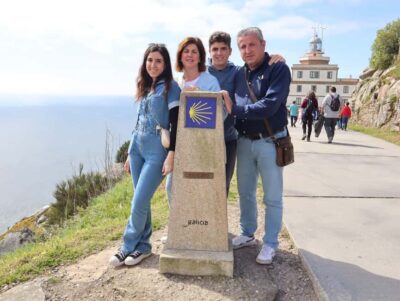
From Santiago: Finisterre, Muxia, Ézaro – 7 stops day tour
Read our review →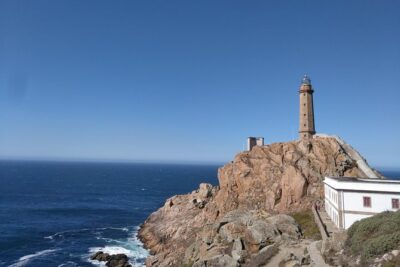
Santiago de Compostela: Finisterre, Muxia & Costa da Morte
Read our review →
Santiago de Compostela Cathedral and Museum Guided Tour
Read our review →
Visit to the Cathedral of Santiago + Portico de la Gloria Option
Read our review →Browse the lists this tour appears in